Shadow economy of billions: how self-service payment terminals found themselves at the center of a financial scandal

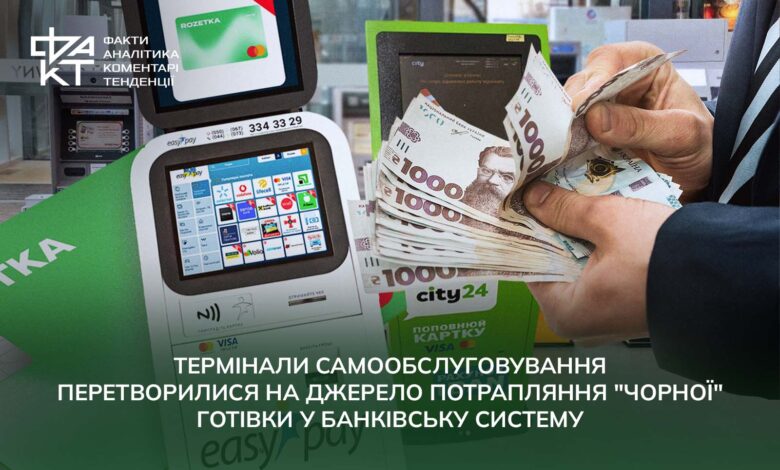
Every time they drop bills into a payment terminal at a supermarket or bus stop, Ukrainians hardly think that they are using one of the largest and least transparent financial systems in the country. While the state reports on the digitalization of payments, billions of hryvnias of “black” cash pass through terminal networks every month, the origin of some of which raises more and more questions from the regulator. This is where two worlds collide: the familiar comfort of quick payments without unnecessary checks and the state’s desire to block channels for shadow money. The consequences of this conflict may be much more extensive than just new fines for terminal operators – the right of Ukrainians to use cash without total control is under threat.
PTKS in Ukraine: why self-service terminals have not disappeared in the era of digital payments
When in the summer of 2024 the National Bank forced terminal networks to introduce mandatory verification of customers by phone number, it seemed that the era of anonymous cash in self-service terminals was over. However, despite total digitalization and the development of mobile banking applications, street payment boxes have not just survived, but have turned into a giant parallel financial infrastructure. Today, the two largest private networks — EasyPay and City24 — together control over 45 thousand terminals, through which tens of millions of transactions are processed every month.
For most Ukrainians, this is a familiar tool for paying for utilities or the Internet, but for the regulator this sector has become a headache in the field of combating money laundering. This refers to unregistered cash funds hidden from tax authorities that arise during shadow financial transactions to evade taxes.
At the end of 2025, EasyPay reported 171 million payments, 10.6 million users, and a network of over 25,000 terminals. The company also announced over 12,000 available services and 19 partner cities in the field of digital municipal services. On average, about 10 million transactions per month pass through the system.
At the same time, City24 reported during the same period that it has a network of over 20,000 terminals in over 2,000 settlements in Ukraine. In 2025 alone, the company signed over 665 new partnership agreements and added over 1,500 new services for payment through its terminals.
Together, the two networks have over 45,000 payment terminals and are one of the largest offline payment infrastructures in the country. For comparison, this number of payment acceptance points exceeds the number of branches of all Ukrainian banks by dozens of times. The scale of EasyPay operations is particularly significant. If we divide 171 million payments by 25,000 terminals, then on average each device served about 6.8 thousand transactions per year or almost 19 payments daily. With such volumes, even a small proportion of questionable transactions can potentially generate significant cash flows.
Despite the digitalization of financial services, statistics show that the demand for cash transactions remains high. At the same time, the scale of the EasyPay and City24 networks shows that self-service terminals still remain one of the key channels for the movement of funds between the cash and banking segments of the Ukrainian financial system.
At first glance, it may seem that the development of mobile banking and contactless payments should gradually replace self-service payment terminals (SPTs). Ukrainians are increasingly paying for purchases with smartphones, transferring funds through banking applications and using digital wallets. However, the Ukrainian market demonstrates a different trend, where SPT networks continue to expand, and their role in the financial infrastructure remains important.
The phenomenon of Ukrainian terminals is that they have become a kind of bridge between the cash and digital economy. For millions of citizens, it is through POS terminals that cash is being converted into a non-cash format. Replenishment of bank cards, payment of utilities, mobile communications, the Internet or making transfers remain everyday practice for a significant part of the population.
Of particular note is the fact that even digital banks have begun to invest in the physical infrastructure of terminals. This indicates that the need for cash deposits and quick access to financial services remains relevant. Thus, POS terminals today perform both a payment function and ensure financial accessibility for the population, especially in small towns and rural areas.
A modern self-service terminal has long ceased to be a simple device for accepting banknotes. In fact, it is a high-tech software and hardware complex equipped with bill acceptors, QR code scanners, remote monitoring systems, cyber protection tools and integration with financial services in real time. In terms of technological sophistication, many modern POS terminals are approaching new-generation ATMs.
At the same time, the POS terminal market demonstrates high adaptability to external challenges. After the cessation of one of the largest market participants — the iBox network — other operators quickly integrated part of the infrastructure and ensured the continuity of service provision. This confirmed the maturity of the market and its ability to maintain stable operation even under conditions of significant structural changes.
Today, POS terminals remain an important element of Ukraine’s financial ecosystem. They combine digital technologies with the needs of users who continue to work with cash, provide access to financial services in the regions, and support the continuity of the country’s payment infrastructure. That is why self-service terminals should be considered not as an outdated tool of the past, but as one of the key components of modern Ukrainian fintech.
Shadow economy through terminals: what the NBU inspections revealed
However, despite its popularity, the POS terminal market is increasingly becoming the focus of the regulator. The May sanctions of the National Bank of Ukraine, which resulted in unprecedented fines of 135 million hryvnias each for the EasyPay and City24 networks, became the logical finale of the state’s large-scale confrontation with the shadow circulation of capital. The tough measures were the result of deep audits, which in their form and involvement of law enforcement agencies resembled full-fledged special operations, accompanied by the seizure of closed-circuit video surveillance materials and a thorough audit of information systems. Representatives of the National Bank state that during these inspections, suspicions were fully confirmed regarding the transformation of PTKS into key tools for the generation and legalization of uncontrolled financial flows in the state.
The root of the problem lies in the conscious or systematic ignoring of basic standards of financial monitoring, in particular in the context of proper verification of persons carrying out transactions. Current legislation allows for small transactions of up to 5 thousand hryvnias under a simplified procedure without providing documents, and the NBU’s requirement to confirm identity at least by mobile phone number, introduced in August 2023, was, as it turned out, widely circumvented.
However, the management of terminal networks regularly justified the lack of telephone authorization by force majeure – power outages or communication failures, which made it possible to pass through colossal amounts of unidentified cash. Analyzing the data set for limited periods of time, the central bank’s specialists uncovered a number of anomalous schemes that clearly indicate the fictitious nature of the processes. The regulator’s analysts recorded several phenomena striking in their unreality, the first of which was the abnormally high rate of settlements. The speed of recording some transactions in the system was so high that a person would not have had time to physically insert paper bills into the terminal receiver, which directly indicates the software injection of numbers instead of real money deposit.
No less absurd was the effect of the so-called “split personality”, when the same mobile number was used for authorization and depositing funds in one city, and within a few hours the same person allegedly carried out a transaction in a completely different part of Ukraine, which contradicts any laws of physical movement in space. In addition, the surveillance camera recordings seized by law enforcement officers completely refuted the reports of the payment transaction registrars (PRO). Where hundreds of transactions were continuously carried out for documents and there should have been a dense human queue, the video camera lenses recorded absolute emptiness near the terminals, which directly proves the virtual and fictitious nature of these transactions.
The situation is further complicated by the fact that the companies to whose accounts these gigantic flows were directed through PTKS, completely “forgot” to reflect the funds received in financial, tax or statistical reporting. Despite the fact that the functionality of the terminals allows you to pay for a wide range of services, about 95% of all transactions were for banal replenishment of bank cards, where monobank was the absolute leader. At this stage, a paradox of mutual transfer of responsibility arose, because the terminal companies believed that the bank accepting the money should be engaged in checking the client, while banking institutions relied on primary control from the PTKS owners, which is why real financial monitoring was not carried out at all.
The National Bank is confident that large-scale laundering of “shadow” money is taking place through these platforms, and in some episodes, auditors found signs of illegal self-collection by representatives of EasyPay and City24. The latter transported cash to banking institutions without appropriate licenses and permits, legalizing its origin exclusively with paper statements from their own PROs.
The financial scope of these networks is impressive, as the monthly volume of hryvnia funds in their circulation reaches the equivalent of 1 billion US dollars, although the regulator does not officially declare the exact share of criminal or disguised capital in this mass. Interestingly, with a minimum commission of 1% of the transfer amount, the companies demonstrate very modest official profits, artificially underestimating the tax base through long-term equipment rental schemes instead of its ownership.
The NBU has already transferred all collected materials and evidence of shadow operations to law enforcement agencies to open criminal proceedings for money laundering, but the payment networks themselves continue to operate as usual after paying the charges. To finally revoke the licenses of these market leaders, the regulator must legally prove beyond a shadow of a doubt that such violations were systematic and long-term, so the companies will provide services to the population at least until the next scheduled or unscheduled inspection.
However, this precedent is guaranteed to change the landscape of the entire market, since the National Bank is already developing a profile resolution that will radically tighten the rules for functioning in the market. New regulatory norms may provide not only for strict limits on the number and amounts of transactions through terminals, but also for the introduction of mandatory biometric identification of users using photo and video capture at the time of payment.
The end of anonymous cash: how the world forces terminals to recognize each client
Meanwhile, the processes unfolding on the streets of Ukrainian cities are only a local echo of the global financial war that world regulators are waging against “anonymous cash.” The experience of EasyPay and City24 is not unique, as it is a classic manifestation of the systemic confrontation between the state and shadow capital, which in search of loopholes always migrates to where digital technologies intersect with paper money. However, in the countries of the European Union, the USA and Asia, the era of naive trust in SMS verifications has long passed, and control over similar networks of payment boxes and semi-technological intermediaries has reached the level of uncompromising digital tightening of the screws.
The main legislative catalyst in Europe was the final transition to the strict standards of the Sixth Anti-Money Laundering Directive (AMLD6). If the Ukrainian regulator keeps the threshold for simplified operations at 5 thousand hryvnias, then in European countries ruthless “micro-limits” are in effect for any street boxes or prepaid cards. Anonymous deposits into the system are limited to 150 euros, and any attempt to exceed this limit is met with a requirement to scan an electronic ID. Even conservative Germany, which has historically demonstrated a deep commitment to cash payments, has forced its payment machine operators to comply with the requirements of the Federal Financial Supervisory Authority (BaFin). Local boxes are now required to carry out real-time video verification of the client, when the terminal’s artificial intelligence does not just take a picture, but scans the biometrics of the face and instantly compares it with the chip in the passport directly during the financial session. Any machine without such a system automatically finds itself outlawed, especially after Europol dismantled a large-scale network of boxes where criminal structures laundered millions with the help of so-called “money mules”, breaking the amounts into hundreds of small transactions.
In the US, the market evolution went even further, and there the classic boxes for paying for services were transformed into multifunctional kiosks and cryptocurrency vending machines, known as BTMs. The American financial intelligence FinCEN, without further ado, equated the operators of these networks with commercial banks, obliging them to implement intelligent behavior monitoring systems. Local software based on neural networks instantly calculates the anomalies that so surprised the Ukrainian National Bank.
If the system records that in different parts of the same state, with an interval of several minutes, amounts are deposited into the same account that almost reach the identification limit, the financial gateways are automatically blocked. Liveness Detection technology on American terminals makes it impossible to use masks or photos in front of the camera, turning the biometric barrier into an insurmountable obstacle for fraudsters.
The most radical solution to the problem of shadow circulation through payment boxes was found in the countries of East Asia, where street self-service terminals have practically ceased to exist as a species. In China, total digitalization through the WeChat Pay and Alipay ecosystems, tightly integrated with the state system of social credit and facial recognition, has simply displaced paper money from everyday use, reducing financial anonymity to absolute zero. South Korea has taken the path of building a “coinless society”, where the Financial Services Commission allows interaction with non-bank ATMs only upon authorization through the citizen’s state digital passport, which has completely eliminated the institution of uncontrolled intermediaries.
This global context becomes a clear mirror for the future of the Ukrainian market. World practice proves that the paradox of mutual shifting of responsibility between terminal networks and banks is always resolved in favor of the uncompromising rule, when the one who first touches the paper bill is responsible for the purity of money. That is why the upcoming reform of the National Bank of Ukraine will most likely be based on strict German and American patterns. Street boxes EasyPay and City24 will either have to finally transform into high-tech platforms of state control with mandatory FaceID verification through “Diya” and hardware protection against virtual injection of numbers, or disappear from the country’s financial landscape, giving way to an era of absolute transparency.
Thus, the introduction of unprecedented fines and the preparation of new strict rules of conduct in the market indicate the inevitable transition of Ukraine to global standards of control, where the primary operator of accepting funds bears joint and several responsibility for the origin of capital. The further functioning of the non-bank payment sector will depend on the ability of companies to integrate uncompromising identification tools, including biometrics and direct synchronization with state digital registers. For businesses, this means a significant increase in capital expenditures for equipment and software upgrades, which will inevitably reduce the margin of cash transactions and force them to reconsider the economic feasibility of maintaining extensive physical networks.
From now on, the PTKS market must decide whether to become a full-fledged technical outpost of state supervision or completely lose its role in the financial system, giving way to cashless payments. The result of this restructuring will determine not only the future of specific brands, but also the real level of transparency of national capital, forcing market participants to reassess the boundaries of the compromise between individual financial freedom and the fiscal interests of the state.