
War does not ask if you are ready for it. It just comes and takes everything away: sleep, peace, a sense of control over life. Every day brings new stress, every battle deals a devastating blow to the psyche, every loss becomes a hole in reality that cannot be patched. Sooner or later, the mind is looking for a way out, at least for a moment to escape from this endless meat grinder.
This is where the doping war comes in. Not for fun, not for pleasure, but for survival. Adrenaline itself has long since stopped working, because the body is tired, the heart is worn out, the brain wants to sleep when it needs to run, and screams when there is finally a moment of silence. Exhaustion overcomes the will, and then pharmacology enters the scene. Stimulants keep soldiers on their feet longer than their bodies can handle. Analgesics block pain, and a person does not even notice that he was injured. Tranquilizers help you fall asleep when nightmares keep you from closing your eyes, and sedatives dull the chest-wrenching panic after a fight. Drugs in war become a way of survival in a reality that leaves no room for weakness. But what to do when the war is over and the addiction remains?
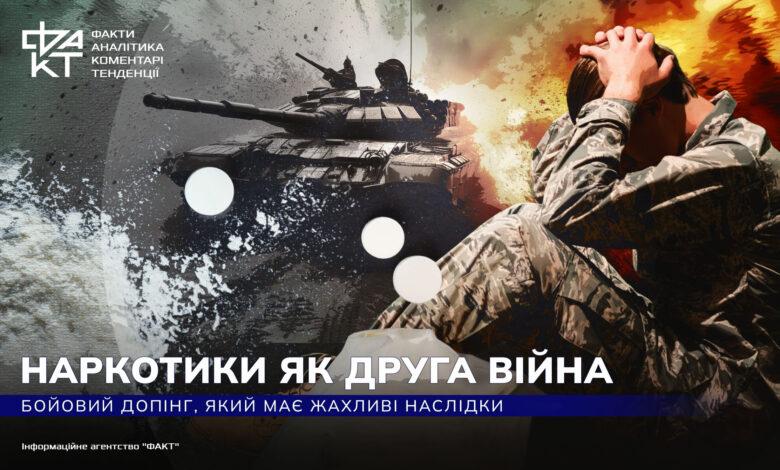
Combat doping, which has terrible consequences
This is not a unique situation. In the history of every war, there is a «combat doping» that helped to survive. But this war is special, because it is not taking place somewhere far away, but here, in our home, among our people. And it leaves deep wounds not only on the body, but also on the psyche. Addiction comes imperceptibly. At first it’s a pill to get through another day. Then one more, because there is no way without it. And when the war ends, those who survived will return to a world where no one shoots, but heads are still torn by pain, fear and memories. And what then? Treatment, rehabilitation, struggle with oneself, or an endless descent into chemistry that promises peace, but takes everything away?
According to the research carried out by the research bureau «Sociologist» on the order of the charitable organization «Kharkiv with you» as part of the project «Drug addiction in the defense forces of Ukraine», the problem of the use of psychoactive substances (SPAs) among the mobilized military was identified. Specialists indicate the main factors that caused such addiction:
- excessive stress caused by direct participation in the war, for which the mobilized were not prepared;
- difficult conditions of stay at the front;
- lack of proper screening for pre-existing addiction among those mobilized.
The most common psychoactive substances are alcohol, as well as drugs, which are often used in combination. Military and veterans use a variety of drugs, including opioids, stimulants, hallucinogens, cannabinoids, and sleeping pills. The biggest danger is psychostimulants, in particular the so-called «salts», which can cause serious brain damage and quickly become addictive.
Experts distinguish several groups of factors that contribute to the development of addiction. They classified the following as the most vulnerable groups:
- men aged 25 to 45;
- servicemen with brain injuries, mental injuries, physical and emotional exhaustion;
- people with experience of using surfactants.
The researchers draw special attention to the fact that in units formed from convicts, the consumption of surfactant is more common. Veterans over 45 are more likely to become dependent on alcohol. Among veterans, the main causes of addiction are severe psychological and physiological injuries, in particular the loss of limbs, which can lead to the loss of life orientations, professional skills, social ties and family. A long period of postoperative recovery and uncontrolled use of painkillers are also significant factors in the formation of drug addiction.
According to experts, the main reasons for the use of SAW among the military are physical and psychological overload, previous experience of drug use, the desire to relieve feelings of fear (fear of being captured, disability, death, loss of family) and the social environment that encourages use. Also important factors are the desire to suppress physical and mental pain, in particular due to the loss of loved ones and siblings, as well as escape from uncertainty. The cause of addiction can also be socio-cultural factors, such as a low level of moral-psychological and combat training or lack of support from the family.
Military and veterans with substance dependence often avoid seeking help because of shame about their problem, fear of exposure, loss of comfort under the influence of SAW, and low awareness of available services. But the most significant reason for refusing treatment is the physical unavailability of help, as well as the reluctance of commanders to release soldiers for therapy or rehabilitation due to a lack of personnel. It should be understood that the problem of drug addiction and alcoholism among the military, together with PTSD and depression, can turn into a problem of a national scale. Therefore, the state is trying to cope with this situation by creating mental health centers in the regions. In addition, it is planned to open about two hundred such centers, where it will be possible to apply without a referral from a family doctor.
The Black Market of War: How Drugs Get to the Frontline
It goes without saying that war brings with it chaos, which is the perfect breeding ground for all things illegal. Where people are balancing between life and death, and constant stress eats away at the psyche, drugs appear almost automatically. They do not need to be brought in wagons or dropped from planes, because they find their way by themselves. The Prosecutor General’s Office recognizes the existence of channels for the supply of narcotics to the front. Currently, this direction is a priority for law enforcement officers in order to stop such activities at the state level. But it is also obvious that combating drug trafficking among the military is quite difficult. All partners help Ukraine at the level of European institutions, the US Department of Justice and the FBI. At the same time, the use of drugs among personnel is recognized as absolutely unacceptable. Therefore, those who use have to look for like-minded people and hide their addiction.
One of the simplest disguises is humanitarian cargo. Packs of pills or ampoules, which are allegedly needed for medical needs, can go along with thermal imagers, berserks and energy workers. Some of them are indeed intended for front-line first-aid kits, but in the conditions of hostilities, control over their use is minimal. Frontline hospitals have access to everything that helps treat pain, fatigue and traumatic shock. Morphine, ketamine, tramadol, diazepam are all necessary, but not always used only as prescribed. In the conditions of war, it is not so difficult to write off a few ampoules.
We should not forget about drug trafficking, which does not disappear anywhere, even during the war. Smugglers quickly adapt and find delivery routes through the war zone. Where there is demand, there is bound to be supply. If in peacetime drug dealers were afraid of the military, now some of them work directly with those at the front.
When there is no access to classic drugs, home-made options appear. Some soldiers mix energy drinks with medical drugs, some find other ways to get at least some effect to drown out fatigue and stress. Sometimes it works, and sometimes it turns into a chemical cocktail that destroys the body faster than war. Obviously, the front has become the place where the laws work differently and survival becomes the main rule. In conditions of constant stress, drugs do not look like something extraordinary, but become just another way to «function». And as long as there are those who need them, there will always be those who will deliver them.
A story of battle-to-battle addiction
War and drugs have been going hand in hand for many years, and history is a witness to this. Soldiers always needed more strength, less fear and at least some possibility to forget about the hell around them. Dozens of countries, hundreds of wars, different ideologies, but everywhere there was «magical» doping that promised to make a fighter more durable, braver, fearless.
Berserkers became one of the earliest examples of how a person can change his psyche and physiology for war. They were the most feared warriors of the Viking Age, whose battle frenzy probably had no natural origin at all. Icelandic sagas describe berserkers as warriors who, before a battle, fell into a «berserker shawl» — a state of uncontrolled aggression, when they became invulnerable to pain, received superhuman strength and literally tore enemies apart with their bare hands. It was believed that this state was given to them by the gods themselves, especially Odin — the patron of warriors, shamans and wolves. But modern research suggests that it was not the gods, but psychoactive substances.
Most likely, berserkers used Amanita muscaria or Hyoscyamus niger — strong natural hallucinogens that could cause aggression, pain-relieving effects, and altered states of consciousness — before the battle. Red amanita contains muscarine and muscimol — substances that cause excitement, distortion of perception of reality, a sense of omnipotence and even insensitivity to pain. Black cohosh contains atropine and scopolamine, powerful neurotoxins that can cause both hallucinations and aggressive psychoses. It is believed that the Vikings used these substances in special rituals before the battle, bringing themselves to a state where their brain no longer responded to fear and pain, and the body worked at the limit of possibilities.
Berserkers were so unruly that after a battle they sometimes had to be killed by their own. In the saga of the Ynglings, it is described that after a battle they could attack friends and allies because they could not quickly come out of their battle trance. Some kings even banned their service because of the danger they posed not only to enemies but also to their own troops. In 1015, King Olaf the Holy of Norway outlawed berserker rituals. Since then, the phenomenon of berserkers began to disappear, and already in the 12th century they remained only in legends.
Although berserkers themselves have disappeared, their methods have been studied and even used in various periods of history. For example, the Nazis experimented with methamphetamine to create «war machines,» and today, stimulants that suppress fatigue, fear, and pain are actively used in military operations.
During the First World War, the trenches became a laboratory for drug experiments. Soldiers of the British Empire actively used cocaine. It was even sold in the form of pills called «Forced March» (from the English «Forced March» — ed.), which were supposed to relieve fatigue and increase endurance. Morphine was also widely used, especially to anesthetize the wounded. But he numbed not only physical wounds, but also removed fear, forced soldiers to accept death calmly.
If in the First World War soldiers still found drugs in pharmacies, then in the Second World War they were already actively issued by the states themselves. Nazi Germany made methamphetamine its official war drug called Pervitin. The German troops literally lived on this substance, because it allowed them not to sleep, not to feel fear and cover hundreds of kilometers without rest. It was thanks to this «doping» that the Wehrmacht so quickly took over Europe at the beginning of the war. But the effect was not only useful. Soldiers became aggressive, mentally unstable, and after stopping the drug, fell into apathy.
For its part, the US also had its own drug for the military — amphetamine. American pilots used it to stay alert during long sorties. In 1943, amphetamine was even officially recommended for aircraft crews. Also, the Vietnam War was one of the most significant in the drug issue. American soldiers massively used heroin and marijuana to disconnect from the horror of constant ambushes, swamps, heat and deaths around. By the end of the war, up to 20% of the US military were heroin addicts.
In addition, the CIA conducted experiments with LSD, a psychedelic drug that they believed could change the course of hostilities. It was tested on soldiers, trying to find a way to make enemies either docile or mentally unstable. The effect was unpredictable, and most of the experiments were classified.
In modern conflicts, drugs have not disappeared anywhere — in the 2010s in the Middle East, ISIS fighters massively used captagon (a strong stimulant that gave a feeling of invulnerability and allowed to fight without rest — ed.). It was called «drug of terrorists». During the war in Afghanistan, American soldiers used opiates en masse. In a country where poppy fields filled the entire territory, drugs were available everywhere. And in Mexico’s drug wars, cartel fighters use crack to numb fear and become more brutal in their killings.
As you can see, wars are changing, but the need for doping remains. In some countries it is official pharmacology, in others it is the black market of drugs, but the essence is the same: to survive the war, many are ready to accept anything. But it is worth remembering that the war will be replaced by a battle for a normal life. And this struggle is sometimes even more difficult than the battles on the front lines.
War ends, addiction remains
Different countries have gone through the problem of drug addiction in the military, and some have found effective solutions. For example, American soldiers returned from Vietnam addicted to heroin, from Iraq and Afghanistan — on painkillers and amphetamines. The US health care system relies on rehabilitation centers at military hospitals. Methadone therapy is used there for those addicted to opiates. Psychotherapy (including cognitive-behavioral therapy) is involved to get a person out of a psychological impasse. But even so, about 20 military veterans commit suicide every day due to depression and addiction.
The British tried to approach the problem tougher. Soldiers undergoing rehabilitation fall under the mandatory control program. If a member of the military is caught using drugs, they risk losing all benefits. But the main emphasis in Britain is on the mental health of veterans. There are reintegration centers in the country, where soldiers are helped to adapt to peaceful life. Bets are being made on sports therapy to help veterans learn to regain control of their bodies. Social programs are launched so that they are not left without work and support.
In Israel, they understand that it is necessary to fight addiction comprehensively. One of the unique solutions is rehabilitation through living in kibbutzim (collective communities — ed.). There, ex-servicemen get a new meaning of life, work, engage in creativity and leave the war. In addition, Israeli scientists are actively investigating the use of MDMA (ecstasy) in PTSD therapy. Experiments have shown that, under the supervision of doctors, this drug helps the brain «rewrite» traumatic memories and reduces cravings for drugs.
In Canada, military personnel suffering from PTSD are officially allowed to be treated with medical cannabis. The state even partially covers its costs. Studies have shown that it helps reduce the need for harder drugs and antidepressants. Canada also has a national veterans hotline where anyone can get help if they have started abusing drugs or alcohol.
After returning, Australian military personnel can take special courses to help them adapt to civilian life. The main emphasis is on employment. The state encourages businesses to hire veterans so that they do not remain alone with their problems. There are also free state rehabilitation centers that accept veterans without bureaucratic obstacles.
However, no country has found a perfect solution. But those who are not afraid to invest money in psychological help, rehabilitation and social support have better results. Drug addiction among veterans remains a huge problem, but history shows that if society does not ignore the topic, the chance of a normal life after war increases significantly.
Doping war has nothing to do with either strength or fearlessness. It’s a way to survive in a reality that destroys the psyche faster than bullets. War forces people to take chemicals in order not to sleep, not to be afraid, not to feel pain. But she does not give instructions on how to return to life without it. Drug addicts will have to learn to live without pills, without stimulants, without painkillers for the soul. And it can be more difficult than surviving under fire. Because if at the front, drugs helped to fight, then in peaceful life they can destroy everything that remains. Therefore, it is worth understanding that the main question is not why the soldiers accept them, but whether society will help them when they return. Otherwise, they will remain forever on the battlefield, which already exists only in their heads.


