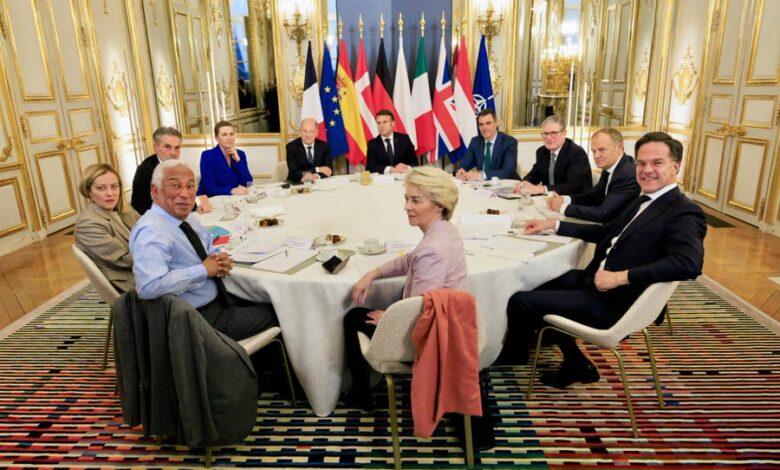
The war in Ukraine remains one of the main geopolitical crises of our time, and the European Union faces a difficult choice: to strengthen support for Kyiv or to seek diplomatic solutions that could lead to an end to hostilities. These questions became key at the crisis summit of EU leaders, which took place on the evening of February 17 in Paris.
The meeting of seven leading European states with the participation of NATO representatives aimed to develop a joint strategy before the planned negotiations between Russia and the USA in Riyadh. However, as noted by the international media, the results of the summit left more questions than answers. In particular, discussions regarding the possible dispatch of a European contingent to ensure peace guarantees in Ukraine did not lead to concrete agreements. An overview of the world mass media allows us to understand what mood prevails among European politicians and how ready the West is for real steps.
Público – Portugal. Lisbon’s Público does not hide its disappointment:
«From the meeting in Paris, it was expected, at a minimum, that the heads of European states and governments present there would express their commitment to two or three measures that are of an urgent nature. Among them: an immediate increase in defense spending, the allocation of funds to strengthen support for Ukraine — so that it could have a more favorable position in the future negotiations. In addition, an obligation to provide a military contingent that, in the event of peace agreements, will provide Ukraine with security guarantees.
… Europe struggles with the lack of time and the illusions of the past. Is it enough to be the only one? Not at all. And the summit in Paris did not bring anything new in this regard.»
La Stampa — Italy. Why hold this summit and flaunt your differences? — asks Turin’s La Stampa:
«The answer to the statements of the US Vice President JD Vance about the alleged tactical and value catastrophe in Europe was given by the French president, whose approval rating in his own country is in free fall.
…Representatives of only a few and at the same time very different countries came to this meeting (one of them is not even part of the EU anymore!), among the participants was a «downed pilot» in the person of the Chancellor of Germany, all of whose statements will have at least some weight within a week at most.
… It is good that there is pluralism, it is good that there are formulas of different speeds in the dispute, but nothing seems more inappropriate now than this summit that has just taken place in Paris.»
El Mundo – Spain. Madrid’s El Mundo would also like to see more unity and strength in Europe:
«This summit showed us a picture of only half-hearted unity, which weakens Europe before Trump, who prefers to act according to the logic of the right of the strong. The question of sending peacekeepers to Ukraine showed this with all the obviousness: British Prime Minister Keir Starmer showed readiness to join a coalition of those who are ready for such a step, but Germany, Poland and Spain are delaying. The summit in Paris made it clear to Europe that it is time take your security under your own control.
… The European Union is obliged to urgently increase defense spending and strengthen political unity weakened by the crises in France and Germany. And the key to the formation of such leadership should be the emergence of a strong government in Berlin.»
The Independent — Great Britain. By agreeing to send a contingent to Ukraine, the British Prime Minister risks overestimating his country’s capabilities, London’s The Independent believes:
«Starmer hopes that this move will put the UK at the center of the Allied peacekeeping mission. … The most important question is whether our armed forces are sufficiently manned and equipped to act as a serious contingent in a peacekeeping mission along the demarcation line. …
Loud talk of Britain’s leading role could turn into a disaster if our involvement in this mission is limited to a small contingent with no back-up in case something goes wrong. Peacekeeping should be a continuation of effective policy, but not a substitute.»
15min – Lithuania. On the 15min portal, political scientist Ramunas Vilpišauskas calls for active actions:
«There is no point in constantly asserting that we should have started acting yesterday. For now, it would be enough to take coordinated measures. If it turns out to be impossible to reach a consensus among all EU countries, then the initiative can be taken by a group of active countries — Germany, France, Poland, as well as the Nordic and Baltic states. The current geopolitical crisis can become an incentive for the EU that will push the community to reform its economic policy, remove barriers to internal market and the allocation of more funds for defense needs.
… This year can be decisive.»
Helsingin Sanomat – Finland. Helsingin Sanomat considers it logical that some European countries have taken a wait-and-see position regarding sending a European contingent to Ukraine:
«Finland will soon start a discussion about sending a contingent. Thinking about it has already begun, but it is still difficult to make appropriate decisions now.
… If the U.S. leaves European armed forces entirely to themselves, they may become a training target or a political bargaining chip for the Russians. Finland is not the only country that has to answer the following question: is it possible to sacrifice its own defense capabilities for the sake of protecting Ukraine?».
Liberation — France. Europe can still influence, — believes the Parisian Libération:
«Even if it is quite late, there is still some time for Europeans to react, rally — and strengthen their defenses. Britain’s Keir Starmer seems quite ready to return to the bosom of Europe, Emmanuel Macron has made a lot of mistakes but is still a staunch European, and the next German chancellor will certainly not be as sluggish as Olaf Scholz (hopefully, of course, that the far-right in the elections on Sunday, both militarily and economically. In addition, China, which is skeptical about the rapprochement between the United States and Russia, will not sit idly by. All this means that Europe still has a couple of trump cards, but it cannot be delayed in playing them.»
At the same time, NATO Secretary General Mark Rutte said at the end of the summit that Europe is ready to take the leading role in providing security guarantees to Ukraine. That’s what he’s about wrote u X:
«Readiness and desire. This is my opinion about today’s meeting in Paris. Europe is ready and wants to take a step forward. Take the lead in providing security guarantees for Ukraine.
Europe is ready to invest more in its security. The details have yet to be decided, but the commitment is clear.»