
Resonant events in the CCC in the Odessa region and hostility in society: social degradation as a natural companion of a long war

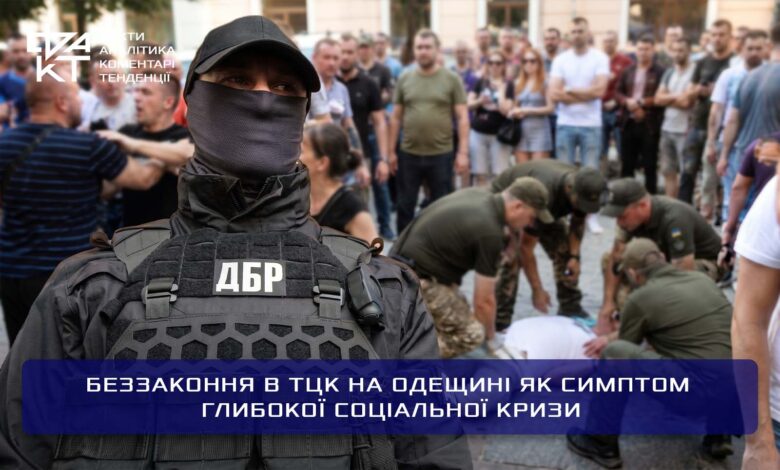
The exposure of a large-scale criminal scheme in one of the district recruitment centers of the Odessa region, where law enforcement officers recorded not only beatings, illegal detention and psychological pressure on men, but also facts of sexual violence, exposed the critical line beyond which state coercion turned into torture. This shocking and systemic practice has become an indicator of a much deeper social disease, because the arbitrariness of officials is developing simultaneously with an alarming increase in aggression within society. Daily fights and quarrels on the streets for petty reasons, total harassment on social networks and abuse of power in office offices demonstrate a dangerous trend. While some selflessly hold the front and save people, others direct their accumulated aggression not at an external enemy, but at their compatriots. When the authorities’ assurances about restoring order remain unfulfilled, and the level of interpersonal hatred continues to boil in public places, the country faces the threat of an internal breakdown, where each side begins to see a threat in its neighbor.
Aggression and arbitrariness in the TCC in the Odessa region: criminal transformation of the mobilization process
Reports of the State Bureau of Investigation on the events in the Odessa region have exposed a systemic problem that has long gone beyond isolated excesses in the regions. The investigation documented the functioning of a large-scale scheme, where six officials of one of the district territorial recruitment centers involved civilian assistants from a local public organization in their activities. This triangular structure, where activists played the role of informants and seekers, and the military – a repressive body, was engaged in a de facto hunt for people in order to artificially improve statistical reports on mobilization. The tools found during the searches, including hammers and rubber batons, eloquently illustrate the methods used by the malefactors in uniform to achieve their goals.
Law enforcement officials officially confirmed that citizens detained under this scheme were kept in closed rooms, where they were systematically subjected to psychological pressure, intimidation and brutal beatings. The scale of cynicism turned out to be even deeper, because the case materials recorded episodes of sexual acts committed against mobilized people. Such methods of conducting a mobilization campaign turn state institutions into a kind of medieval torture chambers, where the law ceases to operate the moment the doors of the institution close behind a person.
The activities of the employees of the district territorial recruitment center in the Odessa region, exposed by law enforcement officers, demonstrate a catastrophic substitution of state defense functions for outright banditry hidden behind official powers. The creation of an organized group turned a state institution into a closed punitive syndicate focused exclusively on fulfilling quantitative indicators at any cost. This collaboration of people in military uniform and civilian informants actually legalized the hunt for citizens, turning the conscription process into a system of kidnappings, where artificial statistical reporting has become much more important than observing basic constitutional rights and preserving human dignity.
At the same time, the arsenal of weapons seized during searches refutes any attempts to justify the illegal actions of officials by stress or the complexity of fulfilling mobilization tasks. The presence of such objects in the offices of a state institution indicates a pre-planned and cold-bloodedly implemented strategy of physically breaking the detained men, who were held in closed rooms as hostages without rights. The use of brute force combined with continuous psychological pressure turned the recruitment center into a zone of absolute lawlessness, where human life and health depend solely on the whims of individuals endowed with dubious powers and weapons.
However, the presence in the investigation materials of confirmed facts of violent acts of a sexual nature against the victims transfers this crime from the plane of severe abuse of office to the category of the most serious criminal offenses, which have no justification or relation to the defense of the state. Such episodes demonstrate the complete collapse of moral guidelines and a sense of absolute permissiveness, when the status of a representative of a law enforcement agency is used not to protect the country, but to satisfy deviant inclinations and forceful self-assertion over helpless victims.
The transformation of a state body into a place where citizens are subjected to torture and humiliation causes irreparable harm to the defense capability of the country as a whole, since such incidents destroy a key element of national resistance – public trust in the army and state institutions, turning employees of the CCC into a source of panic fear.
Mobilization outside the law: the most high-profile facts of arbitrariness of regional CCCs
Statistics of criminal proceedings for the period from 2024 to 2026 demonstrate that the cases in the Odessa region are just one of the numerous illegal actions of employees of the CCC. The register of court decisions and materials of the ERDR contain dozens of episodes in which they appear. Investigations of these cases in different regions of the country paint a common picture of ignoring the Constitution of Ukraine, laws and basic human rights, where the use of excessive force leads to irreversible consequences.
It was previously reported that in Odessa, TCC employees, acting together with civilian accomplices, exceeded all possible limits of what was permitted during one of the forced transportations. The use of a stun gun and physical blows caused the detained man such severe injuries that the metropolitan doctors, where the victim was later taken, could only declare him dead. This case, qualified under the articles of abuse of authority and intentional infliction of fatal injuries, became a symbol of uncontrolled violence, which is sometimes disguised as the performance of a state duty.
A similar case in its cruelty occurred in the Dnipropetrovsk region, where three representatives of the local recruitment center beat a 55-year-old citizen to death. The forensic medical examination clearly indicated a severe traumatic brain injury as the direct cause of the death, and traces of the victim’s blood found in the defendants’ car rejected any attempts to justify the actions of the detainees, whom the court ultimately left in custody without the right to bail.
Tragic incidents inside the military facilities themselves confirm that the danger to citizens exists not only on the streets during detention. The Shepetivskyi City District Court of the Khmelnytskyi region took up the case of a mobilized man whose life was cut short after being beaten directly in the offices of the social and domestic adaptation department.
The Zhytomyr region also added to this tragic list due to the death of Serhiy Kovalchuk, who was taken to the CCC to undergo a military medical commission. The man died in hospital four days after his arrest, and the official death certificate recorded a fracture of the bones of the vault and the base of the skull. An investigation is currently underway to identify the specific individuals who inflicted these fatal blows within the walls of the institution.
A separate category of crimes is complete indifference to the physical condition of people, bordering on intentional leaving them in mortal danger. In the Ternopil region, after violent detention and prolonged psychological abuse on a bus, employees of the Central Criminal Investigation Center simply got rid of an unconscious man who had become ill during the trip. Instead of calling an emergency medical team, they pulled the detainee to the ground near the garbage containers and left him there. Because of this, the victim was immediately taken to the intensive care unit, and two employees received suspicions from law enforcement agencies.
In addition, complaints about the health of mobilized people often become a reason for ignoring them by officials, as evidenced by the tragedy in Transcarpathia, where a 29-year-old man died of sudden cardiac arrest. Despite the fact that the detainee was taken to the hospital twice due to a critical deterioration in his well-being, he was returned to the walls of the recruitment facility each time, where he eventually fainted, never regaining consciousness in intensive care. The State Bureau of Investigation is investigating this case as a direct abuse of power by a military official, which entailed the most serious consequences.
Parliamentary control in the person of Dmytro Lubinets regularly records that the forceful practice of the so-called “busification” leads to injuries and deaths at collection points in Rivne, Kremenchuk and other regions. At the same time, the standard explanations of representatives of the CCC, which are based on diagnoses such as epileptic seizures or acute heart failure, are increasingly refuted by the testimonies of relatives and the conclusions of independent examinations about the failure to provide timely assistance. In June 2026, the Verkhovna Rada Commissioner for Human Rights Dmytro Lubinets reported a critical increase in complaints about the actions of the CCC, the number of which exceeded 3,000 in the first five months of 2026, which is 333 times more than in 2022. Moreover, the most frequent violations include physical violence, the use of balaclavas, and concealment of insignia by CCC employees.
The Paradox of Martial Law: How War Exposes the Best and Worst in Human Nature
The deep trauma of a long-term war, which should have become an indispensable factor of social consolidation, is increasingly clearly revealing the reverse, destructive side of the human psyche and social institutions. Modern Ukrainian society has found itself in a unique and at the same time terrible trap of a colossal value gap, where at one pole there is unprecedented selflessness, humanity and sacrifice of defenders, doctors, rescuers, many police officers and volunteers, and at the other – primitive cruelty is released, which is transformed into internal violence.
When representatives of state structures, called upon to ensure defense capability, cross the line from lawful coercion to torture, beatings, and sexual violence, this signals not just the deformation of individual officials, but a deep systemic pathology and erosion of consciousness within society.
The particular drama of the situation lies in the fact that the public voice, which continuously appeals for justice and demands an end to the arbitrariness of the CCC, remains unheard, despite numerous public assurances from the top state leadership and the Ministry of Defense to restore order. Instead of the expected cleansing of the system and the introduction of a civilized framework, society observes only an escalation of tension, where each new tragedy becomes harsher than the previous one. Attempts to explain such phenomena solely by “production necessity” or “fulfillment of plans” destroy the remnants of trust between citizens and institutions, since no state expediency can justify torture or leaving a person in mortal danger near garbage cans.
However, outbreaks of cruelty and intolerance have long gone beyond the offices of territorial recruitment centers, turning into a disturbing background of the everyday life of Ukrainians. Domestic aggression, which can be observed daily on the streets, in public transport or in shops, where banal disputes instantly escalate into fierce fights and obscene insults, is a direct reflection of general psychological exhaustion. At the same time, social networks have turned into digital arenas for bullying and moral destruction of compatriots, where the degree of hatred often exceeds any rational limits. This phenomenon can be described as a syndrome of total social frustration, when chronic fear of uncertainty, constant threat to life and loss of security are directed not at an external enemy who is physically difficult to reach, but at a compatriot who is within reach.
Finding himself in conditions of a long-term war, society does not simply become aggressive, it simultaneously releases both the highest manifestations of solidarity and humanism, and the worst forms of cruelty, accompanied by the degradation of state institutions. This paradox arises because extreme pressure exposes the inner layers of the psyche, dividing people into those who find a resource for mutual assistance in a crisis, and those who use the atmosphere of impunity or fear to satisfy base instincts and forceful self-assertion.
Historical experience and global trends in large-scale armed conflicts show that such social degradation and a surge in internal violence are natural companions of long wars, and not a unique feature of modern Ukraine. War does unite society at the initial stage under the influence of adrenaline and shock, but over time, as the conflict drags on, the resource of the psyche is exhausted, giving way to a deep polarization of society.
During the First and Second World Wars, most European countries, in particular France and Great Britain, saw a sharp increase in the level of crime, domestic violence and abuses by the rear services, which felt their impunity compared to the front. Even in the United States, during the Civil War or later long campaigns, despite patriotic slogans, internal conflicts between different social groups and power structures often erupted into bloody riots against the backdrop of forced mobilization, as was the case during the famous New York riots of 1863.
In many cases, an external threat, instead of consolidation, provoked a sudden and uncontrolled explosion of internal aggression, when society began to frantically search for hidden enemies, spies, or those who, in the opinion of the general public, were not supporting the defense effort sufficiently. A tragic trend during World War II was the internment of Japanese in the United States of America, where mass hysteria broke out after the attack on Pearl Harbor in 1941. President Roosevelt’s Emergency Decree No. 9066 led to the brutal eviction of over 120,000 ethnic Japanese, most of whom were born in the United States and full-fledged American citizens, from their homes and into internment camps, and a society terrified by war psychosis fully supported this brutal violation of human rights.
A similar espionage mania and bloody pogroms swept through the Russian Empire during World War I, when, amid heavy defeats at the front in 1914–1915, in Moscow and other major cities, angry mobs in a state of collective paranoia destroyed the factories, shops, and homes of anyone with a German surname, ignoring the fact that these people had been subjects of the empire for several generations. An even more radical scenario unfolded during the French Revolutionary Wars, when the attack by a coalition of European monarchies in 1792–93 gave rise to the slogan of revolution in danger, which launched the Reign of Terror, when thousands of perfectly civilized citizens were sent to the guillotine every day for the slightest suspicion of insufficient patriotism.
At the same time, there are completely opposite examples, when external adversity temporarily erased deep internal social conflicts, causing an incredible outburst of altruism and, paradoxically, reducing the level of everyday domestic aggression. A unique phenomenon was the “Spirit of the Blitz” during the massive Nazi bombing of British cities in 1940–41. Hitler expected that air strikes, which took the lives of more than 40,000 civilians, would incite rebellion against the government, but the opposite happened. People from completely different, previously hostile social classes slept together on subway platforms, shared their last clothes, raked together rubble, and showed a surprising peace-loving attitude toward each other, which was even recorded in the sharp decrease in the number of mental disorders and suicides during this period.
A huge humanitarian shift also occurred during the operation to evacuate more than 1.5 million children from poor areas of London to the countryside, where wealthy British families first saw with their own eyes the terrible poverty of urban children and began to massively create charitable funds to support them, which radically reduced class hostility in the country after the war. A similar effect of the “Sacred Unity” was experienced by France in 1914, when on the eve of the First World War the country was on the verge of internal armed conflict between socialists, nationalists and religious groups, but on the day of the announcement of mobilization all parties concluded a pact to end disputes, and the level of political violence within the state instantly dropped to zero.
An analysis of these historical events shows that the vector of society’s behavior in times of wartime hardship always depends on two key factors: the real level of trust in state institutions and the absolute fairness of the distribution of the heavy military burden. If citizens see that the established rules are the same for everyone without exception, and the state apparatus demonstrates respect for the individual, a powerful phenomenon of solidarity and self-organization arises. If state institutions begin to act selectively, turn a blind eye to injustice, resort to uncontrolled violence, or hide contract crimes under the guise of official expediency, society inevitably and naturally reacts to this with an internal explosion of aggression, radicalization, and inevitable division, which weakens the state in the face of an external enemy.
At the same time, a colossal responsibility lies with society itself, because the ability to withstand the blow, resist moral depreciation, and not slide into internecine enmity depends entirely on the basic level of culture, upbringing, value orientations, and the deep mentality of the people. It is they who determine the limits of what is permissible even in the darkest times.


