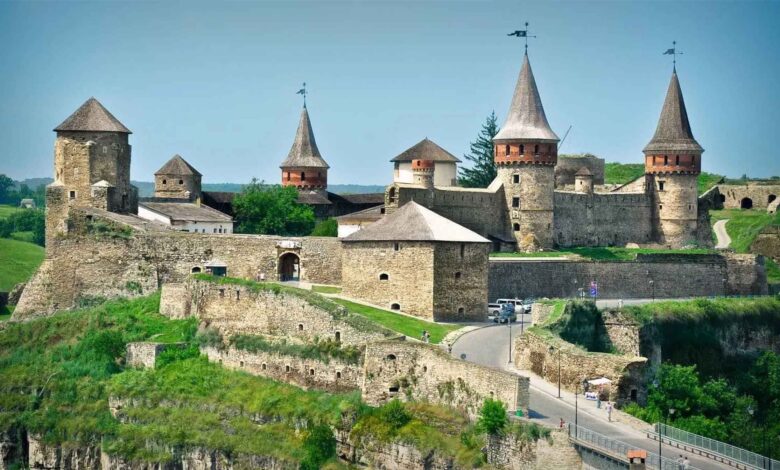
April 18 is the International Day for Monuments and Historical Sites and the Day for Monuments of History and Culture of Ukraine, as well as Ukrainian Environment Day (Environment Day), the Day of the Red Cross Society in Ukraine, and World Circus Day. On this day in the history of mankind, events related to important political decisions, the development of science, culture, and technology, and changes that left a noticeable mark on the collective memory of different countries, were combined.
International Day for Monuments and Historical Sites and the Day for Monuments of History and Culture of Ukraine
This day in the world and in Ukraine annually reminds us that historical heritage preserves real traces of the life of society, its memory, experience, and continuity. These are archaeological sites, old city quarters, temples, fortresses, museums, estates, necropolises, mosaics, murals, archival complexes, and other places where evidence of different eras has been preserved.
For Ukraine, this day has a special significance, because its cultural space is formed by the layering of the princely era, the Cossack era, the imperial period, modern history and the tragic experience of the 20th century, and each monument helps to see more accurately how cities, communities and the country itself have changed.
Now the meaning of this day has become especially acute during the war, when monuments of history and culture have been under a real threat of destruction, robbery and loss. In such a situation, it is no longer just about the restoration or accounting of objects, but about their physical survival, the evacuation of collections, the protection of museum funds, digital archiving and recording of damage for future restoration.
Interesting facts
Angkor Wat in Cambodia is so important to national memory that its silhouette is depicted on the country’s national flag, and the temple complex itself was originally built as a Hindu temple, after which it gradually became Buddhist, preserving traces of both religious traditions in its architecture.
The Lascaux Cave in France had to be closed to the public after it was opened to the public because the heat, humidity and carbon dioxide from visitors began to destroy the prehistoric drawings, so one of the most famous objects of primitive art in the world became an example of how human presence can destroy a monument even without any deliberate intervention.
The temples of Abu Simbel in Egypt were cut into large blocks in the mid-20th century and moved higher above the level of a future reservoir to save it from flooding after the construction of the Aswan Dam, in an operation that became one of the largest cultural heritage rescue projects in history.
In the Hagia Sophia in Istanbul, an inscription associated with the Varangians has been preserved, and it is such small traces on the walls that show that outstanding monuments preserve not only the official history of empires, but also the almost accidental traces of people who passed through them hundreds of years ago.
In Timbuktu, during the threat of destruction of ancient manuscripts, local residents and librarians secretly exported thousands of medieval manuscripts, hiding them in metal chests and transporting them along private routes, so one of the most valuable monuments of world culture turned out to be not only mosques and mausoleums, but also the manuscript tradition, which was saved by the city’s residents themselves.
The moai statues on Easter Island once had not only the famous stone heads and torsos, but also individual red “hats” made of volcanic rock, some of which weighed several tons, and one of the main mysteries still remains the way in which they were lifted to the tops of the statues without modern technology.
The historical center of Odessa was included in the UNESCO World Heritage List during a full-scale war, when the city was under threat of new attacks, and the very appearance of Odessa on this list did not occur during a period of peace, but at a time when its architectural environment needed international protection the most.
In 2023, after a long-standing court case, a collection of “Scythian gold” was returned to Ukraine, which had been taken for exhibition even before the occupation of Crimea, and this story became one of the most high-profile examples of how cultural values become the subject of a major international legal battle.
St. Sophia Cathedral in Kyiv has survived through the centuries not only due to its status as a sanctuary, but also because at different times it was repeatedly saved from reconstruction and destruction, and some of the 11th-century mosaics and frescoes have survived to this day almost continuously in their original place, which is a rare case for such an ancient monument.
The stone Polovtsian women standing in the steppe zone of Ukraine have experienced wars, changes of states and climatic destruction for centuries, and during the modern war some of them had to be protected again with bags, shelters and relocation, as if they were once again on the line of historical contact.
In many Ukrainian museums, after February 24, 2022, the most valuable exhibits began to be packed according to wartime museum protocols, and for this purpose they often used improvised means that were quickly found on site, including building materials, boxes and protective layers made by hand.
Chernihiv, which was heavily shelled in 2022, has one of the oldest groups of sacred monuments in Ukraine, and the fact that the Transfiguration Cathedral dates back to the 11th century makes any damage to the urban historical environment in this region a loss of scale not just for one city, but for the entire European medieval heritage.
In the temporarily occupied territories of Ukraine, the risk to heritage was posed by museum funds, archives, archaeological finds, and local collections that preserve unique items of local history and which, once lost, are almost impossible to restore.
Ukrainian Environment Day (Environment Day)
This day annually reminds us of the state of nature as a part of everyday life, without which safety, health, water, clean air, and the normal existence of communities are impossible. This date is associated with the need to pay attention to river pollution, soil depletion, deforestation, the disappearance of certain species, waste accumulation, dryland fires, industrial emissions and the consequences of uncontrolled use of natural resources. For Ukraine, the environmental issue is of particular importance also because the country has very different natural zones – from steppes and floodplains to the Carpathians and Polissya, and each of these landscapes has its own vulnerability and requires a separate approach to protection.
During a full-scale war, the meaning of this day became even more acute, because environmental damage went far beyond the usual problems of peacetime. We are talking about mined forests, destroyed protected areas, soil and water pollution, fires after shelling, the death of animals, the destruction of treatment facilities, risks to marine and river ecosystems. Therefore, environmental conservation in such conditions no longer means only planting trees or cleaning parks, but also restoring damaged areas, fixing environmental crimes, demining natural areas and returning to life spaces where nature was hit by war.
Interesting facts
The Chernobyl Exclusion Zone, which for a long time was associated exclusively with the disaster, over the decades has become a place where large populations of wild animals, including wolves, lynxes, deer and Przewalski’s horses, have recovered without the constant presence of humans, so one of the most traumatic areas of Ukraine has also turned into an unexpected space for the restoration of wildlife.
The Oleshkiv Sands in southern Ukraine are one of the largest sandy areas in Europe, and are known to many much less than the Carpathians or the Black Sea coast, although this landscape is almost unique for Ukraine, with its microclimate, special vegetation and constant threat of degradation due to fires and military operations.
Askania-Nova is one of the oldest steppe reserves in the world, where it was possible to preserve a section of virgin steppe almost intact, which is especially valuable, because the real wild steppe in Europe disappeared in most areas many decades ago due to plowing.
After the start of a full-scale war, some of the Ukrainian national parks and reserves found themselves in the zone of hostilities or occupation, which caused damage to nature due to the inability to carry out normal protection of the territories, monitor animal migration and quickly respond to fires or poaching.
In the Black Sea, the risks to dolphins and other marine life from explosions, noise pollution, changes in coastal waters and pollution have increased dramatically during the war, so the consequences of the fighting have affected not only land but also ecosystems that remain less visible to most people.
The Ukrainian marshes of Polissya store large reserves of carbon, and when such areas are drained or burned, significant amounts of greenhouse gases are released into the air, so marshes have long ceased to be “useless land”, as they were often perceived in the past, and are now increasingly seen as important natural protection against climate change.
Dry grass fires, which many have considered for years a minor seasonal phenomenon, in fact destroy not only vegetation, but also insects, bird nests, small animals and the upper fertile soil layer, which is why even a short-lived fire causes damage that is much more serious for the ecosystem than it seems at first glance.
Founding Day of the Red Cross Society in Ukraine
Every year, this day reminds us of the emergence of one of the oldest humanitarian organizations in the country, whose activities are related to helping people during wars, epidemics, natural disasters and other crises. This is a structure that works where evacuation, first aid, support for the wounded, care for vulnerable people, search for missing persons and provision of the most necessary things are needed. In Ukraine, it emerged at the beginning of the 20th century and has gone through a change of state eras, large-scale wars and severe social upheavals, while retaining its humanitarian function.
In conditions of full-scale war, the work of the Red Cross in Ukraine consists of daily support for people who have lost their homes, were forced to evacuate, survived shelling or need urgent assistance. In such a reality, the role of volunteers, mobile teams, aid stations, first psychological support programs, training in first aid and response to emergencies has become especially noticeable.
Interesting facts
The Red Cross Society in Ukraine was founded on April 18, 1918 in Kyiv, that is, its history began back in the period of the Ukrainian People’s Republic, and that is why this date has not only a humanitarian, but also a distinct historical dimension.
The Red Cross emblem is not just a sign of charity or medicine, because in international humanitarian law it means the protection of medical personnel and auxiliary services during armed conflicts, and the incorrect use of such a symbol is considered a serious violation.
One of the least visible areas of the Red Cross’s work for the general public is the restoration of family ties, when the organization helps to search for missing people, transmit messages between loved ones and establish the fate of people with whom contact has been lost due to war or displacement.
During the full-scale war in Ukraine, first aid skills became particularly in demand, and because of this, the Red Cross training programs for civilians turned from a useful initiative into knowledge that at a critical moment could depend on life until the arrival of medics.
In different historical periods, the Red Cross worked not only with wounded soldiers, but also with the civilian population during famine, mass displacement, epidemics and the destruction of infrastructure, so its history in Ukraine is much broader than the usual idea of only medical assistance in war.
After 2022, the work of the Ukrainian Red Cross became visible to many people through humanitarian recruitment and evacuation, although much of the activity takes place less visibly – through support for shelters, assistance to the elderly, counseling, psychological support and long daily work with communities.
The International Red Cross and Red Crescent Movement is one of the largest humanitarian movements in the world, but in each country the national society works in its own circumstances, so the Ukrainian experience of recent years has become one of the most complex and intense in the entire modern history of the movement.
World Circus Day
This holiday is dedicated to one of the oldest and most recognizable types of performing arts. It is an art that combines acrobatics, juggling, balancing, clowning, aerial numbers, illusion, plastic and complex physical training, which is often formed over the years. This day reminds us that the circus has a long history and has long gone beyond the boundaries of a simple spectacle, because in different eras it reflected fashion, technical capabilities of the stage, ideas about risk, physical skill and changing tastes of the audience. In the modern world, circus art exists in very different forms – from the classical arena to the modern theatrical circus without animals, where the main emphasis is on human capabilities, dramaturgy and visual language.
This day also has its own significance for Ukraine, because the circus school here has a long and recognizable tradition, and Ukrainian artists have long worked not only in national troupes, but also in large international projects.
Interesting facts
The modern word “circus” comes from the Latin circus, which meant a circle, and this is directly related to the round arena, which became one of the main features of the classical circus space.
The round arena in the classical circus has a not accidental shape, because such a space was historically convenient for equestrian acts: it is easier for the artist to keep balance while the horse moves in a circle, and the audience from different sides sees the performance better.
One of the most important turning points in the world history of the circus occurred when it began to move from a fairground spectacle to a complex stage art with direction, musical dramaturgy, light and a holistic artistic concept.
Many circus dynasties in the world passed down the profession for generations, and in such families children often began to be taught plasticity, coordination and work with equipment at a very early age, long before their first appearance in the arena.
Clowning, which is often perceived as an easy genre, actually requires very precise technique, rhythm, stage reaction and the ability to work with pauses, because even a few seconds of poorly constructed silence can completely change the perception of the act.
In the 21st century, more and more circus companies in the world have abandoned animal acts, and this process has become one of the most noticeable changes in the development of circus art in recent decades.
Aerial acts, which are often perceived by spectators as the most spectacular, are considered to be among the most demanding in daily training, as they require not only strength and stretching, but also an impeccable sense of timing, height, and trust in a partner.
The Ukrainian circus school has long had a strong international reputation, and many artists from Ukraine have performed or worked in troupes and productions abroad, where technical precision, endurance, and high acrobatic training are especially valued.
During the war, some Ukrainian circus artists continued to train and perform in very difficult conditions, and for many children and families, such performances became a rare opportunity to switch off from constant stress, at least for a short time, so the circus during such periods also acquires a distinct human, psychological meaning.
Historical events on this day
1187 – the famous mention of the name “Ukraine” appeared in the Kyiv Chronicle in connection with the death of Prince Volodymyr Glibovich of Pereyaslav. This passage became one of the most frequently quoted in the conversation about the early written presence of the name, which would later acquire great historical and political significance for the entire country.
1506 – construction of St. Peter’s Cathedral began in Rome, which later became one of the main temples of the Catholic world and one of the most famous architectural structures in Europe. Its creation lasted many decades, and leading masters of the Renaissance era were involved in the work on it at different times.
1521 – Martin Luther appeared before the court of the Worms Reichstag, where he was demanded to renounce his views. This speech became one of the key moments of the Reformation, as the controversy surrounding his teachings went far beyond theological discussion and changed the religious map of Europe.
1648 – Bohdan Khmelnytsky arrived in the Zaporozhian Sich with a call for an anti-government uprising. It was from this step that a broad movement began to quickly take shape, which grew into a large-scale war and became a turning point in the history of the Ukrainian Cossacks and all of Central and Eastern Europe.
1846 – American Royal Earl House patented the telegraph. The development of such technologies gradually changed the idea of the speed of information transmission, as humanity moved from a long wait for news to a new era of almost instant communication over long distances.
1865 – in the Russian Empire, censorship was abolished by the law on printing. This decision did not mean complete freedom of speech in the modern sense, but it was an important change for the publishing industry, journalism, and intellectual life, where the printed word had an increasingly greater social influence.
1902 – Denmark became the first country to use fingerprints to identify criminals. This step was an important milestone in the development of forensics, as it opened up a new and much more accurate identification tool for investigators.
1906 – San Francisco suffered catastrophic destruction due to a powerful earthquake, which killed 700 people, left 250,000 homeless, and destroyed 28,000 buildings. This tragedy went down in history not only because of the force of the earthquake, but also because of the large-scale fires that further worsened the consequences of the disaster.
1909 – The Vatican canonized Joan of Arc. A century after her death, she was finally entrenched in historical memory not only as a heroine of French history, but also as one of the most famous figures in the Christian world.
1918 – the battle of Yenakiyevo took place. It was part of the events of the Ukrainian Revolution and became part of a complex military-political struggle for control over Donbas at a time when the future of Ukrainian statehood was being decided not only in government offices, but also on specific sections of the front.
1921 – the first exploratory oil well of the Gazolina company at the Dashava field yielded gas from a depth of 395 meters. This date is considered the birthday of the gas industry of Ukraine, since it marked the beginning of a new stage in the development of energy resources.
1934 – American Cantrell opened the first laundromat in Fort Worth, Texas. A household service that seems commonplace today was then a sign of a new urban everyday life, where mechanization was increasingly entering people’s private lives.
1936 – the first exhibition of architecture in Soviet Ukraine opened. It became a way to show how the authorities saw space, cities, housing construction, and the image of the future, and architecture itself was increasingly becoming an instrument of ideology.
1942 – American aviation carried out the first bombing of the territory of Japan. This operation had great psychological significance, as it demonstrated that the Japanese islands were no longer inaccessible to attacks, and became one of the symbolic moments of the war in the Pacific.
1946 – in connection with the creation of the UN in Geneva, the dissolution of the League of Nations was announced. Thus ended the history of the organization, which after the First World War was supposed to become a guarantee of international security, but could not prevent a new major war.
1949 – Ireland withdrew from the British Commonwealth, and the Republic of Ireland was proclaimed. This step was an important stage in consolidating the country’s full state independence and its distancing from the British political center.
1956 – American actress Grace Kelly married Prince of Monaco Rainier III and became Princess of Monaco. This event gained worldwide publicity, as it combined Hollywood fame, European monarchical tradition and public interest in the lives of celebrities.
1961 – a demonstration was held in Kyiv against the closure of St. Andrew’s Church. Such a performance became a rare example of open public resistance to the religious and cultural policy of the Soviet authorities, which systematically displaced sacred buildings from the living urban space.
1966 – for the first time, the American Academy Awards ceremony was broadcast in color. For television, this was a significant moment of the transition to a new visual era, when the mass audience began to perceive major cultural events in a completely different way.
1968 – the old London Bridge was sold to an American company, which decided to transport it stone by stone to Arizona and reassemble it there. This story became one of the most famous architectural migrations of the 20th century, when the historical structure was actually moved across the ocean.
1995 – the Kyiv City Council decided to return the ancient coat of arms of the city of Kyiv with the image of the Archangel Michael. This decision had not only heraldic significance, but also symbolized a return to the historical images of the city after a long Soviet period.
2008 – a group of researchers from the University of Manchester led by Konstantin Novoselov managed to create the world’s smallest single-electron transistor based on graphene nanofilms. This achievement once again emphasized the exceptional scientific potential of graphene, which at the beginning of the 21st century became one of the most promising materials in physics and nanoelectronics.