The flip side of attacks on Russian targets: why escalating war carries great risks and blocks chances for peace

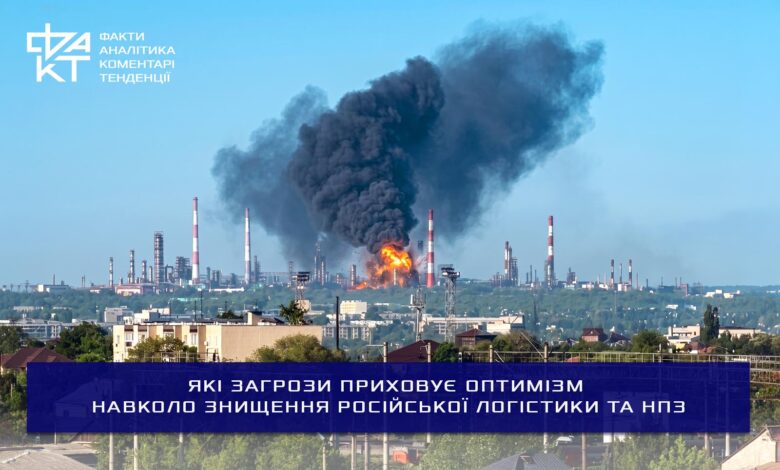
Daily terror, thousands of ruined lives, mutilated children’s lives, and razed Ukrainian cities have turned a firefight across Russian territory into the only way to defend ourselves. When the enemy is waging a war to completely destroy our people, moving the fighting deep inside is a perfectly natural step, but behind every burned-out oil refinery or blown-up bridge lies the cruel reality of a major escalation. The acute problem now is that the large-scale June attacks on Russian infrastructure are triggering an uncontrolled chain reaction and provoking the Russian Federation to mirror, asymmetric revenge.
Russian retaliatory strikes are purposefully targeting Ukrainian infrastructure and the fuel system, endangering the daily lives of millions of citizens and driving the diplomatic process into a dead end. However, instead of another spin-off of this destructive spiral and a new wave of escalation, the main task should be to achieve peace as soon as possible, which, against the backdrop of endless hostilities, few people are talking about now.
A new approach to air attacks: how the Armed Forces of Ukraine rebuilt tactics and increased the number of strikes on the Russian Federation
The summer campaign of the Ukrainian Defense Forces demonstrates a cardinal change in strategic priorities, where the main focus is on the methodical, precise destruction of the enemy’s logistics and logistics. Large-scale operations deployed during the first summer month clearly prove that modern war is won not only on the front line, but also in the deep rear, where fuel tanks roll and the information arteries of the military command pulsate.
The Russian energy sector has come under enormous pressure, forcing the Kremlin leadership to acknowledge an internal deficit and take radical steps to limit fuel sales and ban its export outside the country. The consequences of systematic attacks by long-range drones have been catastrophic for several key oil refining enterprises. The Russian capital region has suffered the most painful blow, when, as a result of massive air attacks on June 16 and 18, the Moscow Oil Refinery in the Kapotny district lost its most important primary processing unit. Huge tanks have turned into flares, and the scale of the destruction of this giant has effectively stopped the production cycle, according to experts, until the end of this year.
No less noticeable for the Russian fuel market was the forced shutdown of the NORSI enterprise in Nizhny Novgorod, which belongs to the Lukoil structure. At the end of the month, a precise landing of an unmanned aerial vehicle disabled the CDU-5 unit, instantly eliminating a quarter of the total capacity of the country’s fourth-largest plant. Yaroslavl also picked up the baton of fire damage, where the Slavneft-YANOS plant’s workshops caught fire on the night of June 28. If we recall the southern direction, the Afipsky, Ilsky, and Novoshakhtynsky plants, which were traditionally considered the base refueling station for the occupation forces operating on the territory of Ukraine, came under constant pressure.
While the enemy’s oil refining industry is counting losses, the Ukrainian military is successfully implementing a plan to completely isolate the Crimean peninsula. The main achievement in this direction was the destruction of the railway bridge across the North Crimean Canal near Rozdolny. After about twenty powerful explosions thundered there on June 18, the Special Operations Forces together with the General Staff confirmed that on June 23 this critically important transport branch ceased to exist. Now the supply of weapons and ammunition to the southern enemy group was in great question. Additional difficulties were added to the occupiers by the destruction of the automobile bridge near Azov in the Zaporizhia region at the end of the month, which practically paralyzed the rapid rotation of their forward units.
At the same time, the Kerch Strait and the famous bridge turned into a constant headache for the Russian command due to regular nightly alarms caused by the appearance of missiles and unmanned boats. At the same time, an attempt to replace the limited capabilities of the bridge with a full-fledged ferry connection failed after Ukrainian forces sank several ferries on June 21 and 26, creating record-breaking multi-kilometer traffic jams on the approaches to the strait.
The occupied Ukrainian peninsula is gradually losing its status as an impregnable fortress, turning into a zone of continuous fire damage, where ATACMS and Storm Shadow missiles methodically burn out expensive S-300 and S-400 anti-aircraft missile systems in the vicinity of Sevastopol, Yevpatoria, Dzhankoy and Chornomorske. Along with air defense, the aviation infrastructure at the Belbek and Gvardiyske airfields is being distributed, where the invaders are losing not only aircraft, but also trained personnel.
The geography of hostilities has long crossed conventional borders, expanding to distances exceeding a thousand kilometers. In addition to the daily detonation of ammunition depots and burning oil depots in the Belgorod, Kursk and Voronezh regions (in particular, a large-scale fire in the Gubkinsky urban district), Ukrainian drones have reached the Volga region and Tatarstan. A special place in this air campaign is occupied by the hunt for military airfields Morozovsk and Yeisk, where the enemy’s frontline aviation is based.
It should be noted that a unique feature of the current stage of the confrontation is the high coordination of actions and the combined nature of the assaults. Dozens of cheap kamikaze drones first exhaust and disorient the enemy’s air defense, after which high-precision ballistics come into play. In addition to energy starvation, the Ukrainian command creates an information vacuum for the enemy, knocking out communication nodes, command posts, and even such strategic objects as overseas radar stations of the Voronezh type.
The bright final chord of June was the repeated defeat of the Dubna Space Communications Center in the Moscow region, which took place on the night of the 30th. The first painful blow to this object was inflicted by Ukrainian drones a week earlier, on the night of June 22. This unique satellite station played a key role in conducting space reconnaissance and coordinating the actions of Russian troops on the front line, so its incapacitation deprives the Russian command of “eyes and ears” at the most crucial moment of the summer campaign.
Military pragmatism and public assessment: how strikes on the Russian rear are perceived in Ukraine
The June escalation of the air war and strikes on the Russian Federation have caused an ambiguous reaction in Ukraine, and assessments in the civilian environment are divided, as the perception of these attacks ranges from optimism to serious concerns about the consequences.
The military leadership, including the General Staff, the Security Service and the Main Intelligence Directorate, completely rejects the emotional component, considering the destruction of Russian refineries and communication hubs like the Dubna complex as a cold calculation. For the Armed Forces of Ukraine, each destroyed facility is a legitimate target that provides the Russian military-industrial complex and the army. Military reports emphasize the practical consequences: less money from oil in the Russian state budget and a real shortage of diesel and gasoline for armored vehicles on the front line significantly reduce the enemy’s offensive potential.
The logistical blockade of the occupied Crimea, which is expressed in the blowing up of railway bridges near Rozdolne and road crossings in Zaporizhia, is assessed by the military as a tactical isolation of the combat zone. When the railway tracks are cut, the enemy loses the ability to quickly deliver heavy shells and rotate personnel, which weakens its positions in the southern direction. The commanders consider the successful overcoming of Russian air defense during strikes on rear communication bases to be proof of the technological maturity of Ukrainian developers of unmanned systems.
In the civilian sector, one part of the citizens perceives the long-range campaign with great optimism, seeing in strikes on Russian fuel giants and infrastructure a long-awaited act of revenge and justice against the background of the daily destruction of Ukrainian cities and villages. For these people, the news of fires in the territory of the Russian Federation is confirmation that the aggressor is paying a high price, and the situation itself restores faith in a symmetrical response. Part of society actively shapes the media space, where each attack turns into an occasion for irony, memes about “cotton” and jokes about Crimean resorts, which helps them to keep under psychological pressure. In addition, the visible destruction behind enemy lines motivates them to donate even more actively for new batches of domestic drones.
At the same time, another part of Ukrainian society treats these operations much more restrainedly and with tangible anxiety. These people focus on the high risks of further escalation and the inevitable steps of the enemy in response. In this environment, there is a fear that strikes on Russian factories and strategic facilities will provoke the Kremlin to even more brutal massive shelling of Ukraine’s civilian infrastructure, in particular the remnants of the energy system. Instead of joy from the burning Russian refineries, this part of Ukrainians weighs the practical consequences for their own daily lives, fearing a worsening humanitarian situation and new waves of destruction in residential areas.
The Price of Escalation: What Risks Do New Strikes on the Russian Federation Bring to Ukraine
The protracted war that the Russian Federation is waging against Ukraine is accompanied by the targeted destruction of both military and civilian populations, the killing of children, the destruction of residential areas and industrial enterprises. Millions of Ukrainians have lost everything they have gained in their lives, become disabled, or have been left homeless, which is actually an attempt at genocide and the total destruction of the people. Under such conditions, the fire responses of the Armed Forces to objects on the territory of Russia and their support from Ukrainian society are quite natural, because Ukraine did not start this war.
When a country has been under daily fire for years, and its citizens are forced to bury children and themselves hide in shelters, the right to respond moves from the plane of purely military expediency to the category of self-defense. Citizens, who see the consequences of the destruction of their own cities every day, realize that it is impossible to stop the aggressor solely through defensive actions. The destruction of the enemy’s logistical hubs and oil refinery is perceived within the country as the only available way to transfer the burden of war to the aggressor’s territory, forcing him to feel the price for the unleashed hostilities and reducing his ability to continue terror against the population of Ukraine.
However, a sober analysis of the large-scale air campaign of the Defense Forces in the deep rear of the Russian Federation and Crimea forces us to consider not only the obvious strategic advantages, but also to calculate the serious associated risks that in no way justify the aggressor’s actions. At the current stage, a comprehensive assessment of these factors is clearly divided into three key aspects.
The first of these covers purely military-technical risks and the nature of Russia’s response. The main challenge remains the Kremlin’s harsh revenge in the form of further destruction of the Ukrainian energy sector. Wanting to neutralize the consequences of the defeat of its oil refineries, the Russian army is trying to completely destabilize the civilian infrastructure of Ukraine by intensifying massive missile strikes. At the same time, successful Ukrainian raids break the usual logic of the enemy’s air defense, forcing the enemy command to withdraw anti-aircraft missile systems from the front line to protect oil terminals and communication hubs like the Dubna near Moscow. In turn, the enemy is quickly adapting, deploying mobile fire groups and modernizing electronic warfare equipment, which over time can reduce the breakthrough capability of Ukrainian unmanned systems.
The second aspect lies in the sphere of geopolitical relations with Western allies. Ukraine is under pressure from Western political elites and the United States, which fear that the incapacitation of Russian industrial giants will provoke a price shock on the world oil market. The problem is complicated by the fact that partners still do not give permission to damage the infrastructure that ensures the export of crude oil – the main source of foreign exchange earnings of the Kremlin, due to fears of global economic shocks against the background of a parallel crisis in the Middle East. In addition, crossing certain “red lines”, in particular deep strikes on elements of the Russian Federation’s strategic nuclear security, such as radar stations of the Voronezh missile attack warning system, is perceived by the West as a dangerous step towards uncontrolled escalation, which hinders the transfer of new models of long-range weapons to Ukraine.
The third aspect concerns domestic political and economic processes in Russia, where the consequences of the attacks are of a dual nature. On the one hand, the fuel crisis, queues at gas stations and the rapid increase in prices in Russian regions affect the stability of life of the population, but on the other hand, strikes on the rear may not demoralize, but on the contrary, radicalize Russians around the Kremlin due to the “sense of a direct threat.” The calculations that the systemic collapse of housing and communal services, darkness and cold will force them to protest with demands to stop the war, are currently being overshadowed by the fact that the Kremlin is using the situation to transfer the economy to hard military rails, mobilizing additional resources. In addition, in the structure of Russian foreign exchange earnings, the export of finished diesel is about 8–9%, and gasoline is only 1–2%. This means that strikes on refineries in the near future are not able to completely undermine the enemy’s war machine economically.
At the same time, Russia’s inevitable mirror response directly worsens the daily lives of millions of Ukrainians, as domestic gas stations, oil depots and civilian fuel trucks are under attack. As of today, large oil refineries in Ukraine are not operating at all for mass industrial production of fuel, since domestic large-scale oil refining has been completely stopped due to systemic Russian missile attacks. Our largest Kremenchuk refinery withstood more than 60 missile strikes and about 260 drone strikes, which led to the complete destruction of its installations and tanks. At the same time, other enterprises, such as the Lysychansky, Odessa or Kherson plants, were not functioning even before the full-scale invasion.
Currently, Ukraine fully supplies its market by importing finished petroleum products from European countries, but the destruction of more than 150 gas stations by the Russians in May and June of this year alone has already provoked the first supply disruptions, and drivers in some places refuse to go to front-line areas due to the threat from enemy drones.
The current situation is becoming another round of escalation, which is distancing Ukraine and the Russian Federation from achieving peace. At the same time, the issue of ending the war and resuming the diplomatic process is in a phase of deep crisis due to the diametrically opposed positions of the parties. Kyiv steadfastly insists on the “Peace Formula”, which demands the complete withdrawal of occupation troops to the 1991 borders, the payment of reparations and the trial of war criminals, which is supported by the NSDC decision on the impossibility of direct negotiations with the Russian leadership. In return, Moscow puts forward ultimatums about Ukraine’s rejection of NATO, demilitarization and recognition of Russian control over all administrative borders of four Ukrainian regions.
Thus, the war has finally entered a long phase of mutual depletion of the resource, economic and military systems of both countries. If this process is not stopped in the near future, each new day will bring only new deaths, cities wiped off the face of the earth and ruined human destinies. Instead of escalating the war and further undoing the spiral of strikes, both states should find ways to end the bloody confrontation as soon as possible and achieve peace.