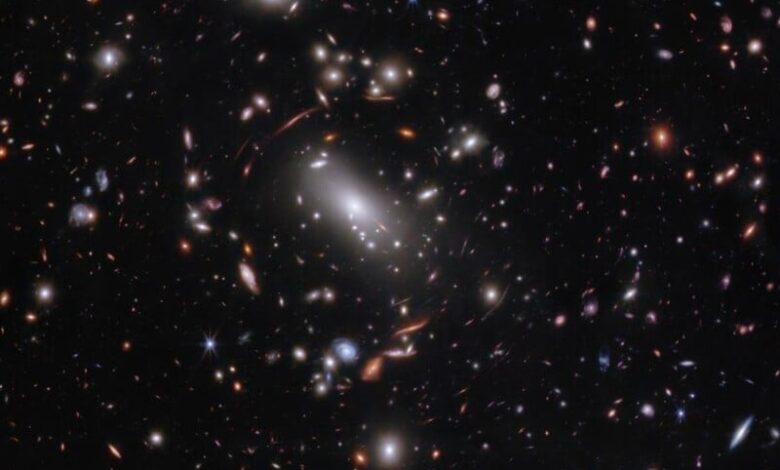
Astronomers using the James Webb Space Telescope have discovered the oldest known galaxy. According to preliminary estimates, it is 200 million years older than the currently recognized earliest galaxy, reports Daily Galaxy.
The object was named Capotauro, but its nature has not yet been definitively confirmed. If the observations are confirmed, the discovery can change the perception of the speed of formation of the first galaxies in the universe. During the analysis of images taken by the Webb telescope, astronomers noticed a bright red spot on one of them. This is explained by the fact that the farther the object is from us, the more its radiation shifts to the red part of the spectrum due to the expansion of space.
Scientists suggest that the light from this object traveled to us over 13.7 billion years. If it is indeed a galaxy, it formed already about 90 million years after the Big Bang—earlier than any other known structure. For comparison: currently, the earliest and most distant galaxy is considered to be MoM-z14, which existed 290 million years after the beginning of the expansion of the universe. The potential Capotauro can be 200 million years older.
This would mean that it was formed at a time when the universe was still filled with hot gas and had no distinct structure. Its confirmed existence would prove that galaxies could form much earlier and faster than most current theories suggest. After all, it was believed that hundreds of millions of years were needed for the formation of the first star systems after the Big Bang.
The extraordinary brightness of Capotauro, which is more reminiscent of the later known galaxies of the early universe, attracted the special attention of astronomers. According to estimates, its mass may exceed the mass of the Sun by about a billion times. However, modern models of cosmology deny the possibility of the existence of such massive structures at such an early stage. This would require nearly all the available gas to turn into stars with an efficiency close to 100%, which is impossible according to current scientific understanding.
If the galaxy really arose already 90 million years after the Big Bang, this would mean an extremely rapid formation of cosmic structures and would be a serious challenge for modern theories about the evolution of the universe.