Cost-based contract: why admission to universities in popular specialties will become unattainable for most

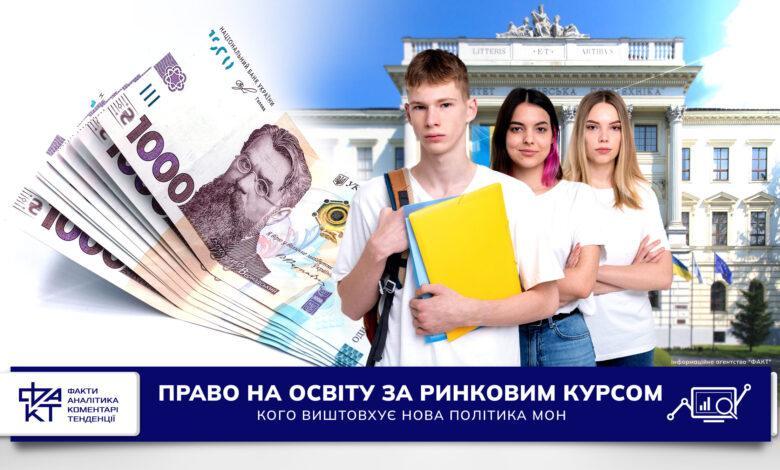
In 2025, for applicants who dream of a career in law, economics, management, tourism or journalism, admission to Ukrainian universities will be a serious financial challenge. The reason is not global inflation, but the decision of the Ministry of Education and Science to equate the fee for contract training with the cost of training a state employee. About this reported in a lengthy interview, Deputy Minister of Education and Science Mykhailo Vynnytskyi. According to him, the state is no longer ready to indirectly subsidize the education of contract students with low scores at the ZNO/NMT, who choose fashionable but oversaturated areas. In a country that simultaneously talks about equal opportunities and the need to develop human capital, such innovations present applicants with the choice not of “who to be”, but “whether you can afford to study at all”. And this choice leaves no options for many.
There is demand – there are no jobs: the economic logic of change
As Vinnytskyi explains, the state does not want to finance the imbalance in the labor market. Every year, thousands of applicants dream of becoming lawyers, economists or managers. But after receiving a diploma, they face reality: the market is saturated, there are few vacancies, and the competition is fierce. For example, in 2024, more than 5,700 people enrolled in the “Law” specialty, of which only 738 received places at state expense. The rest are contractors who paid significantly less than what this training is actually budgeted for.
In fact, the state partially financed their education from the general education fund. The deputy minister emphasized that training in popular specialties remains available to all who wish, but now it involves significantly higher costs. The final decision remains with the applicants, but the state will no longer undertake financial support for this choice.
The innovation provides for the introduction of an indicative cost of education. For the first time in Ukraine, a clear financial standard has been defined: for the 16 most popular and at the same time oversaturated specialties, the cost of the contract cannot be lower than the state’s expenses for one state employee. This rule is designed to stop the common practice, when students with lower passing scores are contracted to study, and universities try to “pull” as many payers as possible by setting lower prices. As a result, the quality of education decreases, and the labor market is filled with specialists without demand.
According to officials from the MES, Ukraine is beginning a serious “repair” of the state procurement system in education. This time, the bet is not on the dream of offices, but on real working hands. In order to train more specialists, which the economy really needs, the government has dramatically increased the number of budgetary places for future engineers, builders and manufacturers by almost a third. About this during the conference “Education of New Ukraine” reported First Deputy Prime Minister and Minister of Economy Yulia Svyridenko. According to her, this year, as part of the introductory campaign, support for technical and applied areas was significantly strengthened, in particular, engineering, IT, industrial and construction specialties. The indicator in state procurement has increased by 27.6% in recent years.
This change is not accidental, because a country where millions of people have gone abroad, and every second business complains of a lack of personnel, can no longer ignore the shortage of personnel. Education should not only be about diplomas, but should contribute to the survival of the economy. Now it is the defense industry, energy, innovation, logistics and transport that will determine what Ukraine will be like after the war. And the most active driver of these transformations, according to her forecasts, will be the private sector. Therefore, the state is already forming the personnel base for future reconstruction.
For those who are not ready to pay UAH 60-70 thousand per year for a law or management degree, the state hints: take a closer look at less popular, but strategically important specialties. For example, agronomy. Here, the contract will cost 30–35 thousand hryvnias per year, although the state spends up to 60 thousand. Accordingly, applicants have better chances for a budget and real employment prospects. Such a decision of the Ministry of Education looks pragmatic. This is an attempt to synchronize the educational system with the realities of the economy, where the surplus of personnel in certain areas can no longer be ignored.
The state supposedly wants the choice of specialty to be accompanied by responsibility, and not just by fashionable ideas and social stereotypes. The decision of the Ministry of Education and Science of Ukraine to equate the cost of contract training with the cost of training state employees in oversaturated specialties raises a number of questions not only of an economic, but also of a social nature. MES specialists claim that this approach is an attempt to reduce subsidies for areas with an excessive number of specialists.
However, if you dig deeper, the consequences can be much more complex, especially for vulnerable populations. The new policy will hurt those who are already in the most difficult life situation. For internally displaced persons (IDPs) who have lost their homes and jobs, such a move could end their children’s chances of higher education in their dream fields. The situation is no better for the families of veterans and people with disabilities. Many of them do not have the resources for full-time training under a contract, especially when it comes to sums at the level of 60-70 thousand UAH per year. In conditions where the system of social guarantees in Ukraine already does not cover the basic needs of these categories, increasing the cost of education only deepens inequality.
It is obvious that the labor market needs correction, and the annual graduation of thousands of lawyers or economists does not meet the needs of the country. But the introduction of a single approach to financing, without differentiation according to social criteria, risks turning higher education into an elitist privilege. If the fee is set the same for everyone, then it becomes not a regulatory tool, but a barrier for the weaker.
Ideally, flexible subsidization or separate state support programs should be implemented for certain categories: children of veterans, IDPs, people with disabilities, and the poor. Without this, the government’s decision-making step looks like a formal “law of the market” behind which is the tacit removal of the state from its social responsibilities.
Risks: to whom the way opens, and to whom the door closes
If you look at the new policy of the Ministry of Education and Culture through the prism of real life, it is similar to the decision to install a turnstile at the entrance to the university – you can pass, but only to those who have enough money in their pockets. And what to do with those who are already on the verge of survival? A teenager from a front-line town, who studied at a school without the Internet and sat in classes in a bomb shelter, suddenly learns that studying to be a journalist or a lawyer now costs the same as a small car. Now his talent, ambition and desire to change something in this country are facing a banal financial wall. He has neither rich parents nor savings, he is simply left with no choice.
And while some are counting pennies, there are also those who have the means and a passport for travel, and therefore calmly pack their suitcases and submit documents to European universities. There, in some places, the same specialties do not cost much more, but the quality, conditions and prospects are much better. And when one of them remains to work in Germany or Poland, no one will ask why the state did not keep them.
It is obvious that the price of a diploma in Ukraine turns into a new social barrier every time, which can break the illusion of equal opportunities. And this is happening at a time when the country needs maximum unity, when everyone is talking about justice, support and reconstruction. In this context, the “market logic” of education sounds like an attempt to save for the future. But the future is not a table in the budget, but living people who will either stay here and build a new country, or disappear in search of better opportunities abroad.
How foreign countries maintain a balance between quality and affordability of education
In many countries of the world, they have long set themselves the task of how to ensure that higher education remains high-quality, but at the same time affordable. And although there is no universal recipe, the experience of individual states shows that it is possible not to drive applicants into a corner between a loan for education and giving up their dream.
For example, Germany, despite the high cost of living, at the state level declares the principle of free higher education even for foreigners. Universities are open like library doors. The main thing is to have knowledge and motivation. A contract there is more the exception than the rule. And the system of social support is so well thought out that a student from a low-income family can receive a stipend that does not need to be repaid, and at the same time can use transport and medical services for free.
But in the USA, where education is one of the most expensive in the world, they also understand that not everyone can and should pay the full price. There is an extensive system of financial assistance: scholarships, grants, discounts for veterans, orphans, and representatives of minorities. Moreover, the cost often depends not only on family income, but also on academic achievements and personal circumstances. Famous universities such as Harvard or Stanford can fully cover the tuition of a student who has shown high results, even if his family lives below the poverty line.
In the Scandinavian countries, the situation is even more interesting, because there higher education is perceived as a basic right, and not as a privilege. In Sweden, Finland, and Norway, a student not only studies for free, but also receives a stipend, which can be used to rent a house and not starve. And no one there will say: “Your choice is your problem”, because education there is perceived as a joint investment of society in every person.
It should be noted that in the conditions of a full-scale war, Ukrainians have the opportunity to enter foreign universities, in particular, higher educational institutions in the Czech Republic. For this, applicants need to demonstrate a high level of knowledge of the Czech or English language, depending on the chosen study program. The contract form of study at Czech universities costs on average from 2,000 euros per year. However, some specialties, especially if the training is conducted in English, can be much more expensive – up to 15 thousand euros annually.
In addition to the cost of tuition itself, students should consider living expenses and daily necessities. Estimated monthly expenses are from 8,000 to 12,000 Czech crowns (approximately from 14,600 to 22,000 hryvnias). This includes payment for the hostel, food, transport, leisure and other household expenses. At the same time, living in a hostel will cost an average of 180 euros per month, and a monthly public transport ticket costs about 10 euros.
The costs of obtaining a student visa should be taken into account separately. The average cost is 50 euros, to which are added the consular fee (35 euros) and visa center services (18 euros). If you use the services of intermediary companies, the processing of documents can cost up to 300 euros. So, Ukrainians have a real opportunity to get higher education in the Czech Republic even during the war. However, for this it is necessary to prepare carefully: not only to master the language, but also to calculate the costs of education, accommodation and visa procedures.
It is important to note that even in countries with paid education, such as Poland, the Czech Republic or France, there are transparent compensation mechanisms for those who cannot pay. They do not equate knowledge with a product on the shelf, because they understand that access to education must be flexible, socially sensitive and dynamic. Against this background, the Ukrainian idea of ”everyone pays equally, because it is so fair” looks like an attempt to put an old economic formula on human history. That is why it is doomed to burst at the seams. The world has long understood that equality is not when everyone is the same, but everyone according to their needs and capabilities. Otherwise, instead of a new generation of specialists, we will get a new generation of disappointed ones.
It is obvious that the state’s intention to adjust the labor market through educational policy is quite logical, but an approach that does not take into account social inequality threatens not to solve the problem, but to create a new one – the outflow of talented youth and the growing gap between “I can” and “I want”. Our officials have forgotten that higher education should not become a luxury for the chosen ones. Otherwise, instead of forming a sustainable, professional society, we risk losing a generation that could become a driver of change. State educational policy should be not only economically expedient, but also socially responsible. Because a country that does not invest in equal starting opportunities will sooner or later pay a much higher price in brain drain, social tension and lost potential.
In the current conditions, when a significant part of the population has lost housing, stable income or is in the status of internally displaced persons, the issue of access to education for children becomes extremely difficult. The state declares support for families with children, but in practice many of these families are left alone with their difficulties. For displaced persons who are forced to live in temporary shelters, rented apartments or dormitories, the first priority is the question of survival — provision of basic household needs. In such circumstances, the costs of educating children are unrealistic.
The problem is especially acute for parents who have lost their jobs or work for the minimum wage, as well as for war veterans with disabilities, who are not always able to support their children in education on their own. In such realities, the question is not only whether learning is formally allowed, but how feasible it is in everyday life. Without systematic targeted support – not declarative, but practical – education for children from such families will remain only an unfulfilled dream.