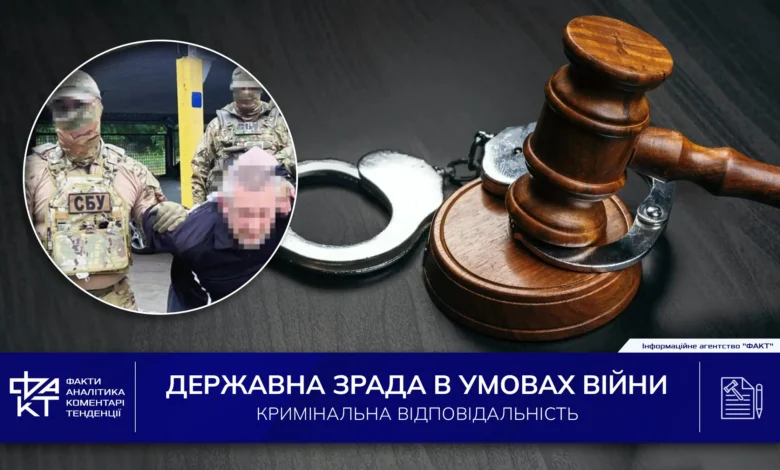
In the criminal legislation of Ukraine, treason is one of the most serious crimes against the foundations of national security. Article 111 of the Criminal Code provides for responsibility for intentional actions of citizens of Ukraine aimed at harming sovereignty, territorial integrity, defense capability, state or economic security. After the changes that were made to the composition of this crime in recent years, the practice of applying this article began to arouse wide public interest. Ukrainians are interested in the limits of interpretation of the concepts of “switching over to the enemy’s side”, “transfer of information” or “assistance in conducting subversive activities”, as well as the issue of the amount of evidence necessary to substantiate the accusation.
At the request of the editors of IA “FACT”, the lawyers of the “Repeshko and Partners” Bar Association commented on the peculiarities of law enforcement of the provisions of the legislation on treason, explained the intricacies of the formulation of the crime and its consequences.
Recently, we are constantly faced with reports in the news about the detention of state traitors by law enforcement officers. One of the latest examples was the information that a man – an actor in a children’s theater – was collecting data on the movement of armed forces, their locations and quantitative composition. He transferred the collected data to an acquaintance who lives on the territory of the Russian Federation, law enforcement agencies establish the involvement of the acquaintance in the special services of the Russian Federation. The next news appeared a couple of days later, about a woman who was detained with explosives near one of the TCC and SP of a big city. Some of the accused acted deliberately, as they say – “for an idea”, some for money, especially teenagers, some had other motives, but we would like to note that since the beginning of the full-scale invasion, as of 2025, more than 3,470 suspicions have been announced under Article 111 of the Criminal Code “Treason”, and 1,048 people have been sentenced.
In our reality, this crime is committed by both high-ranking officials and ordinary citizens. Based on our practice, we can state that if citizens knew about the criminal liability for their actions, many of them would not have committed them. So, in order to warn against a wasted life and a mutilated destiny, we want to tell you the following.
Residents of border areas usually have many relatives and acquaintances living on the other side of the border. Not everyone’s family or friendships ended with the start of hostilities on the territory of Ukraine. This is quite logical, because if the conversation is usually about the weather and nature, health and prices, then there is no reason to hate a relative. Sometimes in a conversation you can complain to him that the air defense works half the night and does not let him sleep, because it is deployed in the forest on the edge of the village next to the house, but what is this? Are you sure that the godfather will not pass this information on to the military and that in a few days, people will not die from an enemy attack on the forest, even civilians in houses on the edge? And then the law enforcement agencies will visit you and life in freedom will end. At the same time, you will tell for a long time that you just complained to the best man about the noise, but in the conditions of martial law, no one will believe it.
The Criminal Code of Ukraine has two articles that regulate these legal relations. The first of them is Article 111 – “Treason”. Let us recall its position:
- Treason, that is, an act intentionally committed by a citizen of Ukraine to the detriment of the sovereignty, territorial integrity and inviolability, defense capability, state, economic or information security of Ukraine: switching to the side of the enemy during an armed conflict, espionage, as well as providing assistance to a foreign state, a foreign organization or their representatives in carrying out subversive activities against Ukraine, is punishable by imprisonment for a term of twelve up to fifteen years with or without confiscation of property.
- The same acts committed under martial law are punishable by imprisonment for a term of fifteen years or life imprisonment with confiscation of property.
At the same time, a citizen of Ukraine is exempted from criminal responsibility if he did not take any actions to fulfill the criminal task of a foreign state, foreign organization or their representatives and voluntarily declared to the state authorities about his connection with them and about the received task.
In addition, there is also Article 111-2 – “Assistance to the aggressor state”, which defines: intentional actions aimed at helping the aggressor state (assistance), the armed formations and/or the occupation administration of the aggressor state, committed by a citizen of Ukraine, a foreigner or a stateless person, with the exception of citizens of the aggressor state, with the aim of harming Ukraine by: implementing or supporting the decisions and/or actions of the aggressor state, armed formations and/or the occupation administration of the aggressor state, and as well as the voluntary collection, preparation and/or transfer of material resources or other assets to representatives of the aggressor state, its armed formations and/or the occupying administration of the aggressor state, shall be punished by imprisonment for a term of ten to twelve years with deprivation of the right to hold certain positions or engage in certain activities for a period of ten to fifteen years and with or without confiscation of property.
Thus, treason consists of the following actions:
1) transfer to the side of the enemy during the armed conflict: physical transfer to the territory of the enemy country (joining the armed forces of the aggressor country); intellectual transition (helping the enemy or its representatives while on the territory of Ukraine);
2) espionage: – collection and transfer to representatives of the aggressor country (in particular, the Russian Federation) of information that constitutes a state or other legally prescribed secret (in the sphere of defense, economy and foreign relations of Ukraine);
3) providing assistance to a foreign state, foreign organization or their representatives in carrying out subversive activities against Ukraine: support for separatist movements of self-proclaimed people’s republics and aggression of the Russian Federation; speeches against mobilization.
We want to pay special attention to the last point. Sometimes we cannot understand or accept all the actions of the relevant bodies, but also the obstruction of mobilization actions drags on for quite a long time.
Since martial law is currently in effect on the territory of Ukraine, all responsibility for high treason will be, respectively, according to ch. Article 2 – deprivation of liberty for a term of fifteen years or life imprisonment, with confiscation of property.
It should be noted that the position of the courts towards the defendants in this category of cases is very strict. The crimes themselves are particularly serious and should not be expected to receive any mitigation – the imposition of a sentence below the lower limit or the minimum. Courts usually give the maximum possible punishment in these cases. So, for example, on March 10, 2023, the Zhovtnev District Court of Kharkiv woman, previously unconvicted, was sentenced for 2 Art. 111 of the Criminal Code of Ukraine to the penalty of imprisonment for a term of 15 years with the confiscation of all property belonging to her by right of ownership. At the same time, the appellate court upheld the verdict.
As established by the courts, the person used the Telegram messenger to transmit to the representatives of the aggressor country information about the location of military equipment, the personnel of the Armed Forces of Ukraine, as well as about their movement in the city of Kharkiv It also reported the locations of populated areas in the Kharkiv region and the distance between them, indicated the locations of hits by artillery and aviation munitions fired by the armed forces of the Russian Federation, which enabled the military personnel of the aggressor country to coordinate their fire, provided information on points of delivery of humanitarian aid to the residents of the city. Kharkov in every possible way showed favoritism and supported the criminal actions of the Russian army.
In the cassation appeal, the defense attorney indicated, in particular, that the person’s actions did not constitute a criminal offense, provided for in Part 2 Art. 111 of the Criminal Code of Ukraine. According to the panel of judges of the CCC of the Supreme Court of Ukraine, these arguments were unfounded. The Supreme Court also left the verdict in force without changing it in any way.
In addition, it should be borne in mind that treason is a completed crime not from the moment of establishing contact with a foreign state, foreign organization or their representatives or agents, or from the moment of receiving a criminal assignment from them, but from the moment of committing certain specific actions to the detriment of Ukraine. Therefore, a citizen of Ukraine who did not take any actions and voluntarily declared to the state authorities about his connection with them and about the task received is released from criminal liability.
As for the aiding and abetting of the Russian Federation, it consists in intentional actions aimed at helping (aiding) it, helping its armed formations, the occupation administration, committed by a citizen of Ukraine, a foreigner or a stateless person, with the exception of citizens of the Russian Federation, with the aim of harming Ukraine, by:
1) implementation or support of decisions, actions of the Russian Federation, armed formations or occupation administration;
2) any cooperation, including the collection, preparation, transfer of material resources or other assets to representatives of the Russian Federation, its armed forces, and the occupying administration of the aggressor state;
3) other interaction with representatives of the Russian Federation, illegal authorities created in the temporarily occupied territory.
We also want to warn that not all lawyers have the desire to participate in these criminal cases. Usually, this category of cases is handled by lawyers from free legal aid in the interests of ordinary citizens, not all of whom are paid for their work by the state. Old wisdom emphasizes that a pro bono lawyer in a criminal case is a second prosecutor. Yes or no, but we do not advise you to check it yourself. So before taking any action, think carefully about its consequences.