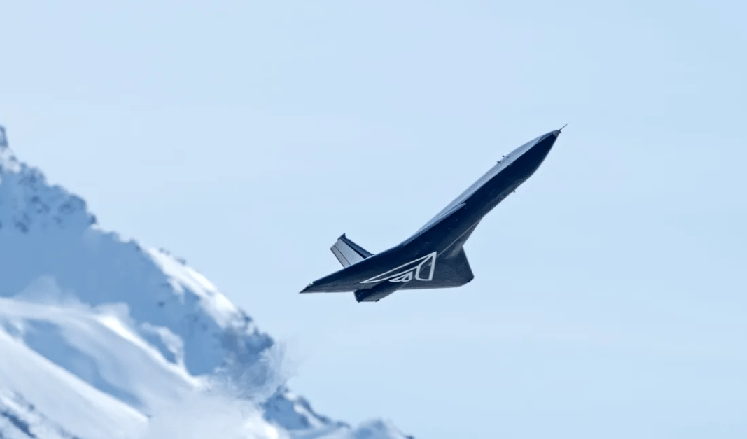
Dawn Aerospace is launching Aurora suborbital space planes capable of delivering up to six kilograms of cargo to an altitude of 100 kilometers. About this informs Space News.
A New Zealand company has announced the start of accepting orders for an unmanned space plane designed to deliver small payloads during suborbital flights. The first deliveries are scheduled for 2027.
Dawn Aerospace is offering the Aurora not in the traditional space model, but in the aviation analogy — the aircraft is sold to customers for operation, not just launch. The company believes that this approach significantly expands the potential market compared to the classic model of providing startup services.
“There are a lot of people who would love to have that opportunity and would be willing to pay for it, but they just can’t get it. It’s not for sale.”, Dawn Aerospace CEO Stefan Powell said on May 22 during a Global Spaceport Alliance webinar.
He compared this model to commercial aviation, where aircraft are not owned by manufacturers but by airlines. This concept of commercial aviation extends to the design of the Aurora itself. The company has been testing the aircraft for several years, including a flight in November 2024 when the Mark 2 Aurora reached supersonic speeds for the first time. Then the device developed a speed of Mach 1.12 and rose to a height of 25.1 km.
“This is an aircraft with the characteristics of a rocket, not a rocket with wings. That is, reliability, reusability and ultimately scalability are not secondary issues, but built in from day one to ensure this airline model.” Stefan Powell emphasized.
Dawn Aerospace is working on a new Aurora modification that will have increased engine thrust, increased fuel volume and a new jet control system for extra-atmospheric maneuvers. These changes are implemented while preserving the body design of the previous version.
The first suborbital instance of Aurora should be ready for flight in 18 months. This will be the start of a six to nine month flight test program. Flights will begin at low altitudes and gradually increase.
In a typical suborbital flight, Aurora will take off from a conventional runway and then gain altitude in a vertical mode. At the peak of the trajectory, the device will reach speeds of up to Mach 3.5 and provide about three minutes of microgravity. The entire flight, including landing, will take about 30 minutes, Powell said, with most of the time spent gliding back to the runway.
Aurora uses an engine based on 90% hydrogen peroxide and D60 kerosene. A fully loaded aircraft weighs 450 kilograms and requires a runway 1,000 meters long. The company has already demonstrated the ability to prepare the device for the next flight within six hours. Powell noted that the goal is to reduce that time to four hours.