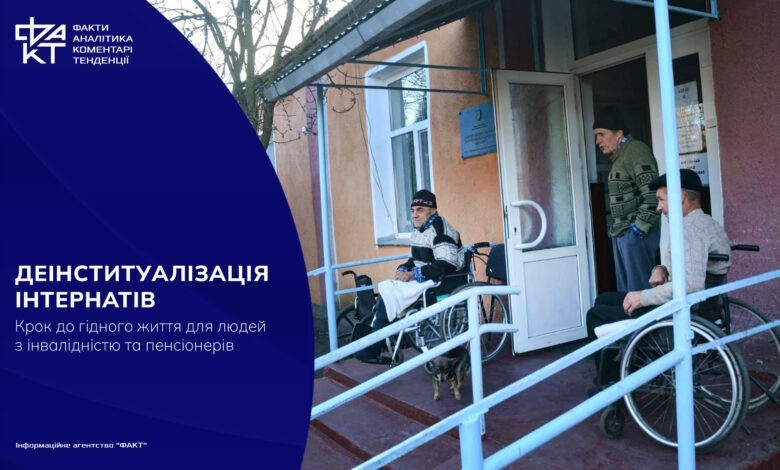
Today, Ukraine is facing severe challenges in various spheres of social life. And this is quite understandable, because since the time of the full-scale invasion, there is probably not a single Ukrainian left who was not affected by this terrible war: every day people lose their homes, property they have acquired over the years, and are forced to look for shelter and means of livelihood. More and more people are losing their physical and mental health, suffering from the terrible consequences of military actions. The number of people with disabilities in the country is constantly growing, and with it the question is becoming more acute: what to do with the system that should support them, but in fact only blocks them from the world?
What is the essence of the reform of deinstitutionalization of residential institutions
The system of boarding schools, which should provide such people with decent living conditions, is more like a mechanism of isolation. Most of these institutions operate according to outdated models, creating closed environments that not only do not help people integrate into society, but often make them invisible to the world. The conditions of stay in many boarding schools are locked doors, lack of quality rehabilitation and almost complete dependence on the system.
If our country aspires to integrate into European society, we must begin to see the problems of “invisible people” who do not live a full life, being isolated from society. It is quite clear that the modern boarding school system not only does not solve the problem, but also exacerbates it. The reform of boarding schools is not just a necessity, but a challenge that will determine whether our society is able to build a humane and effective support system.
For data Ministry of Social Policy, today there are more than 3 million people with disabilities in Ukraine. Sad statistics confirm the fact that every year the number of people who are placed in residential institutions is increasing:
- 2020 – 3130 people;
- 2021 – 4,533 people;
- 2022 – 5,200 people;
- 2023 – 5507 people.
According to experts’ calculations, the country is experiencing an aging population, which means that by 2035, every fifth Ukrainian will be over 65 years old. That is why Ukraine is planning a reform of the deinstitutionalization of boarding schools, aimed at transforming the system of boarding schools in Ukraine. As are reported in the Ministry of Social Policy, the state undertook the implementation of the Strategy for reforming psychoneurological and residential institutions and deinstitutionalization, care for persons with disabilities, elderly persons until 2034 with the aim of creating conditions for independent living in the usual environment of elderly people and people with disabilities, as well as their full participation in social and economic life.
According to this Strategy, the Ministry aims to implement five strategic goals:
- create legislative and institutional prerequisites for realizing the right of people with disabilities and the elderly to live independently in communities;
- economic integration of persons with disabilities and the elderly;
- to develop a system of social and other services in communities for persons with disabilities and the elderly, which will contribute to their independent life in the community and prevent the institutionalization of care;
- to change society’s attitude towards people with disabilities and the elderly;
- to reform residential institutions for persons with disabilities and the elderly.
The essence of the reform is to end the practice of isolation in large institutions and to create conditions where people live at home, with families or in small communities with support that meets their needs. The Ukrainian boarding school system has been preserved since Soviet times. It functions as a closed isolation mechanism that prevents people from integrating into society. This negatively affects their development, socialization and quality of life.
Deinstitutionalization reform is a step towards humanizing the system. It makes it possible to overcome the stereotype of a boarding school as the “best way out” and create conditions in which every person, regardless of age or health, can live with dignity and be a part of society.
Why existing institutional facilities do not meet the needs of their residents
For data of the analytical report of Gradus Research Company “Study of the level of awareness and perception of the population of Ukraine of the deinstitutionalization reform”, 76% of respondents recognize the need for the existence of boarding schools. At the same time, only 27% of respondents understand the harmfulness of boarding schools for children and people with disabilities living in them. The interviewees, who still understand the need to reform such institutions, are in favor of minor changes:
- improvement of food quality – 52%;
- quality of medical services – 47%;
- repair of premises – 46%.
But the problems of the most vulnerable population in such institutions are much deeper and are not limited to unsatisfactory food or the lack of comfortable conditions. People are simply isolated and seem to be invisible to everyone else.
Since 2017, the regulation on psychoneurological boarding schools has been in force in Ukraine. According to this provision, the elderly were allowed to have more personal belongings. For couples, it is possible to live in a separate room. Regarding the safety of the wards, such measures as: the need to install video surveillance, staff call buttons near each bed, lighting of the corridors at night, equipping with ramps and devices to maintain the maximum independence and activity of the residents of the institutions have been thought out. But, as always happens in practice, all these measures remain only on paper, and only a few institutions comply with this provision. Institutions have a conditional division into bed patients and more active people, but the regime for them often remains the same. One of the biggest problems is accommodation of bedridden patients and those who have difficulty walking on the upper floors of the building. According to the employees of the institutions, it is simply warmer on the upper floors. And this means that a motionless person simply becomes a prisoner of his room. The elevator does not work, there is no button to call the staff near the bed, you are not allowed to use the phone. According to monitoring studies, 99% of patients with reduced mobility and bedridden patients do not have access to outdoor walks. In most inpatient departments of territorial centers, there are not enough rehabilitation facilities, special handrails and devices for residents with reduced mobility.
“We were shocked because we ran into a wall. People had no desires. People answered: “I want to die.” Since then, we began to wonder why people do not want to live in institutions? We looked at what our grandmothers sleep on, what they eat. Until you let a person eat not from iron dishes (as in dog shelters), but from ceramics, until you find an opportunity for them to sleep on clean linen, a person will not become happy. She won’t start dreaming,” says human rights activist Olena Temchenko about her visit to the geriatric boarding house.
And what conditions prevail in private boarding houses for the elderly can only be guessed. After all the owner of the establishment may not even allow police officers or employees of the Human Rights Commissioner’s office to enter the territory, citing the fact that the establishment is his private property.
As we can see, in boarding schools where elderly people and people with disabilities live, conditions that are far from decent often prevail. These places, which should become a refuge and support for the most vulnerable, sometimes become a source of suffering and alienation. Neglect of basic needs, lack of proper care and warmth creates a feeling of loneliness that oppresses the soul of everyone who is forced to stay there. The need for immediate changes is obvious. Society has no right to turn a blind eye to these problems. We must join forces so that every elderly person and every person with a disability gets not just a roof over their head, but real support, love and the opportunity to live with dignity.
Inevitable challenges
Of course, the path to the implementation of the reform has certain difficulties. Boarding schools lack funding even to maintain basic conditions, and a complete modernization of the system is planned here. Therefore, the state needs to work very hard to attract investments in this area. Many people still believe that “a boarding school is better than nothing.” And the majority still cannot accept people with disabilities as equals. In addition, there is a lack of specialists in the country to create programs for rehabilitation, support, and adaptation to life in the community of people with disabilities. All these problems can lead to the creation of the so-called “under-reform”, which obviously will not solve the existing difficulties in the integration of people with disabilities. Without a well-thought-out plan, boarding schools may simply decrease, but the conditions for people with disabilities will not change.
The reform provides for the transition to the European model: the creation of small group homes, rehabilitation centers, as well as the active integration of people with disabilities into society. But this is not a quick process. It requires not only changes at the level of legislation, but also a radical transformation of thinking. Boarding schools are not just buildings. It is a symbol of an old system that sees people with disabilities as a burden rather than as equal citizens. In order to change this, Ukraine must take a risk and implement a real, not a cosmetic, reform. Otherwise, the number of isolated and forgotten people will only grow.
It’s time to break down the walls that separate people from society. It is clear that this is a difficult path, but it depends on it whether we will be able to build a country where everyone has the right to a full life.
The experience of foreign countries in creating favorable conditions for the integration of people with disabilities
Around the world, many countries have gone from large institutional facilities for people with disabilities and the elderly to creating comfortable, inclusive environments that allow these groups to be part of society. This experience can become an important lesson for Ukraine, where the boarding school system still operates according to the Soviet model of isolation.
For example, boarding schools in the traditional sense no longer exist in Sweden and Denmark. Small group houses or apartments with the necessary support are created for people with disabilities. This allows them to remain as independent as possible, maintain contact with society and receive individualized care. Yes, in Sweden, a person with a disability can get a personal assistant who helps with everyday tasks.
Older people in these countries also stay at home as long as possible thanks to the developed system of home care. If independent living is not possible, they are admitted to small cozy facilities, more like hotels or private houses, where everyone has their own room and access to medical care.
In the Netherlands, one of the most striking examples of a modern approach was the Hogewey village project for people with dementia. It is a fully equipped community where residents live in conditions as close as possible to real life: they have shops, cafes, parks and even a theater. The goal of such communities is to provide comfort and preserve the dignity of older people, allowing them to live normal lives even with severe cognitive impairment.
In the USA, special attention is paid to technological solutions for the integration of people with disabilities. Smart homes with voice assistants, touch devices and adaptive design allow these people to live independently. Government programs subsidize not only housing, but also education and employment for people with disabilities. For the elderly, there are popular residential complexes with all the necessary services: medical support, cultural events and even sports halls. In such institutions, elderly people continue to lead an active social life.
Australia has implemented a National Disability Support System, which allows everyone to choose how and where they want to receive support. As a result, many people with disabilities can live at home or in small communities adapted to their needs.
So, the system of boarding schools for people with disabilities and the elderly has been showing its weaknesses for a long time. Such institutions often do not provide for the individual needs of residents, create conditions of isolation and lead to the loss of social skills. World experience shows that living in small group homes or with the support of social services allows people with disabilities and the elderly to feel more autonomous and included in society. Deinstitutionalization reform is a necessary step toward creating a system that will provide more effective support and allow each person to live in comfortable and near-normal conditions. The growing number of people with disabilities in Ukraine makes this problem even more acute, because the country risks leaving thousands of people behind the walls who are not allowed into society.