Farmers on the waiting line: what is not working in the compensation mechanisms for losses and demining

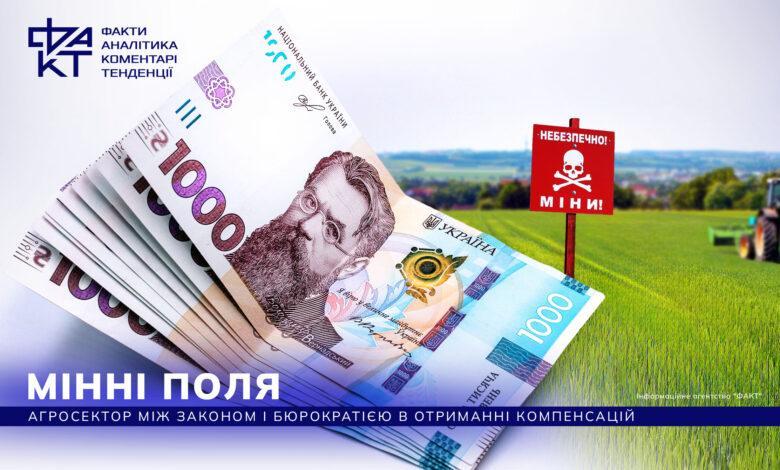
After the fighting and occupation in the east and south of Ukraine, a large part of the agricultural land turned out to be unfit for cultivation. The reason is mass mining, which covered not only the zones of direct combat operations, but also logistical routes and fields, which for decades were used for sowing grain, technical and fodder crops. Thousands of hectares of land remain unsafe for work, while farmers face problems of legal uncertainty and difficulties in the work of state registers. Compensations for destroyed crops, destroyed machinery or mined land are promised by the state, but in most cases do not work. Despite international support and the initiative of local communities, the problem is exacerbated by bureaucratic obstacles, a lack of specialists and technical resources.
State program under the pressure of reality
Ukraine is currently dealing with an unprecedented scale of agricultural land pollution. According to international organizations, hundreds of thousands of hectares remain contaminated, mainly in the Kherson, Mykolaiv, Kharkiv, Zaporizhia and Chernihiv regions. Demining such areas requires huge financial costs, specialized equipment, professional operators and considerable time. At the same time, farmers are unable to cultivate their land, losing income, and the government misses out on potential billions of dollars in export revenue. In such a situation, the process of humanitarian demining becomes not only a matter of security, but also a critical condition for food self-sufficiency and macroeconomic stability.
The compensation program officially started in September 2024 after a nine-month technical training phase. Since then, its mechanisms have been constantly improved in coordination with the Center for Humanitarian Demining and mine action operators. The Ministry of Economy has launched a communication campaign and launched a specialized web resource that should facilitate access to information for farmers. Current instructions, an algorithm for checking compliance and submitting an application through the State Agrarian Register are collected here.
However, even taking into account the technical simplification, the rate of participation of agricultural producers remains low. According to government officials, farmers are mainly focused on spring field work, which reduces their activity in preparing documents for participation in the program. In addition, there is also a psychological barrier, due to which the program is perceived as difficult and time-consuming, which discourages small farms.
Against this background, the activity on the market of demining operators nevertheless increased. In the first half of 2025, 65 public procurements were conducted, as a result of which contracts were concluded for the amount of UAH 835 million. In comparison, in 2024, contracts with service providers were concluded much more slowly: less than 20 tenders, and the total volume of deals then did not exceed 300 million. It is also worth noting that in 2024, only 8 out of 85 accredited companies participated in the bidding, while in 2025 there were already 20 of them.
General financing compensation program in 2025 is UAH 3 billion. It can potentially reach a much larger number of applicants. At the moment, 426 applications for demining more than 14,000 hectares of agricultural land have already been submitted. Compared to previous years, the progress is obvious: from 2022 to 2024, it was possible to clear about 3 thousand hectares. Experts point out that further increasing the pace of demining will make it possible to significantly speed up the recovery of agricultural production, especially in critically affected regions such as Kherson, Mykolaiv and Kharkiv regions.
Involvement of farmers in the program is one of the main factors on which the effectiveness of the implementation of this initiative depends. So far, the level of rejection of applications indicates a deep need for information, support and methodical support. Officials promise to expand the program to other types of land and improve mechanisms for working with communities in the coming months. The success of this initiative will be decisive for the agricultural sector, which will continue to be key for the Ukrainian economy.
For information According to the Ministry of Agrarian Policy, as of the beginning of 2025, 264,000 hectares of agricultural land in Ukraine have already been cleared of explosives. This is definitely progress, but the scale of pollution remains colossal. There are currently 73 accredited mine action operators working on the market. And while that number has grown, demand for their services consistently exceeds capacity.
The Center for Humanitarian Demining, which coordinates most of the processes within the framework of the state program, concluded 50 contracts with operators until February 2025 alone. They covered a little more than 9 thousand hectares. From the formal side, everything looks the same: participants are chosen at auctions through Prozorro, there must be at least two participants, the procedure involves checking documents, concluding contracts and compensating expenses. But it is here, in the bureaucratic chain, that a dead end most often occurs.
Paper barriers: how formal errors stop the recovery of agricultural production
Despite technical readiness and financial support, farmers “drop out” of the process en masse. Of the 225 applications submitted by agricultural producers since the beginning of 2025, almost 189 were rejected due to formal errors or non-compliance with basic requirements. The most common reason was the absence of a non-technical land survey or the submission of applications for plots that are not covered by the program. This indicates a weak understanding of the conditions of participation among farmers and a lack of adequate informational support on the ground.
The reasons lie in a banal misunderstanding of the rules. Many do not have documentary evidence of land contamination, and some simply do not have time to complete an application during field work. In order to improve the situation at least a little, in September 2024 the Cabinet of Ministers increased the amount of compensation for demining from 80% to full coverage of the cost of services. At the same time, the restriction that previously prevented farmers with tax debts from participating was removed. From now on, farmers cultivating both their own and leased plots of land can participate in the program, provided that they are located in the de-occupied territories. However, there are a number of exceptions: enterprises related to citizens of the aggressor state, under sanctions or in bankruptcy proceedings, do not participate.
According to the registration procedure, the agriculturist must submit an application through the State Agrarian Register, open an account in a state bank (currently PrivatBank or Oshchadbank), and after confirmation of the application by the Center for Humanitarian Demining, wait for the announcement of the auction on Prozorro. If the application is accompanied by all the appropriate documents, and demining has already been carried out, then compensation can be received even retroactively, that is, for the period from February 24, 2022 to April 15, 2024. To do this, you need to prepare and send to the official address of the Center ([email protected]) a complete package of documents, in particular:
- contract with a certified demining operator;
- acts of completed works;
- confirmation of payment.
After the Center checks the application and passes the auction, the farmer receives 80% of the cost of the work at his expense. The rest will come after the procedures are fully completed and all stages are approved. The government also plans to expand the participation of banks in the program so that farmers have more choice and convenience in financial transactions. Despite all the organization of the procedure, in order for demined hectares to really become cultivated, precise interaction between the farmer and the state is also needed, which Ukraine still lacks.
How the world managed to bring mined fields back to life
World practice proves that post-war demining of agricultural lands depends not only on explosives technicians in armor and sapper work in the field. It’s also about trust, coordination, technical savvy and human contact. Consider how other countries that have survived armed conflicts have built their field clearing systems.
After the end of the war in the 1990s, Croatia approached demining with cold precision. There they created a centralized structure that coordinated the work of state bodies, local communities, businesses and international donors. The most effective tool was the mine hazard map (an open, constantly updated resource where farmers could see the status of their plots – ed.). Thanks to a clear system, farmers were not left alone with the problem. The state timely informed, consulted and accompanied them at every stage.
The Cambodian approach resembled emergency aid for farmers. Specialized mobile humanitarian demining teams independently went to villages, initiated checks and surveys, without waiting for formal appeals from landowners. This proactive approach has proven to be effective in regions where access to the Internet or government services is limited, and the level of literacy is low. People were simply given help without unnecessary barriers.
After the escalation of the conflict in Nagorno-Karabakh, Azerbaijan completely centralized the demining process. A state agency was created, which not only financed all the works, but also provided farmers with full support: from registering an application to concluding a contract with an executor. Support offices appeared in the regions, where you could contact directly. This model ensured a quick start of demining and allowed farmers to return to work without financial and logistical complications.
It is interesting that although all these countries chose different approaches, they were all united by the understanding that without an active role of the state, simple communication and partnership with local communities, the return to life of agrarian lands does not happen. Ukraine, too, should adapt these tools to its own context, maintaining flexibility, but not losing systematicity.
Ways to overcome the problem: how to turn a minefield into an arable one
It is quite clear that in order to overcome the problem of mined agricultural lands, it is necessary to launch a system that works not on paper, but in real life. For the compensation program to become a truly effective tool, a change in approach is needed at all levels. Currently, the farmer is often left alone with dozens of pages of instructions, technical terms and unclear conditions.
Regional advisory centers, which work according to the principle of a “hot line”, where they often do not provide help, but give vague and not always clear answers, should start cooperating with farmers. In this case, it is necessary to start providing assistance to the farmer not only with answers, but also with support from the first filled-in field in the application to the final transfer of compensation to the account. The participation of agricultural associations and local communities will make this process humane and understandable.
It is fair to say that local authorities often know better where it is dangerous to plow than central institutions. Therefore, it is logical to transfer part of the demining functions to the community level. With appropriate funds and powers, territorial communities will be able to independently form demining order, coordinate applications and interact with operators. It is not only faster, but also more effective, because it is closer to reality.
As we can see in practice, when it comes to compensation, farmers face financial barriers: a limited list of banks, complex requirements for opening accounts and slow processing of documents. If a wider range of banking institutions are included in the program, standard templates for farmers are created, and a fast document flow is established, this will avoid delays and make the financial part of the program understandable and convenient. It is obvious that the proposed steps are able to move the problem from a standstill and return Ukrainian farming confidence in the future and the opportunity to fully work on the land, and not be afraid of it.