From Guardian to Warrior: International Women’s Day as a Litmus Test of Public Sentiment in Ukraine

Today the world community celebrates International Women’s Day. The eighth of March in Ukraine is a date that resembles a litmus test of public attitudes that change under the influence of historical circumstances, political trends and worldview shifts. For some, it is a day of struggle for women’s rights, a historical milestone on the way to gender equality. For others, it is a vestige of the Soviet past, a holiday imposed from outside that does not correspond to Ukrainian national traditions. And someone continues to congratulate women and perceive it as “a day of spring, beauty and femininity.” So what is March 8 today: a real holiday, a political symbol or an occasion for new discussions?
The history of March 8: from protests to recognition:
Today, March 8 is perceived by many as a day of greeting women, compliments, flowers and gifts. But behind this holiday there is a dramatic story of struggle, loud protests and revolutionary changes. A story that began with advocating for equality and evolved into a day of women’s solidarity. At the turn of the 19th and 20th centuries, socialist movements were actively unfolding in the world, demanding better working conditions, shorter working hours, higher wages and general equality between social classes. The issue was especially acute for women, because they often worked in grueling conditions for significantly less pay than men.
One of the key events that started the tradition of March 8 took place in New York in 1908. Thousands of textile industry workers took to the streets demanding better working conditions and women’s suffrage. It was an unprecedented action that attracted public attention and became the first step towards international recognition of the problem of discrimination based on sex.
In 1910, the Second International Socialist Women’s Conference was held in Copenhagen, at which the German feminist Clara Zetkin proposed the establishment of International Women’s Day. It was supposed to be celebrated annually to draw attention to women’s rights and the fight for equality. The date of the holiday had not yet been determined, but the idea itself found support in European socialist circles. Already in 1911, March 8 was officially celebrated for the first time in several European countries – Austria, Germany, Switzerland and Denmark. However, this day was not yet widespread, and only over time gained global significance.
The February Revolution of 1917 in the Russian Empire was a turning point for cementing this date in history. It was on March 8 (according to the Gregorian calendar) that a large-scale strike by textile industry workers took place in Petrograd, which turned into mass demonstrations that became one of the catalysts of the revolutionary events. Tsar Nicholas II eventually abdicated under the influence of this strike.
It was after this that the communist regimes began to widely use March 8 as a day that symbolized not only the struggle for women’s rights, but also the support of socialist ideals. By the way, in the 20th and 21st centuries, March 8 corresponds to February 23 according to the Julian calendar in non-leap years and February 24 in leap years.
In the Soviet Union, March 8 acquired official status and became a public holiday. But over time, its original revolutionary meaning gradually faded, instead the holiday began to be associated with “the day of femininity and beauty.” Women were given flowers, poems were read about their tenderness, but few people remembered the equal rights that were at the beginning of this movement. Thus, March 8 in the Soviet consciousness lost its political color and turned into a day when men traditionally congratulate women.
In 1977, the United Nations officially recognized March 8 as International Women’s Day, emphasizing its importance as a symbol of the struggle for women’s rights and equality in society. Since then, this day has become even more global and is celebrated in many countries of the world.
In the 21st century, March 8 is gradually returning to its original meaning. In many countries, it is not just a holiday, but a day when activists remind about wage inequality, the problem of domestic violence, discrimination at work and the need for full gender balance in society. Modern feminist movements use this day for protest actions, lectures, forums and discussions that draw attention to current issues of women’s rights in different parts of the world. In some countries, such as Spain and Italy, mass women’s strikes are even held on March 8, calling on society to recognize their contribution to all areas of life.
In Ukraine, the history of March 8 also underwent a transformation. During the Soviet period, the holiday was a public holiday and was considered a day when women were traditionally greeted with spring, but the real problems of gender inequality were not mentioned. However, today this date has become the subject of public debate. On the one hand, many Ukrainians support the idea of preserving March 8 as an international day of struggle for women’s rights. On the other hand, some political forces advocate its abolition due to the Soviet past and propose to replace it with Ukrainian Women’s Day, for example, on February 25, the birthday of Lesya Ukrainka.
Despite the differences in opinion, one thing remains the same: March 8 continues to be a day when issues of equality and women’s rights remain at the center of public attention. And this is the main reason why this date has not lost its significance for more than a century.
Outstanding women of Ukraine and the world
History knows many women who not only changed the world, but also changed the idea of human possibilities. Their achievements are not just a personal victory, but breakthroughs that became the basis for the further development of humanity. From science and medicine to politics, sports and art – in every field there are women who have overcome circumstances, societal prejudices and set new standards.
Back in the days of Kyivan Rus, Princess Olga played a key role in state affairs. After the death of her husband, she became the first female ruler of Kievan Rus, reformed the state management system and initiated the first diplomatic relations with Byzantium.
Despite the fact that politics remained a male sphere for a long time, many women managed not only to enter it, but also to leave a deep mark. Margaret Thatcher, the first female prime minister of Great Britain, was nicknamed the “Iron Lady” for her tough economic policy and decisiveness in foreign affairs. Ukrainian history also knows women who became prominent political figures. Yes, Olena Teliga was not a politician in the classical sense, but during the Second World War she headed the Union of Ukrainian Writers and openly opposed totalitarian regimes, for which she died in Babi Yar.
Among the modern figures, one cannot fail to mention Slava Stetsko, who was one of the leaders of the Ukrainian liberation movement, fought for the independence of Ukraine and headed the Congress of Ukrainian Nationalists. Her struggle for a free Ukraine became part of history.
Marie Sklodowska-Curie became the first woman to receive the Nobel Prize, and the only person in history who was awarded this award twice in different fields of science. Her discovery of radioactivity gave mankind new knowledge about the nature of matter and laid the foundation for further research in physics, chemistry and medicine, which contributed to the advent of radiography and the treatment of cancer.
Another outstanding female scientist is Rosalind Franklin. She made a key contribution to the discovery of the structure of DNA, which became a fundamental breakthrough in biology, although her merits were not recognized for a long time.
Ukrainian scientist – Candidate of Physical and Mathematical Sciences and Doctor of Natural Sciences Maryna Vyazovska – is the second woman (after Maryam Mirzakhani) to win the Fields Prize, which is equivalent to the Nobel Prize in mathematics. The scientist received it for an elegant solution to part of Hilbert’s 18th problem — the problem of packing spheres in 8-dimensional space. She solved a problem that scientists considered unsolvable for more than 400 years.
Another prominent figure is Kateryna Yushchenko, who became the world’s first woman – the developer of the high-level programming language “Address Language” by starting the first school of theoretical programming. Its algorithms became the basis for the further development of computer technologies, and thanks to this language, the dependence on the location of the program in memory disappeared.
In medicine and biology, Barbara McClintock made an important contribution by discovering mobile genetic elements (transposons), which changed the idea of heredity. Her discoveries laid the foundation of modern genetics. Olga Bogomolets, one of the most famous doctors, dermatologist and public figure, who was engaged in health care reform and preservation of cultural heritage of Ukraine, also made an important contribution to medicine.
One of the most outstanding figures of Ukrainian literature is Lesya Ukrainka. Her works are not only marked by high artistic skill, but also imbued with the ideas of the struggle for independence, equality and women’s rights. Her dramas and poetry are still relevant today. Another extraordinary writer was Olga Kobylyanska, who promoted feminist ideas in her works. She raised the issues of women’s freedom, equality and education, which was extremely progressive for her time.
Solomiya Krushelnytska, whose voice conquered the most famous stages of Europe and America, received world recognition in opera. She was one of the best singers of her time and saved the opera “Madame Butterfly” from oblivion by playing the title role after a failed premiere. An equally important contribution to culture was made by Frida Kahlo, an artist who conveyed pain, love and suffering through her work. She became a symbol of women’s emancipation and the struggle for women’s rights in art.
Among Ukrainian athletes, Larisa Latynina is a prominent gymnast, a legendary gymnast who won 18 Olympic medals, setting a record that lasted almost half a century. Her achievements are still one of the greatest in the history of Olympic sports. And in boxing, Marina Moroz gained world fame, who became the first Ukrainian woman to compete in the UFC, the most prestigious mixed martial arts league. She demonstrated that Ukrainian women can achieve success even in traditionally “male” sports. In tennis, it is impossible not to mention Serena Williams, who not only won 23 Grand Slam titles, but also changed the perception of women’s tennis, making it more dynamic and spectacular.
One of the most influential philanthropists of Ukraine was Oleksandra Avdeeva, who founded a school for blind children and was involved in the development of education and medicine in Ukraine.
And on a global scale, the name of Coco Chanel forever remained in the history of fashion. She broke the standards of women’s clothing, making it comfortable, and created a fashion empire that thrives to this day.
These women are only a small part of those who have proven with their lives: gender cannot be an obstacle to achieving great goals. They blazed a trail that today enables millions of others to continue to change the world. It is important to remember that the contribution of women in all spheres of life is undeniable, although for a long time their achievements remained in the shadows. From science to politics, from art to sports, women change the world every day, and their names are forever etched in history.
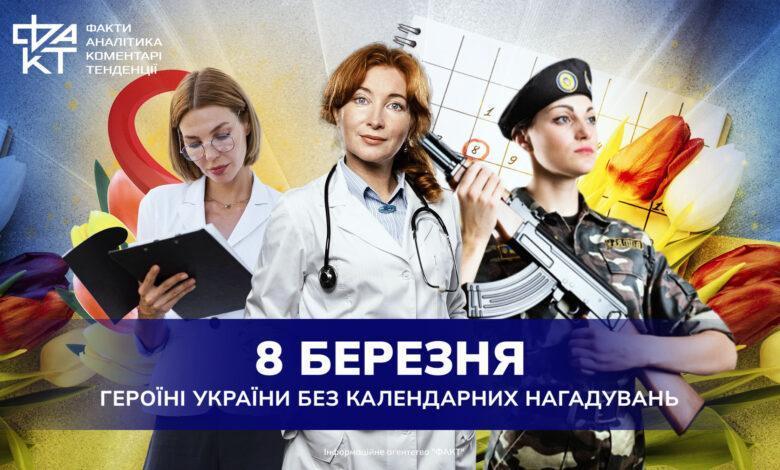
Ukrainian women at war and in the rear
The war in Ukraine has become not only a matter for men, women play an active role at the front and in the rear. The total number of women in the Armed Forces of Ukraine is approximately 68,000. Among them, more than 48,000 are military personnel who serve on an equal footing with men. At the same time, more than 5,000 women are directly in active combat zones, and 6,500 hold leadership positions, making strategic decisions and managing units. They don’t just serve, they fight, heal, teach, operate equipment and save lives. The war brought not only new opportunities, but also great losses. Among the servicewomen there are dead, wounded, those who lost limbs, suffered contusions or severe injuries. Many of them after being wounded return to the army or become volunteers, helping the army.
Women in the Ukrainian army master specialties that were previously considered exclusively male. They serve as navigators, drone operators, gunners, scouts, sappers. They can be found among armored vehicle mechanics, platoon commanders, and tactical medicine instructors. They take part in special operations, liberate occupied territories and work in headquarters where fateful decisions are made. One of the most famous Ukrainian soldiers is Yuliya Paevska (Tyra), a paramedic who saved hundreds of lives in Donbas, and continued her struggle after being captured by Russia. Such women are living symbols of indomitability and strength.
Today, women hold not only the front, but also the rear. They have replaced men in many areas of the economy and industry, working in factories, as drivers, crane operators, in logistics, in energy and utilities. They manage large enterprises, repair cars, manufacture drones, sew military uniforms, weave camouflage nets, and collect funds for the needs of the army. Volunteers organize the supply of ammunition, cars, medicines, bulletproof vests and food. That is, Ukrainian women convincingly proved that war is not only a matter for men. Their courage and endurance became an integral part of the Ukrainian resistance.
Although the celebration of March 8 has recently caused lively discussions, one thing remains unchanged – this day speaks about women and their role in society. And it has long been no longer limited to the cliché about “the shores of the hearth”. Ukrainian women today are not just “strong women”, but people who create, move, break barriers and change the rules of the game. They manage businesses, work in the civil service, law enforcement agencies, science, journalism, education and other fields. But we should not forget that in addition to careers, achievements and social changes, most women also run a household, raise children, and take care of relatives. They often have a double burden – to work on an equal footing with men, and then to lead a daily life, which for some reason is still perceived as “women’s work”.
So, today is the day when it is worth honoring not only beauty, but also strength, intelligence, determination and contribution of women to the history, present and future of mankind. Therefore, men, love and respect your women not only on March 8. Give compliments not only once a year. Help, support, appreciate, indulge – without an excuse, without calendar reminders.
Oksana Ishchenko