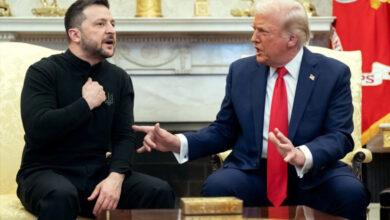
The latest changes in the US policy towards Ukraine, in particular the adoption of the UN Security Council resolution that urges until the end of the war, but does not condemn Russia as an aggressor, became a serious test for Ukrainian diplomacy. Such a move by Washington forces Kyiv to review its foreign policy and look for new ways to win the support of the world.
The situational alliance of the USA, Russia and China: a geopolitical game for the redistribution of influence in Europe
In general, America under Trump’s presidency is trying to push the topic of Russian aggression out of public discussion. Instead, Washington and Moscow are working to restore damaged ties and seek to achieve a political easing of tensions.
At the same time, China almost disappears from the information space, remaining in the shadows. In Beijing limited themselves declarations of support for peaceful settlement and negotiations. This may indicate that China positively evaluates the change in the balance in the relations between the USA and Russia. But for what reasons, if, at first glance, it does not benefit him?
Beijing is not interested in confrontation with the Kremlin. It is important for him save partnership with Moscow and strengthen military-strategic cooperation. The Kremlin wants to create the impression that Beijing fully supports its position on the war in Ukraine, even if the latter is in no hurry to officially admit it.
This is the conclusion did analysts of the Institute for the Study of War (ISW), drawing attention to the differences in the statements of the diplomats of the two countries after the meeting between the head of the Russian Foreign Ministry, Sergey Lavrov, and his Chinese counterpart, Wang Yi, at the G20 summit in South Africa. The Russian side claimed that China sees a solution to the conflict in eliminating its “deep causes”, while Beijing’s official statement indicated that it was Lavrov, not Wang Yi, who spoke about these causes.
As assessed by ISW, this manipulation on the part of Moscow aims to create an impression of unity with China, strengthen its own position on the international arena and influence public opinion in Russia. The Kremlin continues to promote the narrative that the war was the result of a “NATO threat”, thereby justifying its aggression. This is again testifies that Moscow is not interested in finding a compromise, but seeks to dictate its terms to the US and Europe.
The similar positions of Washington, Moscow and Beijing regarding the end of the war in Ukraine testify to the broader intention of this trio regarding the division of Europe. The US seeks to dominate the European market because a strong Europe is against its economic interests. The upcoming trade war with the EU will help them redistribute the market in favor of American corporations.
China wants an end to the war to minimize trade risks with Europe. Beijing demonstrates similar diplomacy in the Middle East, promoting the idea of peace in the conflict between Hamas and Israel. Peace in Ukraine will strengthen China’s position in the region and create conditions for further economic penetration into the Eurozone.
For Russia, the end of the war is necessary to solve internal economic difficulties. Moscow also wants to improve relations with Washington and restore access to the European energy market.
Therefore, the situational rapprochement of the USA, Russia and China is aimed at weakening Europe. The temporary union rests solely on common economic interest, which allows them to put aside their differences for a while and focus on redistributing influence in Europe.
“Divide and Conquer”
However, despite this geopolitical game, the Kremlin continues to expand military operations and strengthen its own positions. ISW draws attention to an investigation by the Financial Times which confirmed, that Russian commanders not only turn a blind eye to the execution of Ukrainian prisoners of war, but can also directly issue relevant orders.
Information also appeared about the joint actions of the Russian military with North Korean units in the Kursk region, which allows the rogue country to gain new combat experience.
In parallel, the Kremlin is increasing the production of glider bombs and modernizing its arsenal of cruise missiles, preparing for a protracted conflict.
Russian Ministry of Defense developed a forecast of the military and political situation until 2045, which foresees the complete destruction of independent Ukraine and the division of its territories between several zones of influence. The document contains four scenarios for the development of global geopolitics, among which the Kremlin would prefer to avoid “hegemony of the West” and “dominance of China.”
Instead, the most profitable options for Moscow are a “multipolar world” or “chaoticization of regions”, which involve victory in the war and the expansion of Russian influence. As part of this scenario, the Kremlin seeks to completely annex Crimea, Donetsk, Luhansk, Zaporizhzhya, and Kherson regions, and turn the central and eastern parts of Ukraine into a puppet “pro-Russian Ukraine” with Russian military bases. The fate of Western Ukraine, according to the Kremlin’s plans, can be discussed with Poland, Hungary and Romania, and the very fact of such discussions will contribute to the weakening of European unity.
The exposure of these strategic plans once again demonstrates that Moscow has not given up its imperial ambitions and continues to build plans to destroy Ukrainian statehood. Using diplomatic manipulation and international pressure, Russia is trying to legitimize its aggressive intentions and consolidate control over the occupied territories.
This is facilitated by Russian propaganda, which works according to a long-tested principle – the creation of a parallel reality in which the Kremlin does not just win, but does so inevitably. This is not just an information campaign. This is a strategy. And if it is not understood, not exposed, not opposed to it, it can have devastating consequences.
Recently, we see how Moscow is trying to impose several main theses on the world. The first is the so-called “tired of Ukraine“. This is a narrative that is actively picked up by some European politicians who are collaborators of the Kremlin, who now pretend that they are not interested in what is happening in our country. However, the reality is different: Ukraine is not a burden for the West. On the contrary, it is the struggle of Ukrainians that prevents Russia from expanding its influence and turning Europe into a field of blackmail.
The second key narrative is the economic crisis. The Kremlin constantly repeats that sanctions against Russia allegedly only harm Europe. However, this thesis is designed for those who do not know how to analyze facts. Because the reality is this: the Russian economy is bursting at the seams, reserves are running out, and even Chinese partners are increasingly wary of Moscow. Yes, European countries had to adapt, but they did not experience the catastrophe that Kremlin strategists had so hoped for.
And, of course, the issue of migration. Russian propaganda depicts Ukrainian refugees as a threat to European society, trying to incite hatred and social tension. But this is also a lie. Ukrainians who were forced to leave their homes proved their hard work, honesty and readiness to integrate into the societies that accepted them. That is why Russian information saboteurs are trying to incite discontent and fear in order to undermine support for Ukraine.
Moscow is playing long. She uses fakes, corrupt politicians, manipulation and fear to get her way. But are we able to understand what is really happening? And are Europeans ready not to fall for this propaganda?
The hesitation of the USA and the challenge for Ukraine: it is time to look for new formats of support
The change in the US position towards Ukraine, manifested in the adoption of a neutral resolution by the UN Security Council without condemning Russia’s aggression, together with the speech of US Vice President JD Vance to the leaders of European countries at the Munich Security Conference, force the Ukrainian authorities to look for support elsewhere.
If America hesitates, now is the time activate cooperation with Europe? It is not only about weapons, but also about joint projects, training, development of the defense industry. Does the change in US rhetoric mean that the world is ready to give in to Moscow? Isn’t it the other way around – it’s a challenge for Kyiv to act more subtly, to look for new formats, to maintain international support? Losing the initiative will only strengthen the Kremlin’s position.
And after all, doesn’t history prove that those who are ready to win fight? Ukraine cannot afford the role of a passive observer. Time to act.
Tetyana Viktorova