
Geopolitics in Ukrainians’ checks: how the conflict in the Middle East is changing modern prices

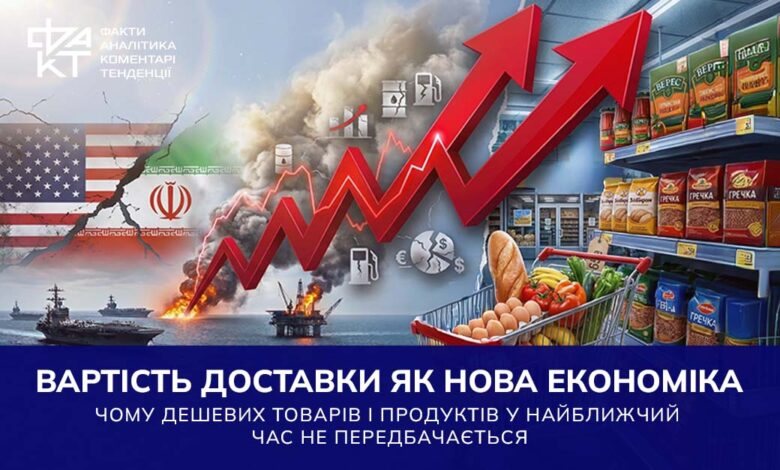
At the beginning of 2026, the geopolitical knot around Iran finally tightened, provoking a price shock that instantly reached the Ukrainian borders. While world exchanges are recording oil at over 140 USD per barrel, domestic gas stations have already reacted with the first “test” price increase. This is only a prelude to a large-scale revision of price lists in all sectors of the economy. The increase in the cost of diesel automatically adds 20–40% additional costs to each delivery of goods. This means that the cost of industrial goods and food products in trade will begin to change due to the cost of their movement. However, the real problem is that the Ukrainian economy, which is looking for ways to stabilize, is once again entering a zone of turbulence, where fuel is becoming the main driver of price increases.
Logistics is getting more expensive — business is raising prices: what the market research showed
The new ratio of fuel supply and demand at the turn of February and March triggered a chain reaction in the Ukrainian corporate sector, forcing businesses to urgently review their survival strategies. A recent study by the European Business Association shows that energy instability has affected two-thirds of enterprises: for 32% of respondents, these changes have become a critical challenge, while 34% assess them as a tangible, but so far manageable burden. A quarter of respondents record only weak echoes of the crisis, and only 9% of companies remain in a kind of vacuum, where the increase in the cost of resources has not yet had time to affect everyday processes.
The main blow fell on the logistics shoulder, as 76% of businesses faced inflated transport budgets, which automatically entailed an increase in the cost of the final product or service for 45% of market participants. In attempts to adapt to new realities, 30% of entrepreneurs have already started adjusting their financial plans, since the dynamics of expenses look disappointing. In particular, 21% of companies note an increase in expenses within 5%, almost a quarter — up to 10%, and for 27% of respondents the financial burden has increased by a significant 10–20%. Only a small share of 4% found themselves in the epicenter of the storm with an increase in costs of more than 20%, while 24% of respondents are still in a state of waiting or have not had time to make final calculations of losses.
Economic pressure inevitably transforms into a change in price tags for the end consumer, creating a domino effect, where every fifth business has already started to actively review prices. Another 37% of companies are keeping their finger on the pulse, considering the possibility of increasing the cost of their offers in the near future, while 40% are trying to maintain price stability, and 3% have not yet formed a clear position.
The margin of safety of Ukrainian enterprises is quite limited, as almost half of those surveyed admit that they will be able to contain inflationary pressure for no more than one or two months. A quarter of respondents expect to survive on internal resources for up to six months, and only 10% have sufficient financial reserves to maintain prices for a longer period, while 17% do not dare to make any forecasts in this unstable coordinate system.
Despite the financial strain, the foundation of the operational stability of most companies remains intact, as 53% of market participants have not recorded systemic failures in their internal cycles. A quarter of companies have encountered minor technical obstacles, and only 8% report deep operational problems that threaten full functioning.
In this situation, the private sector is forming a clear request to state institutions, expecting the introduction of flexible tax instruments and excise holidays during peak fluctuations. Entrepreneurs insist on creating a transparent and understandable market environment, where industries critically dependent on fuel would receive targeted support, which would avoid a large-scale price shock for the entire national economy.
The escalation of tensions over Iran has thus transformed from a purely political standoff into a direct threat to the wallets of millions of travelers, as energy markets have reacted swiftly to the risks in the conflict zone. In the coming weeks, the world could face a sharp jump in airfare prices, driven by the critical vulnerability of fuel supply chains.
The epicenter of global anxiety remains the Strait of Hormuz (a narrow sea artery only 34 km wide – ed.), where the geographical proximity of Iran and Oman turns this space into a strategic “bottleneck” of the global economy. A colossal amount of energy resources passes through this water corridor every day: about 20 million barrels of oil and a fifth of all global liquefied gas, which makes any military activity in this area a detonator for a price explosion.
Unlike the markets for motor gasoline or diesel, the aviation kerosene segment lacks flexibility and the ability to quickly maneuver due to the lack of a practice of instant purchases. As a rule, air carriers rely on long-term stability, but this type of fuel is the most sensitive to the slightest disruptions in supply. The situation is complicated by technological limitations, since jet fuel stocks are traditionally minimal, and its storage requires specialized tanks, which makes it impossible to create large-scale “airbags” in case of a crisis. The Middle East is a key exporter, providing about 1.1 million barrels of jet fuel per day, which actually covers 17% of all world consumption.
The Argus U.S. Index Jet Fuel, which integrates prices from major U.S. hubs such as New York, Chicago, Houston and Los Angeles, has seen a sharp rise to $3.88 per gallon, nearly doubling its previous stable $2. The most shocking reaction came from Singapore, where the price of a barrel of fuel soared 72% to an all-time high of $225.44 amid concerns about a blockade of the Strait of Hormuz.
Global Jet Fuel Market Imbalance: Price Anomalies and Logistical Risks by Region
| Region / Trading Hub | Pre-Crisis Indicator (Baseline) | Current Indicator (Post-Escalation) | Growth Dynamics | Specificity of Impact |
| USA (Argus U.S. Jet Fuel Index) | ~$2.00 per gallon | $3.88 per gallon | +94% | Average of Chicago, Houston, Los Angeles and New York. |
| Singapore (Asian hub) | ~$131 per barrel* | $225.44 per barrel | +72% | Record price due to Asia’s critical dependence on cross-strait supplies. |
| Oceania (Air New Zealand) | $85–90 per barrel | $150–200 per barrel | +76% – 122% | Direct transfer of costs to the cost of tickets and suspension of financial forecasts. |
| Global market (exports from the Middle East) | Stable supplies | Deficit of 1.1 million barrels/day | Risk of loss of 17% of consumption | Impact on long-term contracts and warehouse stocks. |
It is quite clear that even if the conflict de-escalates, prices are unlikely to quickly return to previous values due to the peculiarities of contractual obligations and limited warehouse stocks, which preserves high costs in the chains long-term supply.
Leading industry players, including Qantas Airways and Air New Zealand, have already begun to shift the burden of rising costs onto customers, officially announcing an upward revision of fares. Statistics Air New Zealand clearly demonstrates the scale of the problem, because if before the beginning of the active phase of the conflict a barrel of fuel cost between 85-90 drl, then now this figure fluctuates in the range of 150-200 drl.
Due to such unprecedented fluctuations, carriers are forced not only to increase fees, but also to suspend financial planning, recognizing the impossibility of accurate forecasts for the next year. The final cost of travel now directly depends on how effectively companies have managed to apply effective financial risk management strategies and how long the active confrontation in the Persian Gulf will last.
From fuel to store shelves: how a new wave of product price increases is forming
The Ukrainian economy, which has not yet had time to recover from the February price tsunami, is now forced to take a new blow from the fuel market, which only strengthens the already launched inflationary flywheel. The tectonic shift in the industrial sector began with a rapid rise in the producer price index in February 2026 by 22.3%, which pushed the annual figure to a critical mark of 34.5%. The epicenter of this explosion was energy, where the cost of resources jumped by 53.1% in a matter of weeks, instantly turning the regulatory decisions of the National Commission for the Regulation of Energy and Utilities of Ukraine into an unbearable burden for the real sector. While government structures are trying to label such dynamics as a “short-term technical correction,” business is already forced to choose between a critical squeeze on margins and the inevitable shifting of costs to the consumer.
This impulse has pierced related industries — from coke production (+7.8%) to high-tech electronics (+9.1%), and now, fueled by the increase in the cost of logistics due to fuel prices, it will inevitably reach store shelves. For bakeries, dairy plants, and warehouse chains, the February anti-record has become a tough leading indicator when the rise in production costs, like an underwater wave, is preparing for the final blow to the consumer market.
The situation with the increase in fuel prices is quite telling, because when the price per liter of fuel in the central regions of Ukraine exceeds high levels, it instantly transforms into an additional financial burden for farmers and industrialists, reaching approximately 20–30 dhlr or more than 1,100 UAH per cultivated hectare. As of March 26, the average cost of diesel fuel is 85.04 UAH per liter, 70–75 UAH per liter of A95 gasoline, and prices for automobile gas (LPG) currently fluctuate within 43.99–46.98 UAH/l.
The dynamics of costs in crop production directly depends on the energy intensity of processes, since to cultivate one hectare of land, a farmer needs from 50 to 80 liters of diesel fuel during the season. Although most large and medium-sized farms prudently minimized risks by contracting mineral fertilizers at the beginning of the year at lower prices, small farmers found themselves in a vulnerable position. It is this segment of producers who are forced to purchase resources immediately before the start of field work, which makes their products less competitive due to high cost. At the same time, even such losses are not able to stop sowing, because the sector has already developed immunity to crisis conditions over the past few years.
It is quite clear that the chain reaction from the increase in logistics costs will inevitably reach store shelves, where the vegetable group, meat and milk will be the most sensitive to changes.
In the vegetable segment, prices are forecast to increase by up to 10% due to the critical dependence of transportation costs on fuel prices. Dairy products will increase in price by 6-12% by the end of March, which is stimulated not only by logistics, but also by the activation of exports and the gradual exit of the world market from the stage of overproduction. At the same time, the meat market will retain some inertia, as producers use previously accumulated feed stocks, but the approach of Easter and seasonal growth in demand will allow sellers to raise prices by about 5%.
Food Price Increase Forecast
| Product Category | Price Increase Forecast | Key Factor of Influence |
| Vegetables | up to 10% | Transportation Costs |
| Dairy Products | 6% – 12% | Logistics and Growth exports |
| Meat’yaso | ~ 5% | Fuel costs (through feed) and seasonal demand |
Despite concerns about the impact of global conflicts, in particular events in the Middle East, the Ukrainian agricultural system remains autonomous in terms of providing basic products. The main challenge remains not the ability to grow crops, but the profitability of individual crops, whose profitability is rapidly melting under the pressure of fuel costs. Thus, the Ukrainian consumer will face not empty shelves, but a new price reality, where each truck trip with goods adds weight to the final check by an average of 10%.
As we can see, the inflation of price tags in Ukraine indicates the physical impossibility of businesses to continue paying for logistics with their own margin. The safety margin of enterprises has been exhausted, so the next two to three months will be a period of direct transfer of fuel costs to each check. In turn, products will not disappear from the shelves of grocery stores, but their cost will be determined by the price of a kilometer of delivery. One should also not naively expect that the situation will change in a positive direction, because even with the cessation of the war in the Middle East, the inertia of contracts and logistics chains will “preserve” the high cost of Ukrainian goods for a long time.


