
Gold prices under the influence of geopolitical tensions: how the conflict in the Middle East accelerated the dynamics of spot prices

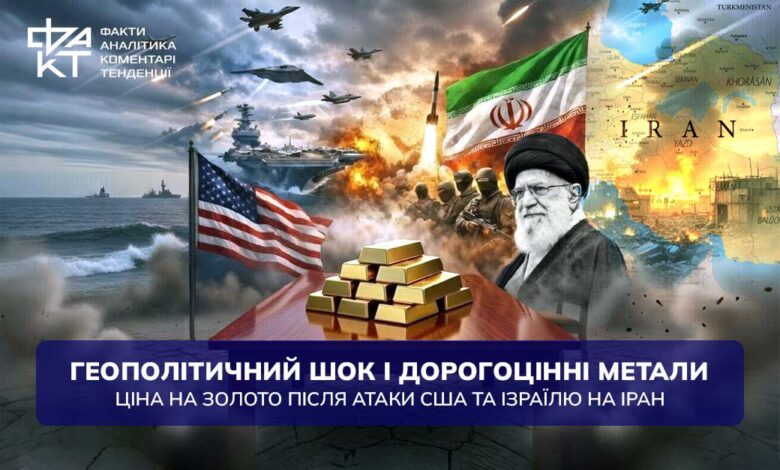
The escalation of conflict in the Middle East following US and Israeli strikes on Iran and the death of Ayatollah Ali Khamenei had an immediate impact on global financial markets. Gold, silver and palladium rose sharply, showing that political upheavals in the region are immediately reflected in the prices of precious metals. History over the past few decades has shown that major geopolitical shocks always create surges in demand for safe-haven assets, forcing investors to reassess risks and seek stability in metals.
Geopolitical Tensions and Precious Metals: Gold Prices After Khamenei’s Death
The escalation of the military conflict in the Middle East, which began after US and Israeli attacks on Iran and led to the death of Ayatollah Ali Khamenei, has demonstrated an extremely close relationship between political events and precious metals prices. On March 2, the spot price of gold reached $5,400 per troy ounce, consolidating a rise that had exceeded 3% last week. At the same time, silver and palladium prices rose, indicating a systemic market reaction to regional shocks and increased demand from both physical investors and financial players.
Silver is showing more aggressive growth compared to other metals, as it combines investment and industrial demand, which makes it particularly sensitive to geopolitical and economic events. After the news of the US and Israeli strikes on Iran, silver prices rose by 1.4–2.1% in one trading session, and as of the morning of March 2, the spot price fluctuates between $92.72–95.55 per ounce. During February, the metal has already grown by 18%, and some analysts predict a possible price movement to $100 per ounce in the event of further escalation of the conflict. It should be noted that a jump in oil prices (Brent to $77) traditionally supports inflationary expectations, which is beneficial for silver.
Palladium reacts more restrainedly than gold or silver, but is also in the “green zone”, demonstrating gradual growth. Metal quotes rose by 0.25-1.4%, and now its price fluctuates within $ 1,790-1,797 per ounce. Although tensions in the Middle East are pushing prices up, some reports indicate a possible short-term correction downward by about 1% due to a general decline in risk sentiment in the market.
Analysis of the events of 2003 allows us to trace a recurring pattern in the reaction of the metal market to major geopolitical conflicts. After the start of the Iraq war, gold rose from $350 to $420 per ounce in six months, silver gained about 12%, while palladium remained stable due to limited industrial demand. The events of 2011 during the Arab revolutions created an even more striking example: within three months the price of gold rose from $1,400 to $1,900 per ounce, silver gained 25%, and palladium – 18%, and such a synchronized reaction of the metals reflected the simultaneous effect of political instability and the region’s dependence on oil resources.
On January 3, 2020, a US missile strike near Baghdad airport killed Iranian general Qasem Soleimani, commander of the IRGC’s Al-Quds special forces unit. The operation was ordered by President Donald Trump, sparking a major escalation between the United States and Iran, which has vowed retaliation. Her analysis shows that the precious metals market reacted immediately to the military action. Gold rose 2.5% in two days, silver 1.8%, and palladium 2%, demonstrating that geopolitical shocks shape short-term financial swings that often turn into long-term trends in the presence of structural uncertainty.
Tensions in international relations, in particular due to the trade policy of the Donald Trump administration, are increasing fears of inflationary pressures and possible currency depreciation. The impact of the conflict in Iran on the current market is determined by several interrelated factors. First, the active purchase of gold by central banks and fears of inflation and currency depreciation create a basic basis for a stable price increase. Second, the massive strikes on Iran and its response with missile strikes have increased psychological tension among investors seeking safe-haven assets, which has increased demand for gold and related metals.
As a result, gold has gained about 25% in price since the beginning of the year, despite a January correction from a record $5,595, and the duration of the monthly increase has reached its maximum values since 1973, when the US military presence and global economic instability were simultaneously active.
The tense and aggressive US foreign policy, combined with the largest military deployment in the region since 2003, contributed to a record increase in metal prices on a global scale. This led to the fact that metal prices showed the longest series of monthly increases since 1973, reflecting not only geopolitical uncertainty, but also the growing demand for strategic resources, which encouraged investors to invest in the metal as a defensive asset. The growth was accompanied by increased market volatility, as any news of military movements or diplomatic steps by Washington was immediately reflected in quotes.
Historical comparative analysis shows that the simultaneous growth of gold, silver and palladium is a typical market reaction to systemic geopolitical shocks. After the conflict between Russia and Georgia in 2008, gold added 5% in three weeks, silver – 3.5%, palladium – 4%, which indicates a coordinated reaction of metals to military instability. Similar patterns were observed during the attacks on oil facilities in Syria in 2013, when gold prices rose by 6% in a month, silver gained 4.8%, and palladium – 5.2%. In all cases, there was a simultaneous active return of speculators and an increase in physical demand, which amplified the effect of the price increase.
The internal logic of the market reaction lies in the interaction of the psychological effect of investors, the structural uncertainty of the region and the actions of central banks. The events of March 2 demonstrated that even individual strikes on strategic targets can create a large-scale effect of risk reassessment. Combined with global economic tensions and inflation fears, this mechanism leads to a simultaneous increase in the prices of gold, silver and palladium, repeating the patterns of past decades.
Thus, the analysis of historical examples and current events allows us to see the patterns that determine the market behavior of precious metals during geopolitical crises. The reaction of gold, silver and palladium is formed through a combination of the psychology of market participants, structural uncertainty in the region, active buying by states and rapid reassessment of risks. Recent events in the Middle East have confirmed that even local shocks can become a catalyst for global risk assessment and stimulate active capital flows into precious metals.
The impact of gold prices on world markets and global prices
There is currently a restriction on physical gold supplies through the trading hub of Dubai, which has become a key node for supplies to Switzerland, Hong Kong and India, directly affecting the global supply of the metal, creating short-term shortages that significantly affect prices. In 2020, when flights were temporarily restricted due to escalation in the Middle East, physical gold quotes in Hong Kong jumped by 2.8% in just three days, while silver and platinum prices added more than 1.5%, demonstrating that logistical disruptions create a synchronous effect on adjacent markets.
Analysis of metal flows shows that the impact of restrictions in Dubai is spreading to global financial centers. London, New York, Zurich and Shanghai are still operating stably, but the concentration of financial flows in these venues is amplifying price fluctuations. For example, in 2013, during attacks on oil facilities in Syria, the temporary blocking of logistics channels through Dubai led to physical gold in Switzerland gaining 3.1% in a week, in Hong Kong – 3.2%, while the spot market in London remained relatively stable. This distribution demonstrates that even partial disruptions in a key logistics hub can cause local price anomalies that are reflected in global markets.
A protracted conflict in the Middle East, which will continue to restrict air travel, could lead to a more systemic shortage of physical metal in consumer countries. India, which imports more than 800 tons of gold annually, and China, which accounts for about 20% of global consumption, could experience a shortage of physical metal. This will not only increase local prices, but also affect freight and insurance premiums. It is worth recalling that in 2008, after the temporary closure of ports in Dubai, gold shipments to India increased in price by 4–5%, and spot prices rose by 2.8% within two weeks, demonstrating the direct economic impact of logistics disruptions.
Global commodity markets and stock indices react to the supply constraints of gold due to changes in risk appetite. After the increase in quotes in March 2026, JPMorgan analysts noted a temporary reallocation of capital from stock indices to protective assets, which was reflected in the fall of the Nasdaq and S&P 500 by 1.2–1.5% in the first days after the disruptions were reported. A similar situation was repeated in 2011 during the Arab revolutions, when physical demand for gold increased by 25–30%, while US and European stock indices lost about 7–10%, highlighting the relationship between metal shortages, higher prices and risk for stocks.
It should be noted that the spread of influence to the raw materials and energy markets is manifested through mechanisms of capital requalification. The increase in gold prices stimulates the growth of risk premiums in the oil and gas sector: in 2013, after logistical disruptions, Brent added 7% in a month, and physical gold in London and Hong Kong rose by 5–6%. The current escalation demonstrates similar effects: supply constraints and increased demand for physical metal are putting pressure on energy and commodity markets.
Thus, restrictions on physical gold supplies due to military actions and logistical disruptions, regardless of Dubai, form a complex chain of influence: local shortages of metal increase prices physically, spot quotes reflect the psychological effect, and stock, currency and commodity markets adjust portfolios for the risks of shortages and increased volatility.
The escalation of the conflict in the Middle East on March 2, 2026 confirmed the systemic connection between geopolitical events and the precious metals market. Gold, silver and palladium instantly reacted to strikes on Iran, demonstrating that even local military actions can cause global price fluctuations. Historical examples from 2003–2020 show a recurring pattern: major conflicts generate simultaneous price increases, reinforced by physical supply constraints and active central bank actions.
Even short-term logistical shocks can be transmitted to global financial markets and affect economic indicators in consumer countries. For the market, this means that metal prices continue to be sensitive to regional crises, and short-term shocks can turn into long-term trends, forming the basis for strategic decisions by investors and government regulators.


