Legal advice

How to file a claim with the International Registry of Damages for Damaged or Destroyed Property: Explanations from Lawyers

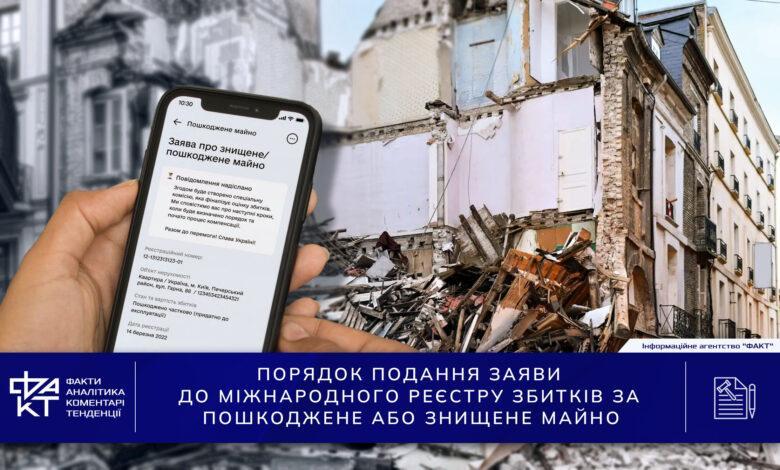
Since the start of the full-scale invasion, Ukrainian property owners — both residential and commercial — have faced extensive destruction caused by Russian shelling. The International Register of Damages Caused by the Russian Federation’s War Against Ukraine has begun accepting applications for damage or destruction of non-residential real estate. These are offices, warehouses, shops, production facilities, cafes and other commercial or administrative premises damaged by shelling, rocket attacks or hostilities.

The lawyers of the “Repeshko and Partners” Bar Association explained how and who has the right to submit a statement, how to prove the fact of damage, what documents need to be collected and what to pay special attention to when filling out the electronic form.

Indeed, the International War Damage Registry has begun accepting claims for damage or destruction of non-residential real property. This Register was created by Ukraine, the EU and 42 other countries. The headquarters of the Register is located in The Hague  We would like to remind you that currently Ukraine compensates owners exclusively for the cost of destroyed or damaged residential real estate. But already now, natural persons – owners of real estate that was not used for residence, including parking spaces, office, warehouse, commercial premises, garages and other non-residential real estate, can submit an application to the International Register of Losses with a view to the future. This application falls under category A3.2 – Damage or destruction of non-residential real estate.

Individual owners have the right to apply for compensation for non-residential real estate destroyed or damaged after February 24, 2022.  To submit an application to the International Register of Damages, a citizen needs to register or log in to the account on the portal diia.gov.ua using an electronic digital signature. After choosing the appropriate category in the damage register – A3.2 – Damage or destruction of non-residential real estate, fill out the application. In the future, you need to confirm the filled-in data or add information about: type of object, ownership, circumstances of damage, evidence of damage and cost of damage, amount of compensation. The final step will be signing the documents with an electronic signature and sending them.

The system will check the application and enter it into the Register. It should be noted that the submission of the mentioned application is not about the compensation received tomorrow, it is work for the future. Currently, only the collection of relevant information about the damaged real estate is ongoing. In the future, after the development of the compensation mechanism, the accepted application and the evidence for it will be submitted to the future application review commission for consideration of the merits and a decision on the payment of compensation.

The compensation commission, to which the submitted documents will be transferred in the future, has not yet been created, its creation is ongoing. It is this commission that will continue to consider your documents on the merits and decide on the amount of compensation. The status of the application and a notification about the progress of the review will be sent to the citizen’s office in the “Pay attention and to e-mail” section.

We note that the right to submit the specified application to the Register is available to full-time owners and co-owners of non-residential real estate. That is, the application can be submitted from the age of 18 or from the age of 16, if you have full legal capacity and can prove it. In the near future, it will also be possible to apply for children, but this function is currently not available. We would like to draw your attention – if the real estate object has several co-owners, each of the co-owners must submit an application separately.

It should be noted that an application to the Register can be submitted regardless of where the real estate is located – even in the case of temporarily occupied territories and in the zone of active hostilities.

What exactly should be included in the statement of evidence? In support of the application, it is necessary to provide all the evidence and information: any documents, records, statements, photographs or other materials that are available and that you consider necessary. This will help the Register in processing, considering the application and making a decision on submitting the application to the Register of Losses.

See also  Latest innovations in military legislation: lawyers' explanations

Such evidence can be the following documents, which:

  • confirm the fact of damages;
  • confirm the amount of damages;
  • confirm the event that caused the destruction;
  • confirm real estate prices;
  • confirm the amount of costs for the repair of the object: contracts, acts of completed works or receipts from the company that performed the repair; receipts confirming the purchase of the necessary materials, together with photos of the completed repair. If you performed the repair yourself, you should add photos or videos of the repair; written statements of neighbors, representatives or managers of local ZEKs, management companies or other persons who can confirm the fact of repair;
  • confirm the presence of another citizenship (if you have more than one citizenship).

If you belong to one of the “privileged” categories (for example, military, medic, critical infrastructure worker, etc.), you must also provide a document that confirms this – service cards, employment contracts, orders, etc. Also, if necessary, you can add your comment to all documents. At the same time, you should know that the documents in the files must be in PNG, JPG, HEIC formats. The file size must not exceed 5 MB.

In addition, it should be borne in mind that in this service Diya acts only as a technical administrator who provides a convenient platform for submitting an application. Property data is contained in the State Register of Real Property Rights. Therefore, it may happen that incorrect data about the owner or real estate is added to the application. In this case, you need to contact the Administrative Services Center directly to correct the incorrect data. If you tried to register your property right, but you were refused registration, then you must specify this information in the application to the Register of Losses with an appropriate explanation of why you were refused registration and provide relevant documents that confirm the attempt to carry out state registration of real estate.

If the property is not registered in the State Register of Property Rights, the following documents should be added when filling out the application:

  • an application for registration in the State Register of Property Rights to immovable property;
  • decision to refuse registration;
  • a document confirming the acquisition of ownership of the object, which was submitted together with the application for registration;
  • court decision on recognition of property ownership;
  • title documents registered before the State Register of Property Rights to Real Estate of Ukraine began to operate;
  • a certificate of the right to inheritance, a contract of sale, gift or gift;
  • extracts from the State Register of Deeds, provided by a notary;
  • a certificate of ownership or documents from local technical inventory bureaus;
  • technical passports of real estate objects;
  • documents from local authorities confirming ownership;
  • tax reporting documents;
  • written statements of neighbors, representatives or managers of local ZEKs, management companies or other persons who can confirm ownership.

The given list of possible evidence is not exhaustive.

Each co-owner can file a separate claim for damages, this process does not require any consent from the other co-owners. Future reimbursement will be proportionate to your ownership interest. However, the platform may attract the wrong number of property owners. This is due to the fact that when submitting an application, all records of co-owners of the property are displayed, including inactive ones (for example, a record of the previous owner). At the same time, this application block is only informative, so you can submit an application with this information. The main thing is to correctly fill out and submit the relevant documents about yourself.

Regarding the amount of compensation if the property has several co-owners. Since each co-owner can file a claim for reparations separately, you need to indicate the amount of compensation you want to receive for your part of the property.

Please note that you can submit an application regardless of whether you have already received compensation under the isRecovery program or not. If the property is located in the temporarily occupied territory and you do not have a certificate of damage to the property, you also have the right to submit an application.

See also  The Ministry of Education and Science of Ukraine has again taken up the task of updating the regulations on the certification of pedagogical workers, justifying this step by the need to improve the mechanisms of teacher evaluation. However, despite the promises to improve the educational process, the innovation raises doubts and concerns among many teachers. The impression is that instead of real support and development of the teaching staff, the new certification may become an additional tool of pressure on teachers. Are teachers ready for the new conditions? Will the new rules really contribute to improving the quality of education, or is this another bureaucratic requirement that focuses on formalities, ignoring the essence of pedagogical work? What's new in the regulation on certification of teachers The Ministry of Education and Science of Ukraine has updated the Regulation on Attestation of Pedagogical Employees (Order of the Ministry of Education and Science of Ukraine from 09.09.2022 No. 805, as amended by the Order from 10.09.2024 No. 1277) in order, according to the officials themselves, to improve the mechanism of teacher evaluation. According to the new order, the following changes were made to the regulation: regulated the issue of awarding pedagogical titles and qualification categories to teachers who do not have higher education; It has been determined that teachers who transfer to other educational institutions to work in the same positions or interrupt their work shall retain their pedagogical titles and qualification categories until the next attestation’. The procedure for the establishment of attestation commissions has been improved and the list of entities that may establish them has been defined. In particular, the possibility of establishing attestation commissions by private educational institutions and/or their founders has been envisaged; The awarding of the pedagogical titles ‘senior teacher’, ‘senior teacher’ and ‘senior educator’ has been regulated. They are awarded to teachers who, based on the results of previous attestation, have been assigned (confirmed) a qualification category not lower than ‘second category specialist’ (or the corresponding tariff category has been established) and whose work experience is more than 3 years; the assignment of such pedagogical titles is standardised: ‘teacher-methodist’, ‘teacher-methodist’, ‘educator-methodist’, ‘teacher-organiser-methodist’, ‘practical psychologist-methodist’, ‘circle leader-methodist’, ‘senior counselor-methodist’. They are assigned to teachers who work in the relevant positions and who, according to the results of previous attestation, have a qualification category not lower than ‘specialist of the highest category’ (or the corresponding tariff category is set), higher education and more than 5 years of work experience; It has been determined that level I attestation commissions may be established in educational institutions and separate structural subdivisions with at least 15 pedagogical staff; The issue of attestation of pedagogical workers who have a workload in several academic subjects has been regulated. In addition, not only taking professional development courses, but also receiving education in an institution of higher, professional pre-university education for the next 5 years will be counted as professional development. Also from now on, in case of teaching several subjects, teachers independently choose the sequence of professional development within the total volume of professional development (150 hours or 30 ECTS credits). Also according to the new order, after the certification sheet on the decision of the commission is issued, the head of the educational institution must issue a corresponding order, which is a document confirming the assignment of a qualification category or pedagogical title to a teacher. According to the Ministry of Education and Science, more detailed requirements for teachers' professional activities have now been established, which allows for an objective assessment of their work. teachers are obliged to take regular professional development courses and participate in professional seminars, which contributes to their professional development. the success of students has become an important indicator of the effectiveness of a teacher's work, encouraging teachers to improve teaching methods. more autonomy has also been granted to local attestation commissions, which allows them to take into account the region of the country. What teachers think about the renewal of attestation In turn, teachers themselves note the growth of bureaucratic procedures and the need to spend more time on preparation for such attestation. Indeed, the updated requirements for teachers are becoming more and more stringent every year. Teachers are forced to fulfil a lot of new criteria, submit a lot of documents and undergo complicated inspection procedures. But are these requirements justified? In most cases, they turn into additional bureaucracy that has nothing to do with improving the quality of teaching. On the contrary, teachers spend more and more time on reports rather than on the real development of their students. Here are a few comments indicative of the general mood of educators. "The problem is that the heads of the MES have no profile pedagogical education and none of them has worked in a regular school. That is, the object of management for them is terra incognito. So what adequate management decisions do you want from them?’, - Ihor Likarchuk, former head of the Ukrainian Centre for Education Quality Assessment, commented on the situation. Victoria Kudinova, teacher, Facebook user: ‘And maybe teachers should test the MES, we will also prepare a programme, and a quest 24/7 arrange, and lastly we will certify...’ Yarema Romaniuk, teacher, Facebook user: "Every year they change something. Apparently, the clerks from the Ministry have to show their ‘vigorous’ activity?" Teacher, Facebook user: "Thank you very much. The peddlers of the director and pedagogical councils recognise the courses or not. And people pay money and pass. This is really done for people!" Larisa Kotlyarenko, Facebook user: ‘The only + that can become and - it is the awarding of the highest category and titles in their own collective.’ However, the most painful remains another thing - despite the new requirements, the attitude to the teacher as a key figure of society has not changed. The teaching profession, which should be one of the most prestigious in the country, is still undervalued. Teachers, who are expected to deliver high results and innovative approaches to their work, continue to receive meagre salaries, often lacking even the basic resources for quality teaching. With conditions like these, it is not surprising that more and more teachers are leaving the profession. Miserable salaries, constant demands, and lack of support from the authorities - all of this makes even the most dedicated teachers consider changing careers. When the state does not value its teachers, it loses not only its personnel but also its future. After all, without competent and motivated teachers, Ukrainian education is sinking into the abyss. The paradox is that the Ministry of Education and Science constantly puts forward new requirements for the certification of teachers, but who protests the very officials who come up with ridiculous reforms? Have any of them worked in a school under real conditions? Do they realise what they demand from a teacher who, apart from the educational process, still has to solve a bunch of social problems of his students and work without proper support? The main question is: to what extent are the new certification rules really necessary? The MES does not offer concrete solutions on how to improve the working conditions of teachers or increase their motivation. Instead, attestation becomes a kind of test that a teacher has to pass every five years. But instead of supporting and developing specialists, certification turns into an additional stress factor. The new criteria do not take into account the real problems of the educational process: the decreasing number of students in classes, insufficient funding for schools, outdated teaching materials. What will happen to education in such conditions in a few years? If the trend with the outflow of teachers continues, Ukrainian schools will simply have no one to teach our children. Ukrainian education is on the threshold of dangerous changes. If the Ministry of Education and Science does not change its attitude to teachers, and the state does not recognise the importance of decent pay and working conditions for teachers, we risk losing a whole generation of quality specialists. After all, when teachers leave, it is not only empty seats in schools. The future of the country is left without support. It is time to recognise that reforms in education should start not with new requirements, but with care for those who work for children every day. Teachers deserve decent salaries, respect and real support, not another bureaucratic burden. Otherwise, attestation, which is supposed to assess professionalism, will turn into another tool of pressure that will get to those who have not yet broken down. How the process of attestation of pedagogical workers has changed Attestation of teaching staff in Ukraine has a long history, which changed in accordance with the social, political and economic conditions of the country. Over time, the process has been transformed, but its main shortcomings have remained unchanged: increasing demands on teachers without appropriate support and incentives. Let's take a look at how attestation was carried out in the past, what has changed now and how it has affected teachers. In Soviet times, attestation of teaching staff in Ukraine was a formal procedure that was aimed at ensuring that teachers met the requirements of the state education system. Attestation was based on clearly defined standards that had little to do with the actual skills and abilities of teachers. Evaluation was done more to maintain the image of the system than to improve the quality of education. The certification process was fully controlled by the state authorities. Teachers had to undergo compulsory certification at certain intervals. Attestation took place once every five years and teachers received qualification categories that affected their salaries and status in the education system. Although a system of professional development existed, it was more nominal. Most teachers took professional development courses only to fulfil formal requirements. After independence, Ukraine retained many features of the Soviet attestation system but tried to introduce certain changes over time. Until the latest changes, the attestation system remained bureaucratic. As before, attestation was carried out every five years. The main purpose was to confirm teachers' qualification categories. Teachers were evaluated by a special attestation commission, which consisted of school administration, trade union representatives and local education authorities. The assessment was based on teacher's work reports, analyses of lessons attended and documents confirming participation in seminars and professional development courses. Attestation was related to the assignment of qualification categories (specialist, specialist of the second, first and highest categories). A teacher's salary depended on the category. The process remained formal and often did not correspond to the real quality of teachers' work. Bureaucratisation and lack of funding prevented the creation of a real motivation system for teachers. Teachers were often required to report and participate in seminars without real changes in the teaching process. In 2023, the Ministry of Education and Science of Ukraine announced new changes to the Regulation on Attestation of Pedagogical Employees. The changes are aimed at improving the quality of education and simplifying the attestation process, but for many teachers they have become an additional burden. The new requirements have added even more burden to the routine work of teachers. Teachers now have to fulfil a greater number of criteria concerning both professional achievements and the use of modern technologies in teaching. An important component of the new system has been the assessment of pupils' progress. This has caused much discussion, as success depends on many factors that the teacher cannot always influence (social status of the family, material and technical support of the school, etc.). Teachers are now required to take regular refresher courses and participate in professional seminars. While this could be a positive aspect, many teachers note that they are forced to take these courses formally, with no real opportunity to put the knowledge into practice. Attestation commissions now have more autonomy, but this has also led to differences in approaches to attestation in different regions. With the increase in the number of criteria for certification, teachers are under more pressure. Many teachers complain that they have to spend more time preparing for certification than actually teaching. The constant pressure to meet new requirements and ensure high student results leads to stress and emotional burnout. Teachers note that the bureaucratic approach to assessing their work creates additional difficulties instead of support. Despite the new requirements, the financial situation for most teachers has not improved. Salaries remain low and additional responsibilities and requirements are not accompanied by appropriate financial incentives. Due to the increasing workload and lack of adequate conditions, many teachers are leaving the profession. This process only exacerbates the shortage of qualified teachers in Ukrainian schools. It is obvious that despite attempts to update the system of certification of teaching staff in Ukraine, most of the changes do not address the main problems, such as low salaries, insufficient support from the state and excessive bureaucratisation. The state should realise that in order to improve the situation it is necessary not only to introduce new criteria, but also to provide real support for teachers, in particular financial support, and to create conditions for their professional development that would meet modern requirements. Attestation of teaching staff abroad Attestation of teaching staff in foreign countries differs significantly from the Ukrainian system and can serve as an example for the introduction of more effective approaches to the assessment of teachers' professional performance. For example, in Finland, which is known for its high-quality education system, teacher certification is practically absent in the usual sense. In Finland, the emphasis is on teacher training and professional autonomy. Teachers receive a high level of academic training while they are still in higher education, as a master's degree is compulsory. However, teachers regularly participate in continuing education and professional development. At the same time, there is no formal appraisal system, but rather student learning outcomes are assessed. In turn, continuous professional development is voluntary and at the same time strongly encouraged by the state. In the US, teacher certification is regulated at the state level, so systems may vary. In general, however, the process involves: Regular reviews and evaluations. Administrators or head teachers observe lessons and evaluate teaching skills and ability to work with students. Professional development. teachers have the opportunity to take professional development courses. Many states require teachers to obtain certificates or licences to prove their knowledge and skills. Evaluation based on student performance. in some states, student performance on standardised tests is an important part of certification. This is controversial because student performance depends on many factors. Canada uses teacher evaluation systems similar to those in the United States, but with certain features. In some provinces, teachers must undergo regular observations and evaluations at different stages of their careers. For example, novice teachers undergo frequent examinations and supervision to test their ability to handle the classroom. Teachers must also undergo periodic professional development courses. As in the US, student results also affect teacher appraisals. In the UK, teacher certification is done through a system known as OFSTED (Office for Standards in Education), the national regulator of educational quality. Appraisal takes place through supervision and inspections, during which lessons are examined. Supervisors can come to lessons unannounced to assess a teacher's professionalism. Great emphasis is placed on pupils' results, progress and level of knowledge. Teachers are required to participate in professional development programmes and this is also taken into account in the appraisal process. Singapore, one of the countries with the most successful education systems, has introduced a comprehensive system of teacher appraisal and professional development. All teachers are required to undergo stages of regular performance evaluation based on the following criteria: performance evaluation - includes lesson observation, teacher self-assessment and student surveys; learning outcomes - student progress plays an important role; professional development - teachers should participate in continuous professional learning programmes, which are also taken into account in the evaluation. As we can see, foreign teacher appraisal systems show that the effectiveness of appraisal often depends on teachers' professional development, autonomy and support system. In many countries, teachers do not experience excessive pressure of bureaucracy, and the process of evaluation of their work is more aimed at helping them develop professional skills rather than punishing them. So, Ukrainian education is on the edge of the abyss, and the next innovations of the Ministry of Education and Science are only bringing it closer to disaster. The new certification requirements have become an additional burden on teachers who are exhausted by bureaucracy, low salaries and lack of real support. Instead of improving the working conditions of teachers, we see a mass exodus of professionals from a system that exhausts them. The question is, who will stand in front of the classroom tomorrow when today's teachers leave the profession? Unless we stop this process and offer real changes - higher salaries, less bureaucracy, support for professional development - Ukrainian education risks being left without those who create it. Famous personalities have long spoken about what a society without education is like, so it would be useful for officials from the MES to listen to them: "Without education, nations quickly turn into obedient slaves ’ - Jean-Jacques Rousseau. "A society that does not invest in education prepares the ground for its own decline ’ - Heinrich Heine. ‘Without education, society is a mob, easier to manipulate than to develop’- William Dubois. "A people deprived of education is like a man without eyes ’ - Konstantin Ushinsky. "Education is the most powerful weapon that can be used to change the world. Without it, the world will remain in the chains of ignorance.’ - Nelson Mandela. "The darkness of ignorance feeds all forms of evil, and lack of education feeds the darkness ’ - Thomas Jefferson. ‘Without education, society lives for today without building a future for itself ’ - John Dewey. "Education is the guardian of liberty. Without it, society will be confined to a framework of blind obedience ‘ - George Washington.

Regarding commercial real estate. An application for non-residential real estate that was used for commercial purposes can be submitted in this category if the property belonged to an individual. However, such a statement may only relate to the value of real estate or the cost of its repair. If your claim also covers other losses, such as lost profits from damage or destruction, you should also claim in another category, such as A3.5 (loss of private enterprise).

The main question that worries owners of damaged property is when exactly will compensation be paid? Ukraine, together with foreign partners, is currently working on the development of a compensation mechanism. Notifications about all important steps, in particular, about submitting a statement to the Register of Losses and its further consideration by the established compensation commission, will be sent to the citizen’s office in the Attention section and to e-mail. Therefore, receiving compensation currently has an indefinite term and depends on many factors.

If you submitted an application to the Register of Damaged and Destroyed Property of Ukraine (RPZM) and after that the authorities of Ukraine conducted an inspection of such property, this information must be included in the application to the Register of Damages.

We draw special attention to the fact that the right to submit an application to the Register belongs to property owners who were its owners at the time of damage. Those who purchased immovable property after it was damaged do not have the right to submit an application and, accordingly, compensation.

If the owner does not have the geographic coordinates of the immovable non-residential property, it is not necessary to indicate them.

Evidence confirming the fact of damage or destruction of immovable property can be the following:

  • information from the Register of damaged and destroyed property of Ukraine;
  • relevant court decisions;
  • documents from law enforcement and judicial authorities, such as documents of criminal proceedings or statements on the opening of criminal proceedings;
  • extracts from the Unified register of pre-trial investigations;
  • Acts of the State Emergency Service, for example, acts on fire, damage or destruction of property with an indication of the reasons;
  • reports of military administrations;
  • acts of local authorities, including reports on the inspection of property by representatives of city, village or village councils;
  • messages from mass media, including online publications and information channels in messengers;
  • photo and video materials;
  • written statements of neighbors, representatives or managers of local ZEKs, company managers or other persons who can confirm the event.

The provided list of possible evidence that is attached to the application is not exhaustive. For those who are just planning to get an expert assessment of damaged property, it should be noted that there is no approved or exhaustive list of experts for this purpose. The main thing is that such an expert has the appropriate certificates for carrying out evaluation activities.

The following documents can be submitted as additional evidence of the event that caused property damage or destruction:

  • documents or information from state, local, law enforcement or judicial authorities;
  • reports of international organizations or civil society organizations
  • messages from mass media, including online publications and information channels in messengers;
  • written statements of neighbors, local representatives or heads of housing and communal services or other persons who can confirm the event.

We advise you not to delay in submitting an application to the International Register of Losses, even if there is currently no question of payment of compensation. The statement records the fact of loss or damage to the non-residential premises and is an important step in participating in future compensation mechanisms. In advance, prepare documents that confirm the right of ownership, and also carefully collect evidence of damage: photos, videos, inspection reports, certificates from the State Emergency Service or local councils. If you have doubts about the wording or structure of the submitted information, you should seek help from specialists to avoid formal errors that can complicate the further consideration of the application.
 

Leave a Reply

Your email address will not be published. Required fields are marked *

Related Articles

Back to top button