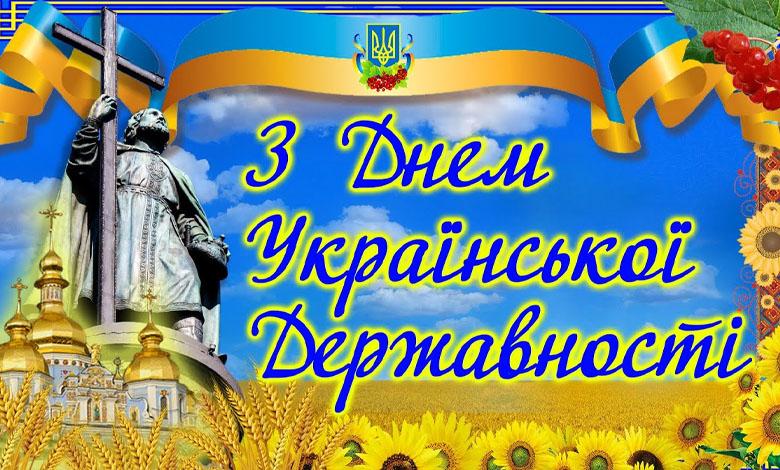
On July 15, Ukraine celebrates two key holidays that shape our national self-awareness — the Day of Ukrainian Statehood and the Day of the Baptism of Kyivan Rus – Ukraine, as well as the Day of Ukrainian Peacekeepers. The world celebrates Charity Day in social media. The events that took place on July 15 in different centuries demonstrate how war and science, religion and culture, technical progress and cinema are intertwined on this day.
Ukrainian statehood day
This is an official state holiday designed to consolidate the continuity of the Ukrainian state tradition from Kyivan Rus to modern independent Ukraine. It was established by the presidential decree of August 24, 2021 as a response to centuries-old attempts to destroy Ukrainian identity and historical subjectivity. The holiday symbolizes the continuity of the state development of Ukraine, starting from the princely era, through the era of the Kozachchyna, the Ukrainian People’s Republic, the Soviet occupation – until independence in 1991.
In 2024, the Verkhovna Rada of Ukraine supported draft law No. 9431, which moved the date of the celebration from July 28 to July 15. This decision is coordinated with the transition of the Orthodox Church of Ukraine to the New Julian calendar and is related to the commemoration of Volodymyr the Great, the prince who established Christianity as the state religion. Thus, the day of Ukrainian statehood is synchronized with the new church calendar and symbolically distanced from the Russian interpretation of the heritage of Kyivan Rus.
Interesting facts
Under Prince Volodymyr the Great, the first coins were minted – “gold coins” and “silver coins”. They had a trident, the same one that is the coat of arms of Ukraine today. It is not just an ornament, but a symbol of state sovereignty as early as the 10th century. Coins were minted in Kyiv, which testifies to the centralized economic system of an independent state long before the appearance of Moscow.
The Muscovy principality did not officially use the term “Rus” until the 15th century. Instead, the inhabitants of the lands of modern Ukraine – Kyiv, Halychyna, and Volhynia – called themselves “Russian”. This is documented in Hungarian, Polish, Byzantine and Lithuanian sources. The name “Russia” appeared only under Peter I in the 18th century.
The Acts of the Central Rada and the Constitution of the Ukrainian People’s Republic clearly stated that Ukraine is the successor to the statehood of Russia, and not a newly created state. At the same time, the scientific works of Ukrainian historians (M. Hrushevskyi) substantiated the continuous line of statehood from Russia through Kozachchyna to the Ukrainian People’s Republic.
From the moment of the baptism of Rus until 1686, the Kyiv Metropolitanate was subordinated to the Patriarchate of Constantinople. The transition to the power of the Moscow Patriarchate took place only at the end of the 17th century — and then as a result of political pressure and an actual corruption agreement. The Ecumenical Patriarch still does not recognize this transfer as legitimate.
In 1929, a number of scientific institutions of the Ukrainian SSR, which interpreted Kyivan Rus as a Ukrainian state, were dissolved. Historians who defended Ukrainian independence from Russia were persecuted, expelled or destroyed. The most famous example is the destruction of Mykhailo Hrushevsky’s school.
The small coat of arms of the Ukrainian People’s Republic (at that time without a blue-yellow shield) was approved on March 22, 1918. The decree clearly states that it originates from the coins of Volodymyr the Great, and is a direct line from Kievan Rus to the new state.
Baptism Day of Kyivan Rus-Ukraine
This day is not just a church date, but an event that determined the course of the history of Eastern European civilization. The baptism of Kyiv Rus is a historical act that changed the status of Rus in the international context. From a pagan federation of tribes, it turned into a state recognized among the Christian countries of Europe. The adoption of Christianity in 988 under the leadership of Prince Volodymyr the Great not only laid the foundations of church tradition, but also contributed to the centralization of power, the development of administration, the emergence of writing, book-writing, schooling, diplomacy, architecture and law.
With baptism, a change in values in society began: the establishment of the idea of the supremacy of the law over personal will, the strengthening of the role of the prince as a secular and sacred leader, the introduction of the institution of marital monogamy, and the regulation of customary law. Baptism united the scattered Slavic tribes into a single political community with a clear ideological basis.
It was also a geopolitical choice: Rus’ joined the Byzantine Christian tradition, not the Latin West. The choice of Constantinople as a spiritual landmark was of strategic importance, determining the vector of development for several more centuries.
Interesting facts
The official baptism took place in Kyiv — in the Pochayna River, a tributary of the Dnieper, which is now almost completely destroyed by construction. This river is mentioned in “The Tale of Timeless Years”. It was there, according to the annals, that the mass baptism of the people of Kyiv took place. Today, Pochaina is partially preserved in the form of a technical channel near Oboloni, its channel is mostly filled in. In the 2010s, attempts to restore it as a historical monument continued.
Archaeological and written sources testify that Christianity penetrated Russia long before 988. Prince Igor’s wife, Princess Olga, was baptized in Constantinople around 955. Christian communities existed in Kyiv already in the 9th century. So, the baptism of Volodymyr became a formal confirmation of the process that had already begun.
After the baptism, Kyivan Rus received a new legal system – the “Church Statute of Volodymyr”. This is the first known document on the territory of Ukraine that regulated legal relations between the church and the state. It established the norms of marriage, punishment for crimes against faith, regulated issues of property, charity, and church justice.
Under Volodymyr, the Tithing Church was built in Kyiv, the first stone temple in Russia. It was an unprecedented step – before that all buildings were made of wood. Later, his sons Yaroslav the Wise and others continued the tradition: Sophia of Kyiv, churches in Chernihiv, Pereyaslav, Vyshgorod.
Baptism contributed to the introduction of the Cyrillic alphabet and the spread of book culture. It was after the baptism of Russia that the active introduction of writing began. Liturgical books were translated, the first schools attached to churches were created, and already in the 11th century, the first chronicles, sermons, and lives appeared. This contributed to the unity of the state through a common cultural space.
Immediately after his baptism, Prince Volodymyr married Anna, the sister of Byzantine Emperor Basil II. This was an unprecedented case – Byzantium almost never married its women to foreign rulers. The marriage of Volodymyr and Anna meant the recognition of Russia as an equal partner in international politics.
Day of Ukrainian peacekeepers
This day is an annual commemoration of military personnel participating in peacekeeping operations outside of Ukraine. This is the date dedicated to the first peacekeeping mission of the Ukrainian military: on July 15, 1992, the first units of the Armed Forces of Ukraine went to Yugoslavia as part of the UN peacekeeping operation. It was from this moment that Ukraine became an active participant in international security efforts in conflict zones.
Peacekeepers from Ukraine served in the hottest places in the world — in Kosovo, Bosnia, Iraq, Sierra Leone, Liberia, Kuwait, the Democratic Republic of Congo, Afghanistan, Mali and many other regions. Their participation included not only security, but also demining, medical assistance, patrolling, providing humanitarian corridors, and engineering support.
Despite the war in Ukraine, Kyiv remains a participant in international peacemaking initiatives. This is important for maintaining Ukraine’s status as a state that not only protects its own sovereignty, but also promotes global stability.
Interesting facts
The Ukrainian contingent in Kosovo has one of the highest efficiency ratings among participating countries. The units of the Armed Forces of Ukraine as part of the KFOR peacekeeping mission have repeatedly been recognized as one of the best in terms of discipline, interaction with the local population, and efficiency in the protection of facilities. In 2005–2010, Ukrainians were even appointed to guard key facilities in Pristina, the capital of a partially recognized state.
In the 2000s, Ukrainian sappers demined tens of thousands of square meters of territory in Africa. In particular, in Sierra Leone and Liberia, the Ukrainian military not only defused mines, but also trained local residents in mine safety. This work is considered one of the most time-consuming, because the territories were contaminated with ammunition after the civil wars.
More than 50 Ukrainian peacekeepers died while carrying out missions abroad. These are officially confirmed losses in various regions — mostly due to explosive devices, attacks on convoys and disease. The names of most of the dead are engraved on memorial boards in military units.
Ukrainian aviators performed strategic humanitarian flights as part of UN missions. In the 2000s, Ukrainian Il-76 and An-26 delivered UN cargo to Sudan, the Democratic Republic of the Congo, and even Haiti. They transported medicines, food, equipment for mobile hospitals.
Many Ukrainian military personnel who served in UN missions received international certificates and experience of joint work with the armies of the USA, France, and Great Britain. Some of these specialists now command brigades or head key units of the Armed Forces at the front.
Charity day in social media
It’s an unofficial but important date that reminds us of the potential of online platforms for real help. The idea arose in the USA in 2013 at the initiative of the non-commercial project Givver. Its founder, Chris Sommers, set out to make philanthropy part of the digital habit. He started a campaign on Twitter with the hashtag #Give, urging users to donate money to socially important causes – just by tweeting. The mechanism was simple: one tweet, one donation.
In the days of the launch of the platform, users could transfer funds to a charity in a second using a command like #give 10 (i.e. donate $10). It was a breakthrough approach to micro-donations at the time: fast, without complex forms, accessible directly from a mobile phone.
For the first time, July 15 as a date to celebrate “Social Media Giving Day” was officially supported by the governor of the state of Missouri, where the founder himself came from. The meaning of this date is not in the amount of money collected, but in rethinking how you can help. In the digital age, a tweet, story or post can change the fate of a particular person if it is accompanied by a link to a fundraiser or a request for help.
Interesting facts
The first major organization to support Social Media Giving Day was the American Red Cross. It was this organization that tested the donation system via Twitter even before the launch of the holiday, and enabled Givver to connect real-world donations to its technical API.
The #Give campaign was supported by US politicians — including then-Sen. One of the first official faces of the project was Senator Roy Blunt, who publicly called for participation in digital charity through his account. It was the first time in the US that an elected official used Twitter not only for political statements, but as a platform for a charitable initiative.
The principle “one tweet – one donation” became the prototype for further SMS-donations and features on platforms like Patreon, GoFundMe, Tiltify. The model pioneered by Givver has since been adapted by larger services, which have started using simplified, one-step donation forms — with a minimal number of actions, often just a button or a message.
After the tragedy in Boston in 2013, it was thanks to Givver and Twitter that more than $100,000 was collected in the first 48 hours for the victims. This case showed the effectiveness of quick micro-donations in social networks and became an argument for the wider use of such technologies in crisis situations.
In Ukraine, a similar mechanism of donations through social networks began to work on a large scale only after 2022. Although the idea of digital donations existed before, it was the full-scale invasion of Russia that made Instagram, Telegram and Twitter in Ukraine tools for raising millions of hryvnias for army, medical and evacuation needs. The formula “repost = help” went beyond slogans and became a real action.
Historical events on this day
1015 – Volodymyr the Great, Prince of Kyiv, who was later canonized as a saint, died. The death of Volodymyr caused a bloody feud between his sons.
1099 – participants of the First Crusade captured Jerusalem after a long siege. The event was accompanied by the mass destruction of the city’s inhabitants, regardless of their religion. The capture of Jerusalem became the main goal of the Crusaders and established the Christian presence in the Holy Land for almost a century.
1228 – Pope Gregory IX canonized Francis of Assisi, the founder of the Franciscan Order. This monastic order played a significant role in Christian educational activities, and Francis himself became a symbol of radical humility, renunciation of material things and love of nature.
1410 – the Battle of Grunwald took place between the Teutonic Order and the allied army led by King Jagail and Grand Duke Vytautas. It was one of the greatest battles of medieval Europe, in which a combined Lithuanian-Polish-Russian force defeated the Teutonic Knights, effectively halting their eastward expansion.
1663 – in Lviv, King of the Polish-Lithuanian Commonwealth Jan II Casimir decided to organize an expedition to the territory of the Left Bank of Ukraine. This decision was part of a complex political game surrounding the division of Ukrainian lands between Muscovy, Poland and Cossack autonomy.
1683 – the siege of Vienna by the army of the Ottoman Empire began. This was the beginning of an important military campaign, which will end in September with a great defeat of the Turks and stop their further movement into Europe.
1776 – the La Scala theater opened in Milan, which would later become one of the most famous opera houses in the world. Its stage was the stage for the performances of Giuseppe Verdi, Luciano Pavarotti, Maria Callas and dozens of other legendary performers.
1783 – the world’s first steamship was launched in France. It was a technical experiment that marked the beginning of the era of the steam fleet. The invention did not immediately receive commercial use, but it laid the foundation for further breakthroughs in transport.
1799 – the French officer Pierre Bouchard found the Rosetta Stone in Egypt – a basalt slab with inscriptions in three languages. This discovery made it possible to decipher ancient Egyptian hieroglyphs and became fundamental for Egyptology.
1834 – St. Volodymyr’s Imperial University started working in Kyiv, today Taras Shevchenko Kyiv National University. It was the first classical university in Ukraine, which gradually became the center of scientific and public life.
1916 – Ilya Mechnikov died – Ukrainian biologist, Nobel Prize laureate, co-founder of immunology and microbiology. His research on phagocytosis and its role in understanding the body’s immune response remains the foundation of modern medicine.
1920 – a pedagogical institute was founded in Kyiv, which later became the Kyiv Pedagogical University. Its creation was a response to the need for mass training of teachers in the new Ukrainian school.
1959 – the premiere of the film “Some Like It Hot” took place in American cinemas, which quickly became a classic of world cinema. Starring Marilyn Monroe, Jack Lemmon and Tony Curtis, the film combined satire, gender themes and music in a groundbreaking comedy.
1975 – as part of the Soyuz-Apollo program, the first joint flight of Soviet and American crews into space began. It became a symbolic gesture of “detente” between the two superpowers at the height of the Cold War.
1988 – the premiere of the movie “Die Hard” (“Strong nut”) took place in the USA, with Bruce Willis in the main role. The picture has become a model of the action genre, and its main character is an archetype of an “ordinary person” in extreme circumstances.
Official approval of the national anthem “Marseillaise”
On July 15, 1795, France officially adopted the Marseillaise as its national anthem, a song born in an atmosphere of revolution, war, and political turbulence that retains its status to this day. It was created on April 25, 1792 in just a few hours by Claude Joseph Rouget de Lille, a military engineer, poet and composer from Strasbourg. At that time, he did not plan to write a hymn. The song was called “Battle Song of the Army of the Rhine” and was addressed to French soldiers who were going to oppose the invasion of foreign monarchist armies. It was written under a strong emotional impression after the declaration of war on Austria.
The song quickly gained popularity. It became known under the name “March of the Marseilles” – because it was the detachments from Marseille that went to defend revolutionary Paris that sang it during their marches. Therefore, the name “Marseillaise” was established as a folk name, even before official recognition.
It is interesting that Roger de Lille himself was not an ardent supporter of the revolution. He supported the ideas of a moderate republic, but opposed terror. During the reign of the Jacobins, he was accused of anti-revolutionary activities and was almost executed, but he was saved by another political coup.
“Marseillaise” was repeatedly banned, including by Napoleon, who saw in it too strong a revolutionary message. In the 19th century, its execution could be a reason for arrest. The last time the song was banned was during the Nazi occupation: on July 17, 1941, its performance became illegal in northern France controlled by the Third Reich. In the Vichy zone, instead of the Marseillaise, another patriotic song was used – “Marshal, we are here!”, which stylistically imitated the motifs of the anthem, but served as a cult of the personality of Marshal Pétain.
After the liberation of France, the Marseillaise was officially reinstated as the national anthem. Its status is enshrined in Article 2 of the Constitution of the Fifth Republic adopted in 1958. Claude Joseph Rouget de Lille wrote more than 50 works, but it was this song, created almost by accident, that brought him immortality. It became a symbol of the struggle for freedom – first in France, and later throughout the world.
The beginning of the construction of the Kharkiv subway
On July 15, 1968, the construction of the Kharkiv Metro began in a solemn atmosphere on Slovyanska Street, not far from the South Railway Station in Kharkiv. The official reason for starting this large-scale project was that Kharkiv in 1962 achieved the status of a millionaire city. According to the unspoken norms of the Soviet era, this meant the possibility of obtaining permission to build a subway. However, only the capitals of the Union republics were formally allowed to build subways. According to sources, it was possible to overcome this obstacle thanks to the efforts of the first secretary of the Kharkiv Regional Committee of the CPSU Hryhoriy Ivanovich Vashchenko. By December 1965, he was able to obtain permission to build an underground.
Thousands of Kharkiv residents came to the ceremonial inauguration. According to tradition, the first shovels of earth were removed by hand, after which machinery – excavators and trucks for removing the soil – joined the work. The construction of the subway was carried out not only by specialists from Baku, Krasnoyarsk and Kyiv, but also by miners from Donbas and the Moscow region. Students of Kharkiv universities, students of vocational schools and technical schools also played a big role – student construction crews worked actively throughout the construction period. For the development of project documentation, a separate research and design institution was created – the “Kharkivmetroproject” institute.
On the evening of July 30, 1975, the first test train of the metro passed along the track. On August 21 of the same year, the State Commission signed the act of acceptance into operation of the first stage of the first line of the Kharkiv metro, rating it “excellent”.
The first international docking of spaceships in history
On July 15, 1975, the first ever international space docking took place – the Soviet Soyuz-19 spacecraft with cosmonauts Oleksiy Leonov and Valery Kubasov on board successfully connected in space with the American Apollo 18 piloted by astronauts Thomas Stafford, Vance Brand and Donald Slayton. This event became a symbol of a temporary warming in relations between the USA and the USSR during the period of “detente” of the Cold War. However, behind the scenes of public diplomacy was hidden complex technical and communication training that lasted several years.
Despite the political rhetoric about a “common mission of mankind”, engineers on both sides faced many problems. The first is the incompatibility of the systems: the USSR used Moscow time, and NASA used the countdown from the moment of launch; the Soviet ship had the usual terrestrial atmosphere, the American one filled with pure oxygen; one side worked in the metric system, the other in the British system. To ensure a safe docking, a unique docking module was created – a transition chamber that combined two completely different systems of locks. Soviet engineers also developed new spacesuits, because it was dangerous to breathe in the oxygen environment of the American ship in old suits due to the risk of fire. Even small things turned out to be critical: for example, the external elements of the Soyuz skin had to be adapted to NASA standards, and vice versa.
However, the real tension began just a few minutes before the live broadcast of the historic crew meeting. The opening of the airlock was supposed to be filmed from the American Apollo, but the TV camera refused to work. The probable cause was a malfunction of the connector in the switching unit – under the panel at the cosmonaut’s feet.
Access to this unit, according to the instructions, was not provided – dozens of closed bolts would have to be unscrewed. And then the flight engineer Valery Kubasov took an unusual step: he opened the lid with an ordinary can opener, found and repaired the breakdown, and used pharmacy plaster to insulate the wires.
The unexpected outcome of this impromptu “accident” was preserved in the anecdotal memories of the crew. As the hatch opened and the Americans entered the Soyuz, Stafford settled into a chair just above a panel that had just been cut out with a knife and plastered over. He stretched out his legs and noted with satisfaction: “It’s much more comfortable here than here.” His height was almost two meters. The Soviet cosmonauts nodded their heads in silence, wishing only that his feet would not accidentally touch their improvised electrical wiring.
This symbolic moment united the two states not only at the level of diplomacy, but also of human improvisation, humor and technical intuition. After a few days, the crews separated, but after this mission, the attitude towards international cooperation in space was never the same.