
Law without justice: why the courts and the police are increasingly losing the trust of Ukrainians

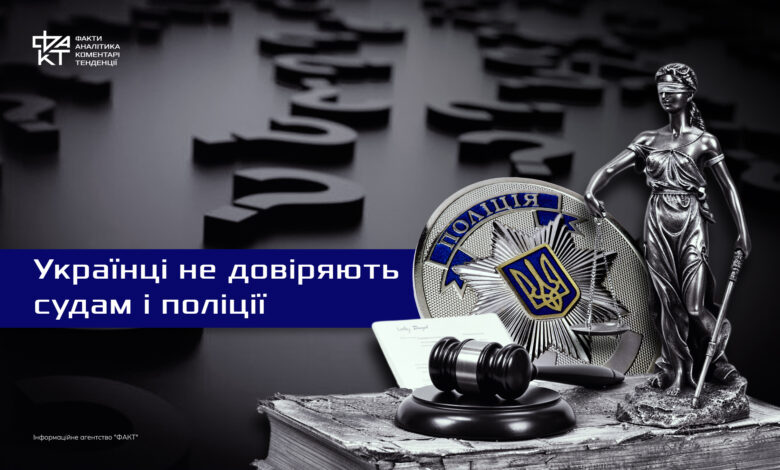
In an era when the state should be a support for citizens, ensuring their rights and security, the courts and the police are on the brink of disaster. Instead of serving as a reliable protection against injustice, these institutions become a symbol of inaction, corruption and abuse of power. Ukrainians, who for years hoped for the protection of their rights, are increasingly faced with the fact that justice is a privilege available only to the chosen ones, and not a fundamental right of everyone. The police, which should be a guaranteed protection against crime, turns into a tool of intimidation and manipulation. Courts, which are supposed to be an inviolable fortress of justice, become an arena for whitewashing the criminals and punishing the innocent. Such a situation gives rise to distrust and anger, endangering not only individual institutions, but also statehood itself. Why are institutions called to maintain law and order and justice increasingly moving away from their tasks and losing the trust of Ukrainians?
What the polls of citizens show
According to the CASE Ukraine sociological survey, 18.1% of respondents expressed their distrust of Ukrainian courts and police. 31.2% of respondents hope that capable and functional legal institutions will appear by 2030. At the same time, there were 8.4% of respondents who expressed their trust in law enforcement agencies in the state in which they function now.
The judicial system is designed to ensure a fair trial and deliver impartial verdicts based on current legislation. The courts are the guarantors of the rights and freedoms of citizens. And the police, in turn, must ensure public order and protect the population from crimes, investigate offenses and monitor the execution of court decisions. On the way to European integration, Ukraine must ensure the effective functioning of legal institutions. However, more and more citizens despair of the fair and responsible service of law enforcement officers and servants of Themis.
Reasons for loss of trust in courts and police
According to the results research, dedicated to people’s rights in Ukraine, only 30% of respondents consider the court to be the most effective means of protecting human rights. However, as practice proves, the integrity of the judges themselves remains in great doubt. Thus, the ex-head of the Supreme Court Vsevolod Knyazev was detained while receiving a bribe of 3 million dl. Probably, this is how he “struggled” against corruption and “protected” the justice of the law. Oleksiy Salnikov, the head of the State Judicial Administration, was another such briber. He was arrested for receiving a bribe of UAH 7.5 thousand. Ex-judge of the Court of Appeal of the Cherkasy region, Volodymyr Ponomarenko, during his activity for a bribe of UAH 30 thousand, sought to help the driver who was driving a vehicle. drunkenness, to avoid responsibility. A few months before this incident, Ponomarenko had successfully passed a qualification assessment without raising any suspicions.
The story of Oleksiy Buran, ex-judge of the Malinovsky district court of Odesa, is generally striking in its unusualness. Part of the bribe was found in his house during the search, but Buran himself defiantly resisted the law enforcement officers, opened fire on them with a pistol and escaped through the window. It seemed that for such actions the judge should have been immediately dismissed and sent to resign, but this did not happen. Instead, the case was deliberately dragged out for years in the courts, until the VRP sent Buran into honorable retirement. The judge’s lifetime allowance is set at UAH 1.6 million, and Buran still receives this money from the state.
Ukrainians also remember the ex-head of the Lviv Appeal Administrative Court, Ihor Zvarych, who was once caught “caroling” with millions in his pocket. Over time, he was released and tried to return to his post. It seems that even prison walls cannot hold such “talented” judges for long. Apparently, now he is giving a master class to his colleagues on how to return to life with a “clear” conscience and leave old habits somewhere behind… or maybe not?
The behavior of judges outside of work is no better either. Here is one of many examples. Oleksiy Tandyr, head of the district court of the Kyiv region, distinguished himself by beating to death 22-year-old serviceman of the National Guard of Ukraine, Vadym Bondarenko, at a roadblock. Forensic psychological examination showed that Tandyr was seriously high.
Despite the fact that the state provided the judges with high salaries, the servants of Themis turned out to have quite an appetite. They are looking for ways to get more and more money without neglecting illegal activities. Such examples, when the servants of Themis find themselves at the center of scandals due to bribery, are becoming more and more. They go free as if nothing happened, and the system seems to just shrug its shoulders impotently. These are not just individual cases — this is a whole epidemic, where honesty and justice give way to money “carols”.
If a person standing on the guard of justice commits illegal acts, then what kind of faith can there be in the justice and effectiveness of judges? Of course, not all of them dishonor the honorable title of guardians of the law. However, such high-profile cases leave an unpleasant impression on the reputation of Ukrainian judges in general.
There are two conditions that stand in the way of Ukraine’s membership in the European Union – judicial reform and the fight against corruption. Probably, it is the dishonesty of the servants of Themis that prevents Ukraine from moving in the right direction.
Things are not better in the police. Despite the reform of the law enforcement system, which was so praised by the authorities, police officers were repeatedly exposed in such illegal actions as inactivity, corruption schemes, drug sales, brutal treatment of citizens, torture, murders, incompetence, and low level of professionalism.
So, the police decided to teach the driver from Kupyan region to behave politely by handcuffing him to the steering wheel. And before that, they beat the man’s sides well with clubs. A veteran of the Special Operations Forces, Pavlo Yakimchuk, received insults from a police officer in the Darnytskyi district of the Kyiv region because he made a remark to the driver of a car who parked in a place for people with disabilities without having the appropriate sticker on the windshield. The woman called the veteran “completely disabled”. And this is because the man sacrificed his health while protecting the borders of our state.
The death of the 5-year-old boy Kyryll from Pereyaslav-Khmelnytskyi will remain a stain on the reputation of the police for the rest of his life. That time, two policemen decided to amuse themselves by shooting metal cans with firearms. One such bullet, which should have protected against criminals, spared the life of a little boy. The accused have already been released from law enforcement agencies. However, they renewed their rights through the court and resumed service. They never admitted their guilt and even refused to take an alcohol test.
There are rare cases when policemen commit beatings and rape directly in the police station. One of these cases was the case of the rape of a girl in the district department of Kyiv region. According to the investigation, a gas mask was put on her, she was shot over the head and raped several times.
“Police work attracts both sincere crime fighters and sadists who want to legally satisfy their perversions. In developed countries, a person is checked for sadism, cruelty, and aggressiveness during recruitment to the police”, – comments lawyer-criminologist Anna Malyar on the situation.
For the sake of fairness, it should be noted that not all police officers behave defiantly and illegally. There are many who serve honestly, conscientiously perform their duties, risking their lives for the safety of citizens. However, even these dedicated servants of order find themselves under the shadow of a general great distrust. Anger is building up in society, spilling over into criticism on the streets, in the media, and on social media. People are increasingly doubting the fairness of the entire law enforcement system, which is rapidly losing trust. It is a distrust that eats her from the inside, despite the efforts of those who are really trying to change the situation for the better.
How do the courts and the police function in the EU and the USA
Trust in the courts and the police in the EU and the USA is based on the rule of law and the independence of the judicial system. Courts are not subject to political pressure, and therefore have the opportunity to make fair and transparent verdicts. Police officers and judges undergo thorough retraining, which includes both legal and ethical aspects. The activities of the courts and the police are subject to control by independent bodies, mass media and the public. All this contributes to the fair application of laws and gives citizens a sense of security and confidence that justice and law enforcement agencies are really working in their interests.
Judges in the United States adhere to high ethical standards. Any violation may result in serious disciplinary action and even dismissal. Moreover, the disciplinary commission imposes a ban on the submission of such candidacy for the post of judge in the future.
Most trials are held in public, and court decisions are published, which increases transparency and accountability.
The high level of trust in the police in foreign countries is evidenced by survey data (72% of respondents). Record high level of trust in Scandinavian countries:
- in Sweden – 91%;
- in Finland – 95%;
- in Denmark – 90%.
They respect and trust the police in Germany (79%), the Netherlands (87%) and Estonia (80%).
The secret of the success of law enforcement officers in European cranes is not to uncover crimes that have already been committed, but to prevent them from being committed. In addition, the ability to communicate with the population and journalists makes it possible to ensure transparency and reporting of the activities of law enforcement officers. Society sees and understands how their work is done. There is no need to drag out the processes of investigation and search for so-called “scapegoats” for a tick. For example, in Sweden, the work of police dialogue is actively used, who during the gathering of the Maidans communicate with the demonstrators, answer their questions and, thanks to such tactics, identify the initiators of criminal protests.
Distrust of the courts and the police in Ukraine is a serious global problem that stands in the way of building a democratic society. However, offering the state a solution to the problem based on the experience of the EU countries is like expecting a victory in Formula 1 from a person who has just learned to drive a car. It is obvious that the payment of exorbitant salaries to judges will not be a guarantee of refusal to accept bribes. Only the awareness that a violation will result in a real punishment with a ban on holding a given position will be able to stop the flourishing of corruption schemes. It is also clear that a policeman’s salary of UAH 18,000 is unlikely to attract a large number of people who want to serve, risking their lives every day and ensuring order in society. Therefore, the shortage of personnel causes the recruitment of random people, which ultimately negatively affects the “honor of the uniform” and the effectiveness of the performance of the functions of law enforcement officers.
In order for the courts and the police to work honestly and effectively, the state should have done a single comprehensive systemic reform of all law enforcement agencies and courts long ago, which goes beyond loud slogans and facade changes. At the core of these reforms should be a tough fight against corruption, real responsibility for violations of the law, transparent processes of appointment to positions and constant control by the public. Only such deep and decisive steps can restore public trust, which is the main criterion for the effectiveness of the courts and the police. Without this, any reforms will remain only an imitation, which will further destroy law and order and justice, which means trust in society.


