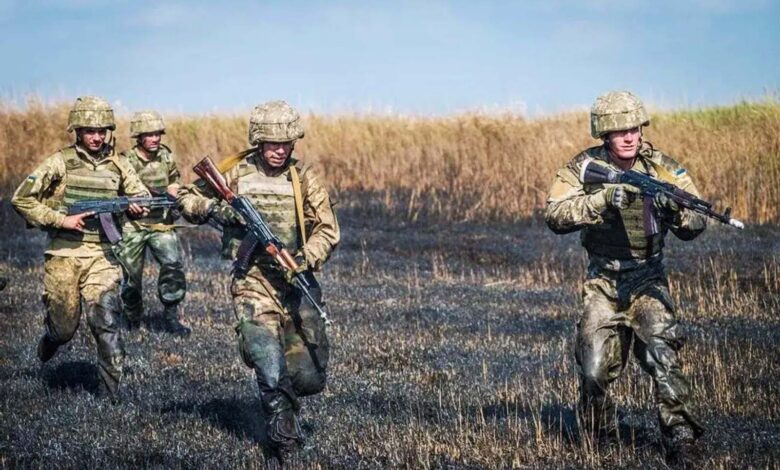
May 6 is the Day of the Infantry of the Armed Forces of Ukraine, the International Day Against Dieting and Dazhbog Day. On this day, important historical events took place in different years, which changed the state borders, military history, technical progress, sports and political life of different countries.
Day of the Infantry of the Armed Forces of Ukraine
This day was established in 2019 to honor the military mechanized, motorized infantry, mountain assault units and units of the Ground Forces, which perform the main combat work on the ground.
Infantrymen hold positions, storm fortifications, cover other units, work in cities, landings, trenches and open terrain. In a full-scale war, it is the infantry that is the first to meet enemy attacks and the last to leave dangerous areas when it is necessary to gain time for maneuver or evacuation.
Interesting facts
On May 6, 1648, the Cossack army of Bohdan Khmelnytskyi won at Zhovty Vody, and the infantry was an important part of the Cossack army.
The modern Ukrainian infantry includes not only classic mechanized units, but also motorized infantry and mountain assault units that fight in various conditions – from the steppe regions of Donbas to forests, urban areas and mountainous terrain.
In the battles for Bakhmut, infantry units held the defense for months in conditions of almost constant assaults, artillery strikes and battles at very short distances, sometimes for individual houses, basements and landings.
During the defense of Mariupol, the Ukrainian infantry, together with other units, kept the city in complete encirclement, when supplies, evacuation of the wounded and communications became extremely limited.
In Severodonetsk and Lysychansk, infantrymen fought in industrial zones, residential areas, and at crossings where heavy equipment had limited room to maneuver.
After 2022, the role of infantry changed dramatically due to the widespread use of drones: simple movement to positions, delivery of ammunition, and evacuation of the wounded often became as dangerous as the battle itself.
In many units, infantrymen now have to be able to work not only with small arms, but also with walkie-talkies, thermal imagers, map tablets, electronic warfare equipment, and drones for short-range reconnaissance.
Infantrymen often hold positions in small groups, where each soldier has several roles: a rifleman can be an observer, a medic, a drone operator, or a communications officer.
In modern warfare, much of the work of infantry is invisible to the news: setting up shelters, night shifts at observation posts, standing by under fire, rotating through mined roads and evacuating comrades under fire.
International Day Against Dieting
This day was launched in the UK in the early 1990s as a reaction to dangerous standards of appearance, the cult of thinness and the popularity of strict diets, which are often harmful to physical and psychological health.
Today’s day is dedicated to the topic of body acceptance, a critical attitude towards the weight loss industry and the dissemination of information about eating disorders. In different countries, people talk about the risks of exhausting diets, the pressure of social networks, unrealistic beauty standards and the importance of a healthy attitude to food without extremes.
Interesting facts
The initiator of the International Day Against Dieting was the British woman Mary Evans Young, who suffered from anorexia in her youth and after recovery started a campaign against the dangerous culture of weight loss.
The first actions to this day were held under the symbol of a light blue ribbon and included public picnics, where people openly spoke about pressure due to weight and appearance.
In the 1990s, the diet industry in the United States was already valued at tens of billions of dollars, although most people regained the lost weight after strict diets within a few years.
Many popular “magic” diets of the past are now considered dangerous: there were eating schemes with a minimum number of calories, diets only on grapefruit, cabbage soup or even cigarettes as a way to “control appetite”.
The topic of excessive weight loss has become so prevalent on social media that some platforms have begun to restrict searches for content related to anorexia and dangerous weight loss methods.
Doctors note that constant sharp fluctuations in weight can negatively affect the cardiovascular system, sleep, hormonal balance and mental state of a person.
During the full-scale war in Ukraine, psychologists are increasingly talking about the importance of stable nutrition and supporting the body in stressful conditions, when strict food restrictions can increase exhaustion and anxiety.
In modern medicine, more and more attention is paid not to the number on the scales, but to the general state of health: the level of physical activity, tests, quality of sleep, mental state and eating habits.
Studies show that people who get enough sleep and have a stable diet often feel better than those who constantly sit on short-term strict diets.
Dazhbog Day
Dazhbog Day is traditionally celebrated on May 6 among adherents of Slavic mythology and Native Faith traditions. In ancient beliefs, Dazhbog was considered the god of the sun, light, prosperity and world order. His name is associated with the gift of warmth, harvest and vitality, and in the chronicles he is mentioned as one of the main gods of the ancient Slavs.
In folk beliefs, Dazhbog was the patron saint of agriculture, the change of seasons and daylight hours. The spring period was considered special for his honor, because it was then that nature finally switched to warmth, field work and an active agricultural season began. In modern Ukraine, interest in the figure of Dazhbog is preserved mainly through the study of pagan culture, folklore and pre-Christian history.
Interesting facts
Dazhbog is mentioned in the “Tale of Bygone Years” among the gods whose idols Prince Volodymyr installed in Kyiv at the end of the 10th century, even before the baptism of Rus.
In the “Lay of Igor’s Campaign,” the Rus’ are called “Dazhbog’s grandchildren,” which is one of the most famous images of ancient Russian literature associated with Slavic mythology.
There is a version that the name “Dazhbog” means “god who gives” or “one who bestows good,” and the image itself combined the features of a solar deity and the patron of abundance.
Among the ancient Slavs, the sun was often perceived as a living force, so they associated the harvest, weather changes, family well-being, and success in the economy.
Archaeologists have found jewelry, amulets, and symbols with solar ornaments on the territory of Ukraine, which are associated with pre-Christian sun cults.
After the introduction of Christianity, some pagan ideas did not disappear completely, but were preserved in folk rites, spring songs, embroidery symbols, and holiday customs.
During the Romantic period of the 19th century, Ukrainian historians, ethnographers, and writers actively studied the image of Dazhbog and other Slavic gods, collecting folk tales and folklore.
In modern culture, the image of Dazhbog is used in books, music, computer games, reconstructions of ancient rites, and festivals of historical culture.
Historical events on this day
1686 – The Moscow Kingdom and the Polish-Lithuanian Commonwealth concluded the “Eternal Peace,” which secured the division of Ukrainian lands between the two states. The Left-Bank Hetmanate remained under the rule of Muscovy, the Right-Bank – under the control of the Polish-Lithuanian Commonwealth, and part of the central territories was to become an uninhabited buffer zone.
1833 – The first steel plow was created in the USA, which greatly facilitated the cultivation of heavy soils. The invention was important for the development of American farming and the development of large agricultural areas.
1840 – The world’s first mass-use postage stamp was issued in Great Britain – the “Black Penny” with the image of Queen Victoria. It simplified the payment of postal items and became the beginning of the modern postal system.
1863 – The Battle of Chancellorsville during the American Civil War ended. The Confederate troops won, but lost one of their most important commanders – General Thomas Jackson.
1872 – The Football Cup was founded in England, which later became one of the oldest and most famous football tournaments in the world. Its appearance solidified the organized format of club competitions.
1889 – The construction of the Eiffel Tower, built for the World Exhibition, was completed in Paris. At first it was criticized as a temporary metal structure, but later it became one of the most famous symbols of France.
1920 – The First Winter Campaign of the UNR Army ended, during which Ukrainian troops marched about 2,500 kilometers behind enemy lines. Despite illness, cold, lack of equipment, and constant battles against white and red forces, the campaign preserved the army’s combat capability and became an important page in the liberation struggle.
1937 – The German airship LZ 129 “Hindenburg” exploded during landing in New Jersey. 35 people died, and the disaster itself effectively ended the era of large passenger airships.
1941 – The USSR adopted a decree on the mandatory employment of war invalids. The authorities tried to involve people with injuries and loss of working capacity in the economy, especially against the background of increasing military tension.
1944 – The British authorities released Mahatma Gandhi from prison. His arrests were part of the confrontation between the colonial administration and the Indian independence movement.
1953 – American surgeon John Gibbon first successfully used the heart-lung machine during surgery. This was a breakthrough in cardiac surgery, as it allowed doctors to perform complex open-heart procedures.
1958 – The last death penalty was carried out in Wales. This event was part of the gradual withdrawal of the United Kingdom from the practice of capital punishment.
1968 – Due to massive street clashes in Paris, the French authorities closed the Sorbonne. Student protests quickly escalated into a large-scale political crisis that engulfed workers, trade unions and government structures.
1987 – The An-124 aircraft set a world record for the distance of a closed route flight, covering 20,150.92 kilometers. The record confirmed the capabilities of the Ukrainian aviation school and heavy transport aircraft manufacturing.
1990 – The state border between Moldova and Romania was opened. The event had great symbolic significance after decades of Soviet control and limited contact between people on both sides of the border.
1991 – Ukrainian pole vaulter Serhiy Bubka set a world record in Japan, clearing 6 meters 7 centimeters. His series of records made Bubka one of the most outstanding track and field athletes in history.
1992 – The constitution of the Republic of Crimea was adopted. The document became an important stage in the complex political processes surrounding the status of autonomy in the early years of Ukraine’s independence.
1994 – The Channel Tunnel between France and Great Britain was inaugurated. The Eurotunnel created a permanent rail connection between the island and continental Europe.
2023 – The coronation of Charles III and Queen Camilla took place in London. The ceremony was the first British coronation in 70 years, following Charles III’s accession to the throne in 2022.