
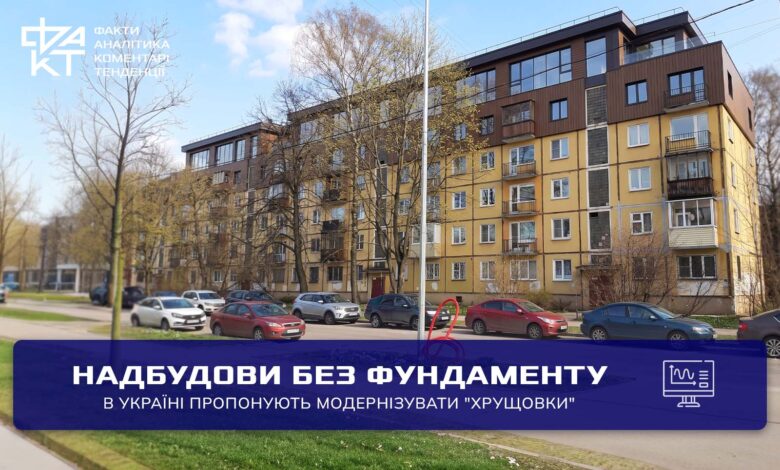
In today’s conditions, Ukrainian cities are on the verge of infrastructure default, but the state chooses the tactic of “cosmetic repair” of ruins. The Verkhovna Rada announced that there will be no mass demolition of “Khrushchevs”. Instead of dismantling emergency facilities, the bill proposed by the people’s deputies provides for their “comprehensive reconstruction”. While the walls of the “Khrushchevs” are literally coming apart at the seams, this initiative actually leaves people hostage to apartments with a negative value in buildings whose standard operating life has officially expired long ago.
Housing stock of Ukraine: number of obsolete buildings
Statements on solving problems with “Khrushchevs” in Ukraine show the state’s ability to work with large-scale, inertial problems. The new law “On the Basic Principles of Housing Policy”, adopted by the Verkhovna Rada on January 13, 2026, replaced the Housing Code of 1983, creating a modern legal framework for the transformation of outdated buildings. Instead of the previous desire to demolish them, priority is now given to the comprehensive renovation of entire blocks.
One of the mechanisms for financing such large-scale works is the possibility of building one or two additional floors, which allows attracting investment funds for the overhaul of the entire building. To unblock the reconstruction process, legislators reduced the required level of consent of apartment owners from 100% to 75%, which significantly simplifies the process of making collective decisions.
However, when trying to understand the real state of the housing stock, it turns out that a noticeable gap has formed between official records and reality. The current estimates are still based on data generated around 2019–2020 and set out in the explanatory note to draft law No. 6483 on the comprehensive reconstruction of outdated housing stock, which was adopted as a basis back in 2022. This is where the figure for the demolition of about 45.6 thousand old houses, as well as more than 17 thousand emergency ones, comes from. There is also a breakdown by construction period:
- 7,646 houses built before 1919;
- 9,693 in 1920–1953;
- 7,192 in 1954–1969 (classic “Khrushchevs”);
- 5,364 in 1970–1989.
As of 2026, Ukraine will have over 30,000 houses that belong to the outdated housing stock, of which a significant part (about 10,000–13,000) are classic “Khrushchevs”. The largest mass of outdated housing stock is concentrated in Kyiv, and significant volumes of such housing are also typical of Kharkiv, which is traditionally considered one of the country’s megacities where “Khrushchevs” are concentrated. Expert estimates here vary widely – from approximately 2,500 to 4,000 houses, which reflects the lack of unified accounting. In Dnipro and Zaporizhia, as typical industrial centers of the Soviet period, significant mass housing developments have also formed – approximately from 1,000 to 2,500 houses, depending on the city. A similar situation is observed in Kryvyi Rih, where a large share of housing was built for working-class areas.
On the other hand, in Odessa and especially in Lviv, the structure of the housing stock is more mixed. In Odessa, pre-revolutionary and “Stalinist” buildings play a significant role, so “Khrushchevs” do not dominate there, although their number can still reach 1,500–2,000. In Lviv, due to historical buildings and the smaller scale of Soviet industrialization, the estimates are lower — approximately 800–1,200 houses.
In general, these data should be considered as estimates of the order of magnitude, rather than exact statistics. However, they well reflect the key pattern, according to which the largest share of outdated housing is concentrated in large industrial cities in the east and center of Ukraine, while the western regions have a more diversified and historically formed structure of the housing stock. This structure is important because it shows that “Khrushchevs” are only part of a wider problem, although its most massive component.
It is quite clear that after 2022, this statistical base began to rapidly lose relevance, and not due to natural changes, but due to the sharp intervention of factors that were not previously taken into account on such a scale. According to estimates, about 236 thousand buildings were damaged or destroyed, which is approximately a tenth of the country’s housing stock. Some of these objects were completely removed from the register, others were transferred to the category of emergency, and still others formally remained “residential”, although in fact they require capital intervention. Thus, even without changing the nominal number of houses, the structure of the fund has significantly deteriorated.
Added to this is another process, less noticeable, but no less important – the natural degradation of buildings that have already exceeded their design service life. As of 2026, most of the “Khrushchevs” are actually living beyond their standard service life. Panel houses of unbearable series, designed for about 25 years, should have exhausted their resource back in 1985–1990, because they were massively built in the 1960s. Brick “Khrushchevs” had a longer reserve — about 50 years, but for them this term mostly ended in 2010–2020. The fact that these houses are still standing is explained not by the relevance of their resource, but by the safety margin laid down during design and construction.
The end of the regulatory period does not mean that the house will collapse the next day, but it changes the very nature of the risk. In panel houses, welds age, connecting elements corrode, engineering networks lose reliability, and any serious accident — from a pipe burst to a gas explosion — can have much more serious consequences than in a building with an unexhausted resource. For residents, it is also a legal and financial trap: banks and insurance companies are reluctant to work with such housing, and apartments in buildings with an expired service life are increasingly becoming an asset only formally.
Reconstruction of “Khrushchev” without a reasonable calculation
Despite the government’s previous promises to demolish “Khrushchev”, the Verkhovna Rada is currently preparing new rules according to which old ones can be modernized by adding one or two additional floors. This approach is presented as a way to update the housing stock without completely demolishing buildings and large-scale reconstruction of entire districts.
However, the idea of adding additional floors to “Khrushchev” looks like an ill-conceived solution, deeply disconnected from reality, bordering on managerial irresponsibility. Attempts to solve the housing problem by burdening structures that have reached their service life limit at the end of the last century demonstrate a complete lack of systemic analysis on the part of the initiators of the process. Instead of a comprehensive renovation of the urban space, citizens are offered facade solutions that ignore the fundamental technical condition of buildings and the ability of urban networks to survive under peak loads.
The critical vulnerability of this project begins with the very foundation — the foundations, which under the “Khrushchevs” were actually performed as lightweight supports for temporary housing with a limited shelf life. Since these buildings were designed as a quick solution to the housing crisis with minimal deepening of basements, any additional vertical load can provoke irreversible deformations and cracking of load-bearing walls. Even the most modern strengthening methods will not be able to turn the foundation of a “temporary building” into a reliable base for a multi-story facility, since the geometry and depth of the basements themselves do not allow for full-fledged technical reinforcement without the threat of collapse of the entire structure.
The technological gap between the illusions of officials and the real state of engineering communications looks even more threatening, given the wear and tear of intra-building networks. The electrical wiring in such buildings remains predominantly aluminum, designed for electricity consumption according to the standards of the 1960s, which categorically does not meet the needs of modern household appliances. Adding new apartments will inevitably lead to an overload of the system, provoking constant accidents and fire-hazardous situations, since replacing the main cables will require billions of investments, the sources of which are not specified in the initiative budget.
The social aspect of this modernization turns a technical problem into a humanitarian catastrophe for the most vulnerable segments of the population. Considering that more than 70% of residents of such buildings are elderly people and citizens with limited incomes, any large-scale reconstruction will become a source of stress and destruction of living space for them, rather than the promised comfort. At the same time, the domestic chaos, inevitable when interfering with load-bearing structures and replacing risers, will fall as a heavy burden on those who do not have the financial resources to restore their homes after the so-called “state improvement”.
In Kharkiv urbanism, the house on Kadenyuka Street (formerly Tankopia) occupies a special place, serving as a clear illustration of how an ambitious architectural experiment can turn into a textbook example of urban planning mistakes. The complete reconstruction of a typical “Khrushchev” series 1-438, implemented in the early 2000s, was planned as a breakthrough solution for the outdated housing stock, but later this experience became an instructive dystopia for the expert community.
The transformation of a standard five-story building into an actual seven-story building by adding two full levels and an attic was accompanied by an external renovation of the facade and replacement of windows, which at first glance created the illusion of modern, comfortable housing. Shortly after the completion of the work on the facade attractiveness, serious functional miscalculations were revealed, among which the most acute was the ignoring of the residents’ needs for vertical movement. Since the existing standards for buildings of such height require the mandatory presence of an elevator, the refusal to install a lift during the construction of new floors forced residents to overcome a considerable height on foot every day. This approach not only violated modern standards of inclusivity, but also became the main complaint about the project, since the logic of saving on internal communications came into direct conflict with the basic quality of life.
The technical condition of the building’s panel-brick skeleton also caused a wave of skepticism among specialists and concern among residents of neighboring neighborhoods. Despite official reports on the strengthening of the supporting parts, the question of the durability of the foundation and walls, designed back in the 1960s and not designed for such a massive additional weight, remains open. This constructive discrepancy is exacerbated by the degradation of internal engineering networks, as the old communications of the basement and the mains of the entire microdistrict remained in their original state, without being modernized for the increased number of consumers. As a result, residents faced typical signs of an overloaded system: weak water pressure and frequent failures in the sewage system.
The aesthetic component of the object over the years has only intensified critical perception, as the updated facade began to rapidly lose its original freshness under the influence of time and weather conditions. Now the building looks like an alien element in the structure of the district, creating a sharp architectural dissonance with the surrounding buildings and resembling a chaotic superstructure, rather than a coherent urban planning solution.
The logic of the authors of the initiative, dictated by the appetites of the construction market and the desire to get expensive square meters in already formed areas, completely ignores the issue of the capacity of the urban infrastructure. An increase in the number of residents without expanding heat points, water pipes and sewer collectors will lead to a drop in pressure in the taps and cold in the radiators of all residents of the microdistrict. Thus, the initiative looks not as a way to renovate the housing stock, but as an attempt at commercial profit at the expense of the safety and peace of thousands of Ukrainians, whose homes become hostage to unprofessional and dangerous experiments.
So, instead of promoting the development of urban planning activities, the bill initiated in the Verkhovna Rada consolidates Ukraine’s status as a “country of temporary solutions.” The inconsistency and ill-considered decisions of government officials today will inevitably become a slow-moving mine for the safety of citizens tomorrow. When the “Khrushchevs” begin to collapse under their own weight and the weight of “superstructures,” excuses about “mistakes of predecessors” and “complexity of procedures” will no longer save anyone.


