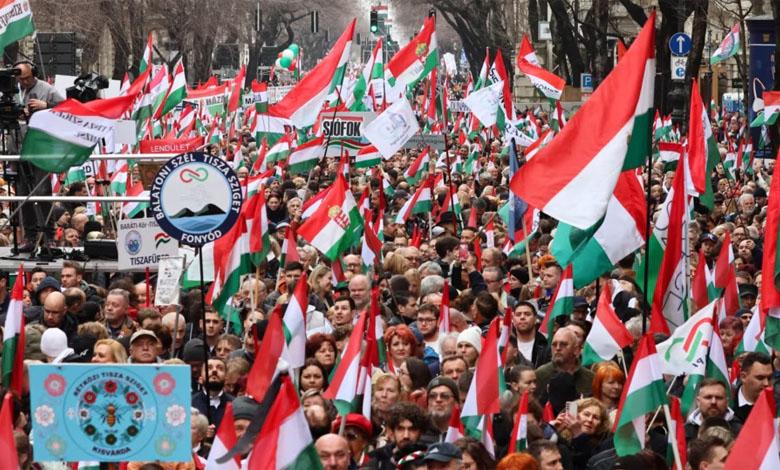
Hungary is exploding. Budapest pond the epicenter of a political struggle that can change the history of the country. More than 50,000 people took to the streets with national flags, chanting:The end of the Orban regime!”, “Orban’s winter ends – our spring begins!This is not just a protest, it is a demonstration of a great confrontation.
In front of the crowd spoke Peter Magyar is the leader of the opposition party Tisza, a former ally of Orbán, and today he is his main political opponent. His words became a challenge: “Those who deceive their own nation must end up in the dustbin of history. Our time has come.”
Tisza, a party that is only a year old, already ahead of ruling Fidesz in most polls. This is a serious blow to Orbán, who has held power for more than 15 years. And this is not just a political trend – it is the response of Hungarians to the economic crisis, rising inflation, corruption scandals and the country’s political isolation. The 2026 elections will be decisive, and this protest is the first sign of change.
Hungary at a crossroads: Orbán is preparing a “cleansing” and the new power of Tisza is challenging his regime
Orbán is not backing down. At the celebration of the Day of Hungary, he threw up challenge: “Today’s celebrations are followed by a big Easter cleaning, because the beetles have survived the winter. We will eliminate the entire shadow army“. This is not just rhetoric – it is a direct allusion to the crackdown on politicians, journalists and non-governmental organizations that receive funding from abroad. Orbán directly accuses the opposition of being allegedly financed by the USA and Brussels, and threatens a purge. That’s right: a purge in the center of Europe, in the 21st century.
Moreover, Orban again spoke against Ukraine’s membership in the EU, again called for negotiations with Russia regarding a ceasefire. His position directly contradicts the general policy of the EU. Under his leadership, Hungary has repeatedly demonstrated its support for Moscow, and is now officially promoting constitutional changes that allow people with dual citizenship to be expelled if they “threaten the country’s sovereignty.” This is a step towards final isolation from the civilized world.
And that’s not all. Earlier, the Hungarian MP Akos Hadgazi received a fine for broadcasting an old speech by Orbán, where he in 2007 urged prevent the return of Russian influence. It is a real irony of fate: then Orbán called for a fight against the Kremlin, and today he is one of the main pro-Kremlin lobbyists in Europe.
Consequently, Hungary’s new political force, the Tisza party led by Peter Magyar, is ahead of the ruling Fidesz party in most polls, signaling significant changes in the country’s political landscape. Magyar promises join the European Public Prosecutor’s Office to ensure the transparent use of EU funds and the return of misappropriated state assets. The party plans to unlock frozen EU funds, eliminate corruption and make economic policy predictable, which will reduce debt servicing costs. Tisza has the intention is to support people who live in rural areas and who mostly support Fidesz.
Peter Magyar and his Tisza offer an alternative to the current course, promising to restore democratic values and integrate Hungary into a strong Europe. Their program is aimed at overcoming corruption, economic revival and development of rural areas, which contrasts with the authoritarian tendencies and foreign policy priorities of Orbán.
It starts in Hungary collapse a system that Viktor Orban has been building for over 15 years. The reason is not only social fatigue, but primarily the economic crisis, corruption and political miscalculations that challenge the existence of the regime.
Inflation in Hungary hits records Inflation, which had slowed to 4.1% in July 2023 after a peak of 25.7%, accelerated again to 5.5% in January and 5.6% in February 2025. The increase in prices reduced the purchasing power of the population. This is a direct consequence not only of global economic trends, but also of Orbán’s domestic policy.
In addition, corruption scandals undermine trust in the authorities. The business interests of Orbán’s entourage cause outrage in society, and accusations of misappropriation of EU funds have become a reason for investigations at the international level. This hit according to the regime is so serious that the EU has already limited Hungary’s access to funding, which additionally hit the country’s budget.
But the problems do not end there. Orban leads the policy of limiting democratic freedoms, controls the media, destroys the independence of the judicial system, and expands its influence on civil society. These processes have already been recognized by the European Union as a direct violation of basic democratic standards.
Power that fears the truth: how Orbán and Musk reduce political opponents to the level of parasites
This is no longer just a struggle for power – it is demonstrative destruction civil society. Orbán creates Office of the Protection of Sovereignty – a structure that has unlimited powers and complete carte blanche to hunt anyone who receives even a penny from abroad. According to his logic, any public organization is a potential espionage cell. Orban is not even hiding – calls NUO “shadow army” and openly promises to make their activities impossible. Because in this country, the ruling party now has a monopoly on “truth”.
State media for a long time perform the role of a mouthpiece of government propaganda, spreading distorted information, destroying the reputation of opponents and creating the image of an “enemy of the state”. These are not conjectures, these are facts confirmed by mass protests, where people demand to stop turning the state media into a propaganda tool.
And here there is a direct parallel with Elon Musk’s rhetoric – only Washington instead of Budapest. Musk, with the same passion, is fanning the fear of “deep state“, by government officials who prowl social networks, monitor, control, censor. The same “witch hunt”, only in the packaging of Silicon Valley. In general, Musk directly says that the USA is turning into a system where special services and officials are out of control and working against people.
This is one and the same scenario – a government that fears its own citizens more than an external enemy. The fighting capacity of such a system is not determined by weapons – it is held by fear of the truth, of an active minority that has the courage to ask: whose side are you on? On the side of the country or on the side of one’s own interests? Both in Budapest and in Washington, the main target is anyone who is still able to think and speak out loud.
Orbán does not even hide his contempt for the opposition. He is direct in his speeches calls politicians who oppose him, “bedbugs“. This is not just an insult – it is a targeted attack on the very political legitimacy of the opponents. Orbán clearly declares: all those who are against us are not a political force, not citizens of this country, but parasites who must be crushed. His goal is clear – discredit, marginalization, complete clearing of the political field. So that even the thought of an alternative seems unnatural.
Considering this philippic, one remembers the rhetoric of Elon Musk, who openly calls American government officials “government dogs”. The logic is the same – to portray the opponents and the entire state apparatus as a pack of jackals who pounce on anyone who speaks outside the script. Musk, like Orban, works on the same feeling – the system is rotten, teeming with parasites and dogs, and only he himself is the last barrier between people and this dirty pack.
This is not even populism, but a banal technology: when an opponent is turned from a political opponent into a cockroach or a dog. And after that you don’t discuss anymore – you poison.
Hungary wakes up: youth and Tisza challenge the Orbán regime
In Hungary is formed a new front of resistance. Youth, independent media and civil society unite against Viktor Orbán’s policies. The youth, who a few years ago stood on the sidelines of major political processes, are coming to the forefront. They are tired of corruption, authoritarianism, isolation from Europe. They have a strong demand for freedom, transparency and justice. And this request resonates with the program of the opposition party Tisza, which proposes radical changes in the country. According to a Publicus Institute study, Tisza has already overtaken Orbán’s Fidesz party, with 24% support against the incumbent’s 23%. This is the first drop in Orbán’s rating in the last 18 years.
And this support is not accidental. Last October, thousands of protesters came out to the headquarters of state TV, accusing the government of using the media to spread propaganda. People demanded independent media, freedom of speech and objective information. This protest was initiated by the Tisza party, which confirms its connection with civil activists and the struggle for people’s rights.
But it is not only about streets and slogans. It is about a new generation of Hungarians who do not want to live in isolation, who want Hungary to return to democratic standards. They see Tisza as a chance for renewal. Youth organizations become centers of political activism, support new initiatives, fight for access to true information. They are no longer intimidated by threats or government attempts to control civil society.
…Next time we will consider how national rhetoric, historical myths and the image of a “besieged fortress” became the main political tool in Hungary. But it is already obvious that the 2026 elections may become a test for the entire system.
Viktor Orbán’s Fidesz keeps the media, courts and election rules under control. At the same time, the Tisza movement, led by Peter Magyar, unexpectedly entered the political arena and broke the usual scenario. While sociology is cautious, the potential for real competition has emerged for the first time in a long time.
It is possible that the authorities will try to further adjust the law to suit themselves – by changing districts or the vote counting system. Not only the result depends on this, but also the perception of the integrity of the elections.
The European Union maintains a restrained critical position. Part of the funding is blocked, there is no direct pressure yet. But if before the elections the authorities resort to open repression, the reaction may intensify.
Hungarian society is deeply divided. Orbán relies on the provinces, older voters and those who fear change. The opposition is stronger in big cities, among young people and businesses that are tired of the oligarchic rules of the game.
The economy is also at risk — delays in European money, the outflow of investors, pressure on business can only increase tensions.
Against this background, the topics of national identity and “traditional values” remain the main weapons of the government. Migration, LGBT, the West are all parts of a larger story about who and what to protect.
It is to this policy of mobilization that we will devote the next conversation.
Tetyana Viktorova