
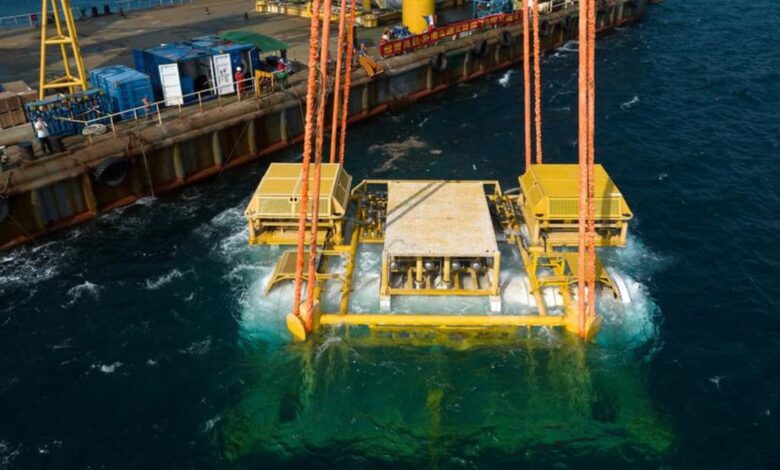
In the Chinese province of Hainan, the world’s first underwater data center, which became part of the strategy for the development of the “blue economy,” officially began operations. The servers are located in a special capsule weighing 1,433 tons, which is equal to the weight of about a thousand passenger cars. reports Interesting Engineering.
The main advantage of this technology is energy efficiency. If ordinary data centers spend significant resources on cooling the equipment, sea water performs this function underwater. Stable temperature and ocean currents provide natural cooling, reducing costs and environmental impact. According to project manager Pu Ding from the Shenzhen HiCloud company, underwater data centers can reduce energy consumption several times compared to land ones.
The capsules are located at a depth of 35 meters, each of them contains 24 server racks and can accommodate up to 500 servers. In the future, it is planned to create a network of 100 such modules, which will ensure the development of marine research, digital services and intelligent manufacturing, making Hainan an important technology and innovation center.
China has also allowed full foreign ownership of data centers in Hainan, Shanghai, Beijing and Shenzhen. This decision should attract international investors and strengthen the country’s position in the global data infrastructure market, the demand for which is growing rapidly thanks to the development of artificial intelligence and cloud services.
The initiative in Hainan was a continuation and development of an idea previously tested by Microsoft as part of Project Natick. In 2018, the company submerged an experimental data center with 855 servers off the coast of Scotland, which operated for two years and confirmed the viability of the concept. However, in 2024, Microsoft closed the project, abandoning its commercial development.
Thus, China was the first to move to large-scale practical use of underwater data centers, including them in strategies for economic development and international investment.


