There is no elevator, the platform is via stairs: how Ukrzaliznytsia explained the problem for people with disabilities and parents with wheelchairs

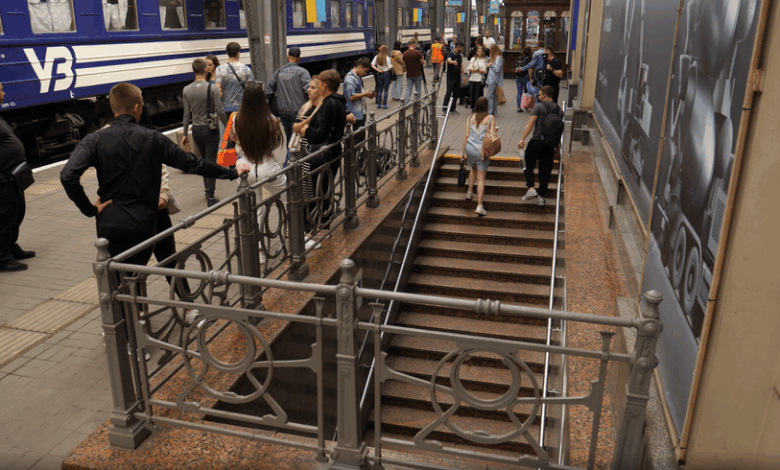
The problem of access to platforms at large Ukrainian railway stations has been accumulating for years in everyday situations where people with strollers, heavy suitcases, injuries, disabilities or age restrictions are forced to climb stairs where it is logical to expect a barrier-free route. Kyiv station occupies a special place in this discussion, because for the main railway junction of the country, the issue of convenient and safe passage to platforms has become an indicator of how well the real infrastructure meets the needs of passengers. The new discussion has only exacerbated the old contradiction: people expect understandable physical access, while the carrier explains the situation through an escort service that should compensate for the lack of a simple engineering solution.
Access to platforms in Kyiv
The impetus for a new public discussion was the appeal of a passenger on the social network Threads, who asked how a mother with a one-year-old child can independently climb from the platform to the station building, if there are only stairs on this route.
“Please explain how a mother with a one-year-old child is supposed to independently climb from the platform to the station building, if there are only stairs? No elevator, no convenient ramp. Only stairs,” the woman is indignant.
Her complaint hit the very essence of the problem, because it concerned not an exceptional situation, but a completely familiar route, which for some people turns into a serious obstacle already at the moment of arrival or before boarding. At the heart of this question is a situation that a passenger usually perceives as a basic condition for the operation of a station: the ability to reach the desired point without the need to seek external force for ascent or descent.
The reaction of Ukrainians to this post was sharp because the problem is easily recognizable by many passengers. For a person traveling alone, the road from the platform to the central part of the station is extremely problematic. For parents with a small child, people with disabilities, passengers with injuries, postoperative conditions or limited mobility, this route often becomes a grueling ordeal, where each flight of stairs means dependence on random help.
What Ukrzaliznytsia Offers
Ukrzaliznytsia responded to this appeal, emphasizing the service that is already in operation. The company representative indicated that for such cases, the “Station Assistant” service is provided, through which the passenger can receive support and assistance at the station in advance.
The content of the explanation boils down to the fact that Ukrzaliznytsia offers to solve the problem of moving around the station through individual support from an employee. Such an assistant should help the passenger get to the platform, get off the train, move around the station territory and, if necessary, cope with heavy luggage. So, the response of “Ukrzaliznytsia” is built around the service model: if the infrastructure does not allow a person to travel the route independently, then this route can be traveled with the participation of a station employee.
The company recognizes that for some passengers, independent access to the platform is difficult, and as a working solution it offers not a technical means of transportation, but human support. For some passengers, this can really be a way out, especially if the trip is planned in advance, but for others, such an approach means dependence on a prior order, a correctly completed request and the actual availability of an employee at the right time.
Representatives of “Ukrzaliznytsia” explained the procedure for obtaining this assistance. To do this, the passenger needs to log in to the website using his number, then go to the profile, open the “My tickets” section, click the menu and select the option to order an assistant. After that, the user must indicate what assistance is needed during the trip.
Such instructions show that the service is integrated into the already familiar ticket management system, therefore it is provided as part of the standard passenger service. At the same time, another important conclusion follows from the explanation of Ukrzaliznytsia: a person who needs support is offered to take care of the organizational side of the trip in advance, because without such a request, it is much more difficult to count only on occasional assistance on the spot.
A special emphasis in the explanation of Ukrzaliznytsia representatives was placed on the fact that the service is free for people with disabilities and passengers with limited mobility. Station employees help them when boarding and disembarking from the car, and also accompany them around the station. In this part, Ukrzaliznytsia’s answer is important not only as a technical clarification, because it shows who the company includes in the category of passengers who are entitled to free support on the way.
For a wider range of passengers, in particular for parents with strollers, such a service also looks practically useful, since the problem that started the discussion concerned a mother with a small child. Because of this, Ukrzaliznytsia’s response actually extends attention from the topic of barrier-free travel to the topic of service support for those people for whom the stairs at the station become a real obstacle even without an officially established status of reduced mobility.
Because of this, Ukrzaliznytsia’s explanation can be read in two ways. On the one hand, the company gave a specific answer and named a tool that the passenger can use now. On the other hand, the very appearance of such a request indicates that the problem of accessibility has not disappeared anywhere, and therefore service assistance is still covering the consequence, while the cause remains in the station infrastructure.
Taking into account the position of Ukrzaliznytsia representatives, a passenger who understands that it will be difficult to pass the station on their own should anticipate this at the stage of preparing for the trip. The assistance service does not look like a spontaneous decision on the spot, since it is proposed to issue it through a personal account together with a ticket. So, the company’s logic comes down to advance planning: if the route may be a problem, assistance should be ordered in advance to avoid a situation where a person finds themselves in front of the stairs without a real opportunity to quickly resolve the issue.