
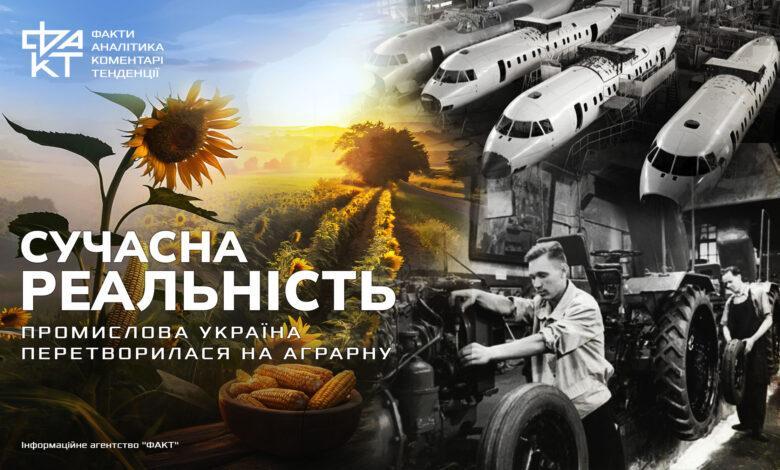
A few decades ago, Ukraine was an industrial country with powerful metallurgy, engineering and energy. However, the economic landscape of the country has changed significantly in recent years. Industrial giants are closing down, factories are standing empty, instead agriculture comes to the fore. Ukraine is increasingly focusing on the agricultural sector, increasing the export of oil, grain and other products. Now the country, which at one time was called the “forge” of Europe, is becoming its “granary”. This is not just a change in the economic course, but a new reality that will determine the future of Ukraine on the world stage.
What Ukraine exports
Ukrainian exports in 2024 showed growth in all key indicators. Shipments increased by 28.8%, and the total value of exports exceeded 41 billion dollars, which is 13.4% more than last year. However, should we celebrate this success, or is it better to look closely at its components?
The key factor in this growth was the normalization of seaports, which, despite all the threats, resumed their activities. If in 2023, 54.8 million tons of products were shipped by sea, then in 2024 – 87.2 million tons. Sounds like good news. But what exactly is exported? Ukraine is increasingly turning into an exporter of raw materials. The sales leader again became sunflower oil, which brought the country more than 5 billion dollars. Also in the top three winners: corn ($4.9 billion) and wheat ($3.68 billion). Iron ore is a little behind ($2.75 billion). In other words, we export everything that does not require a high level of processing and added value.
Of course, we can be happy that metallurgy is also beginning to revive. Semi-finished iron products were exported for 927.5 million dollars, hot-rolled products for 802 million dollars, and cast iron for 500 million dollars. But this is not the level it was before the war, and on a global scale, Ukrainian metallurgy has not yet regained its position.
Another interesting point is the export to Europe. Our neighbors remain the largest sales market: more than 59% of Ukrainian exports are directed there. However, at the same time, almost half of the imports into Ukraine are also goods from the EU. It is also worth mentioning that dissatisfaction with Ukrainian agricultural exports is growing in Europe. Ukraine is already preparing for new negotiations on “sensitive” goods: corn, cereals, honey, sugar, eggs and poultry meat. It is not difficult to guess that European farmers do not really like Ukrainian products, which create competition for them. So shouldn’t we invest more in our own processing instead of flooding foreign markets with raw materials?
As for other key markets, everything here is quite predictable. The largest partners of Ukraine remain China ($2.3 billion), Turkey ($2.1 billion), Egypt ($1.6 billion), India ($986 million) and Moldova ($935 million). That is, the same countries as before – no breakthroughs into new regions, no expansion of the export geography.
But there are also pleasant surprises. Ukraine exported furniture worth 460.6 million dollars, and cable products in general brought 1.26 billion dollars. These are precisely the segments that provide added value and could become the basis of the Ukrainian economy if the state systematically supported such industries. But, as we can see, their contribution to the export structure is still insignificant.
Therefore, exports are growing. However, the key question is: is this really a sign of economic success? If we want to become a strong state that does not depend on fluctuations in the prices of raw materials, we should pay attention to what we sell and think not only about the volume, but also about the quality of our economy. Because so far, we are more and more like a supplier of resources for developed countries, which, based on our raw materials, create a real product and earn much more.
An agrarian country or an industrial desert?
According to the data of the Ministry of Agrarian Policy and Food, in 2024 almost 60% of all exports from Ukraine were agricultural products – more than 78.3 million tons. At the same time, revenues from its sale reached 24.5 billion dollars, which became the second best indicator after the record-breaking 2021. If it was once a trend, now it is the final collapse of the industrial core of the country. The sad irony is that in times of war, industry should normally grow, because defense orders stimulate production. But not in Ukraine. In our country, it decreased by one and a half times, and this is not just a number, but a real verdict.
The military-industrial complex (MIC) is not an autonomous island that can be grown in conditions of economic ruin, but a complex mechanism based on an extensive network of enterprises, science-intensive technologies and highly qualified personnel. That is why Israel and South Korea developed their military industry only after creating a powerful civilian industry. Ukraine decided to try a new model of development: first to destroy the industrial base, and then to ask in surprise – why is it not possible to produce modern tanks, planes and missiles?
Military industry needs not only production capacities, but also innovations. The absence of developed industry means the absence of technological progress. Science and research centers cannot work in a vacuum, and their funding directly depends on the demands of production. In other words, if there is no industry, there are no orders for innovation. You can talk as much as you want about developments in the field of drones, but without a full-fledged production cycle, they will remain experiments.
Now a little prediction. What will Ukraine become if the situation does not change? It’s very simple: 80% of the economy will be in the service sector, 15% in the raw material sector and 5% in industry, which mainly produces spare parts, not finished products. What does this mean? The fact that we will supply raw materials, receive for this a small share of the value of the final product and rejoice in the statistics of export growth. Someone will say that the agricultural sector is the basis of the economy. But the problem is that grain, sunflower oil and corn do not create technology, do not launch space satellites and do not produce armored vehicles. Countries that rely on agriculture do not become economic leaders.
Of course, you can try to restore the industry, but it will take decades. The experience of Turkey, which has spent more than 30 years building its own defense industry, shows that nothing will work without a strategic vision and long-term investments. Ukraine is currently moving in the opposite direction. We do not create high-tech production, but on the contrary, we get rid of even what is left.
It should be noted that the destruction of industry is also the destruction of the system of training highly qualified personnel. The absence of industrial enterprises means a decrease in demand for engineers, technologists and specialists in the processing of metals and materials. Why train a highly qualified workforce if there is simply nowhere for them to work? Instead, the country is increasingly turning into a supplier of cheap labor for the developed economies of Europe.
Ukraine in the past
Once upon a time, Ukraine was one of the most powerful industrial states in Europe. As an inheritance from the Soviet Union, the country received a huge industrial base, which provided not only domestic needs, but also exported products to the international market. Our country was one of the ten world leaders in steel production, had a developed aviation, shipbuilding, machine-building and defense industries. Today, the situation has fundamentally changed.
In the early 1990s, Ukraine was one of the largest producers of steel in the world, occupying the 8th place in the global ranking. The metallurgical plants of Dnipropetrovsk, Zaporizhzhia, and Donetsk produced millions of tons of rolled steel, steel, and cast iron, which were exported to European and Asian countries. Mechanical engineering was represented by such giants as Antonov, which created unique airliners, Pivdenmash, which produced rockets and space equipment, and ZAZ, which produced cars.
Kharkiv was one of the main industrial centers of Ukraine. It is here that the Kharkiv Tractor Plant, Turboatom – the largest enterprise producing turbines for the energy industry, the Malyshev Plant, specializing in the production of tanks and armored vehicles, and many other plants are located. However, most of Kharkiv’s factories are now dilapidated and bankrupt. Kharkiv was also a center of scientific research and engineering development, which ensured technical progress in industry.
At the same time, Ukrainian shipyards (Mykolaiv, Kherson, Kyiv) built ships for the navies of many countries, and the transport industry produced railway cars and locomotives that were used all over the world. The energy sector provided nuclear and hydropower, and Ukraine was an exporter of electricity.
However, the destruction of the industry began in the 1990s. The first blow was dealt by chaotic privatizations, when strategic enterprises passed into the hands of oligarchs. Lack of investment, corruption and failed economic policy gradually destroyed the competitiveness of Ukrainian factories. Many enterprises became bankrupt, some were dismantled for scrap metal.
The political situation in the country and the war that began in 2014 also dealt a devastating blow. Donbas, which was the heart of Ukrainian industry, became a war zone, and factories in Donetsk, Luhansk and Mariupol were either destroyed or came under the control of the occupiers. In 2022, a full-scale Russian invasion finally finished off Ukrainian heavy industry. “Azovstal” and “MMK Ilyich” were destroyed, the Zaporizhzhya metallurgical plant is partially operational, the defense industry has gone into crisis mode.
So, Ukraine was a powerful industrial giant – with factories, metallurgy, aircraft construction and technological potential. Today, it increasingly resembles a commodity colony that supplies agricultural products and ore to foreign economies and then imports finished products from there. Now Ukraine faces a choice: or we will begin to restore our own industry, or we will finally turn into an agrarian commodity appendage. But it looks like the choice has almost been made, and it is far from being in favor of industrial development.
If the government does not undertake the restoration of industry, the country will forever remain an agrarian state. We will not be able to create the latest equipment, develop our own industrial complex and compete in high-tech industries. A state that does not produce is unable to control its future. And if this course is not changed, Ukraine risks losing not only its economic potential, but also the status of a full-fledged independent country. Whether this situation will change is a question that depends on the political will and strategic decisions of the authorities.
Oksana Ishchenko


