
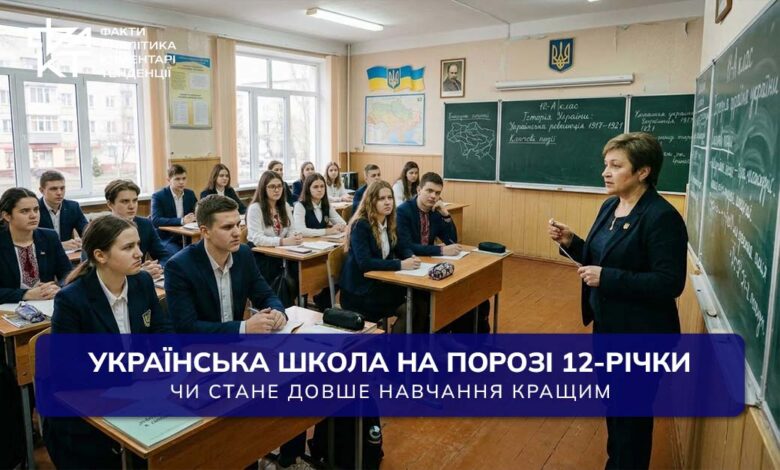
The transformation of Ukrainian secondary education, which involves the transition to twelve-year education, is positioned by the Ministry of Education and Science as a strategic path to the European space, where the time standards for training specialists are synchronized. According to MES officials, the orientation towards the Western model of education for Ukraine should become a marker of civilizational choice, because the preservation of the eleven-year education system de facto leaves the state in the inertial orbit of the past, where the pace of knowledge acquisition does not meet the modern requirements of the competitive world. However, while officials are preparing “additional solutions” in response to existing problems, the education system risks getting stuck in a transitional period, where old patterns have already been discarded, and European quality remains only a nice point in reports for Brussels, not supported by timely action on the ground.
Late “support”: how the Ministry of Education and Science is failing the reform at the start
As stated by the Minister of Education and Science, Oksen Lisovyi, the transition of the Ukrainian education system to a 12-year education system is a strategic condition for Ukraine’s accession to the EU and a final break with the Soviet past. However, the Ministry of Education’s attempts to pass off late adjustments as a proactive strategy look somewhat dubious in the eyes of territorial communities, which have long experienced all the “charms” of bureaucratic pressure when forming a new network of institutions.
When teaching staff and local governments have been trying to untie the knots of contradictory recommendations for months on their own, the “additional support” widely announced by Oksen Lisovyi is perceived through the prism of bitter irony. After all, as you know, an expensive spoon before dinner. Instead of receiving effective tools and resources at the start of planning, communities are forced to be content with promises of “solutions to support” when deadlines have already passed and social tension among parents has reached its peak.
Declarations of the urgency of change and a departure from the logic of the past are at odds with the real pace of methodological assistance, which often turns the substantive reform of the New Ukrainian School (NUS) into a formal change of signs. The Minister of Education and Science emphasizes the importance of implementing European integration indicators, but ignoring the fact that it is the untimely and careless support of communities that undermines trust in the reform more than any information attacks is a dangerous managerial blindness. The attempt to write off the criticism as attempts to discredit the National Ukrainian School looks like a convenient shield, behind which the inability of the department to ensure a smooth and logistically verified transition to new tracks without harming the educational process itself is hidden.
The introduction of a twelve-year cycle of education, ambitiously planned for 2027 within the framework of the New Ukrainian School concept, is currently facing unprecedented social and institutional resistance, caused, as expected, by a financial deficit, as well as a deep gap between legislative requirements and harsh military reality. Despite the fact that the transition to in-depth study of a profile spectrum of subjects is a requirement of European integration progress, only 11% of parents are ready to support such a long trajectory, while a quarter of those surveyed express categorical protest due to the prospect of children completing their education at the age of 18–19. This creates a tangible social dissonance, since postponing entry into the labor market and entering higher education in conditions of economic instability is perceived by many as an artificial prolongation of the period of dependence of young people on the older generation.
The infrastructural unpreparedness of most territorial communities to create a network of powerful academic lyceums calls into question the very viability of the idea of specialization, since the lack of modern STEM laboratories and equipped dormitories for rural youth automatically preserves inequality in access to knowledge. The huge investments required to transform ordinary schools into high-tech educational hubs seem too burdensome for the budget of a country at war, where funds for shelter and basic security are often scarce. It is quite obvious that without proper material support, an additional year of study risks turning into an inertial pause that does not add quality, but only accumulates the existing systemic shortcomings of basic schools, of which there are many.
It is worth recognizing that behind the official facades of “modernization” lies an inertial survival model based on the principle of “it will be okay,” where declarative equipment exists mainly in reports for ministerial offices. Technological progress in such institutions is limited to episodic access to the network, and the latest equipment, devoid of service support and elementary instructions, turns into non-functional decorations. Instead of being architects of critical thinking, teachers are forced to play the role of crisis managers, single-handedly patching holes in budgets for elementary projects and trying to contain the degradation of the educational environment in an atmosphere of general indifference. The school has effectively capitulated as a center for community development, transforming into a closed ecosystem where survival has become the only form of life. While the bureaucratic machine measures the success of reforms with sterile percentages, reality dictates bitter arithmetic, where the educational process in the country continues not thanks to the state strategy, but in spite of the system that has exhausted its resources.
The blind spot of education: how the middle level destroys the foundation of knowledge
Analysis of the current educational trajectory in Ukraine highlights a paradoxical situation where the basic level of secondary school (grades 5–9) has turned into a systemic “blind spot” that levels the achievements of the primary level and undermines the foundation of the upper level. While the relevant ministry directs billions of subventions to the development of academic lyceums, it is in the middle classes that a catastrophic intellectual drain occurs, confirmed by the results of the international PISA study.
The performance of 15-year-olds, who demonstrate a level below the EU average, is not just a statistical error, but a verdict on the current model, where reading literacy has degraded under the pressure of the pandemic and war, and mathematical skills remain fragmented and insufficient for global competition.
It should be noted that the results of the EdEra and PISA-2022 studies indicate a systemic crisis in mathematical education in Ukraine: critical knowledge losses are formed already in the sixth grade, when the foundation for algebra, geometry, and natural sciences is laid. The fact that almost every eighth student fails to cope with the tasks of the fifth and seventh grades shows that the school program does not provide a proper transition from basic arithmetic to more complex concepts. The loss of high-performing students — 40% per year — indicates that talents simply drop out of the educational process, and the school does not have time to support those who could demonstrate high achievements.
The vulnerability of the system is inherent in the moment when students move from the fourth to the fifth grade. Unlike the educational systems of the USA or Canada, where the practice of annual teacher changes and the presence of several specialized specialists from the elementary grades is the norm, the Ukrainian school remains hostage to the monopolistic influence of one teacher. For four years, the child is completely dependent on the personality, methods and moods of a single teacher, which creates the risks of forming a subjective attitude or selective favoritism. In Western models, the diversification of the teaching staff allows students to adapt to different communication styles and receive a higher-quality subject base, while the domestic primary level often locks the child in an artificial “protective cocoon”, which becomes the cause of painful stress during the subsequent transition to secondary school, where students fall under the “dictatorship” of disparate subject teachers.
These specialists are usually focused on the mechanical implementation of overloaded curricula, rather than on filling gaps in students’ understanding, which becomes fatal for linear disciplines such as the exact sciences. In a situation where in grades 5–6 the basic concepts of fractions or proportions remain unlearned, the student actually deserts the educational process, turning into a “transparent presence” in the classroom that imitates learning while the system continues its doomed race according to the program. As a result, we get a passive listener who later comes to NMT without knowing the multiplication table, relying exclusively on a calculator and short-term memory.
The solution to the methodological crisis in high school rests on a systematic negative selection of personnel, because the low level of remuneration and prestige of the profession leads to the fact that applicants with the lowest scores enter pedagogical universities. A teacher who does not himself own the logic of solving complex problems is a priori unable to form competencies in a child, which creates a vicious circle of ignorance.
Although the concept of NUSh declares academic freedom and the ability to change standard programs by 10–20%, most teachers, raised in the Soviet paradigm of fear of tests, voluntarily give up this autonomy. Instead of implementing integrated courses or project-based learning, they choose to safely follow outdated textbooks, because they are afraid of “deep water” and do not know how to record innovative methods in paper journals for regulatory authorities.
The critical shortage of qualified teaching staff capable of leading specialized areas, especially in the natural sciences and mathematics segment, makes the promised academic depth unattainable for most provincial institutions. The search for teachers who can teach physics or chemistry at a level that eliminates the need for tutors turns into an impossible quest in the regions. Under such conditions, there is a real threat of an increased outflow of talented ninth-graders to foreign educational systems, which seem to parents more stable and understandable than domestic reform experiments.
The historical memory of the ten-year education system fuels today’s skepticism, because that model functioned as a perfectly synchronized vertical, where the fundamentals of knowledge were combined with maximum time savings for the state and the individual. A graduate who left school at 16–17 years old with a solid knowledge base immediately entered a clear system of vocational or higher education, which was a direct superstructure over the school curriculum without any substantive gaps. The high concentration of hours on basic disciplines and the absence of information noise allowed to achieve the effect of complete immersion in the material, which made the school an effective social elevator.
Dictating programs and the silence of teachers: the internal crisis of the Ukrainian school
Ukrainian educational policy has finally turned into a hermetic system that functions in a monologue mode, completely ignoring the interests of key participants in the educational process, namely students, teachers and parents. The Ministry of Education and Science has built an impenetrable wall, where the opinion of the parent community is not even considered a valid factor, and teachers have turned from active subjects into disenfranchised extras. Reforms are born in sterile ministerial offices, where the real state of the school is known only from retouched presentations and dry statistics that do not take into account either the lack of heating in the classrooms or the critical emotional burnout of the teams.
Instead of a real partnership, the state offers a facade democracy in the form of “councils of change agents” and fictitious public discussions, which in reality only legitimize the decisions already made at the top. Any constructive criticism from practitioners is branded as sabotage, forcing the professional community to plunge into systemic silence. Teachers are simply faced with the fact of receiving new programs, new assessment models or dubious platforms, and the implementation of these tools occurs without any prior consultations regarding their real viability. This creates a deep crisis of trust, as teachers are forced to bear responsibility for the results of experiments on the architecture of which they had no influence.
The greatest tragedy of the current course is that “updates” are created for an idealized system that does not exist in nature. In fact, the Ministry of Education and Science produces stillborn reforms with no roots in reality. When strategic vectors are determined by people who have not stood in front of a living classroom for years, the reform becomes ineffective even at the stage of signing the order. Initiatives that should simplify life only multiply bureaucratic reporting, and courses designed to improve quality turn out to be disconnected from the actual needs of modern students. Without involving the experience of those who see children’s eyes every day, any concept has no chance of survival in real educational soil, turning into another paper report on “successful implementation”.
As we can see, the transformation of a modern school into a three-year senior level without a radical revision of methodological support and timely support of local communities may lead to the fact that the declarative departure from the Soviet form will remain only a change of signboard. Belated attempts to correct gaps in the lyceum network a year before the start of the reform only increase the distrust of parents and teachers. Without a clear answer to the question of how exactly the 12th year of study will relieve the student and whether it will provide real readiness for life without a calculator and a tutor, the reform risks becoming another bureaucratic burden, not a window of opportunity.


