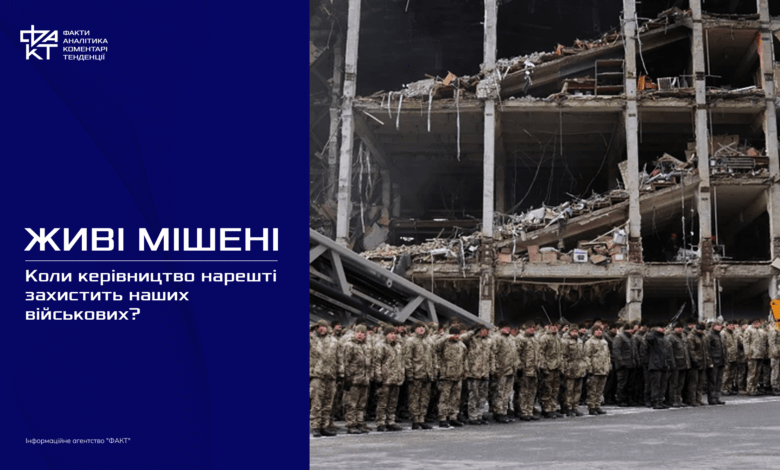
Each new tragedy during the war is not just another terrible episode, but a pain that we all experience together. The tragedies that take the lives of Ukrainian soldiers remind us that the conclusions from previous mistakes have not been drawn, and the terrible consequences of wrong decisions are only accumulating. The case, when dozens of soldiers were killed and more than 300 were injured during a rocket attack on the Poltava Institute of Communication, became another reminder that war requires not only courage, but also the wisdom of the leadership in making decisions.
Could this tragedy have been avoided? The answer is obvious: yes. When young people who are just beginning their journey to the service find themselves in a situation where their lives hang in the balance due to the lack of proper safety measures, the question arises about the competence of the leadership. Does it understand that the Russian Federation continues to use the tactics of mass strikes on military concentrations? Why were so many people gathered in one place that became an easy target for the enemy? The tragedy in Poltava, which took place on September 3, is only one of many, but, unfortunately, not the last, if conclusions are not drawn immediately.
Day after day after this tragedy, social networks were filled with messages about the funerals of fallen servicemen — people of different ages, from different parts of Ukraine, with different life stories. Some already had combat experience behind them, some had just started their service, and some were just studying. The Institute of Communications in Poltava, where they studied or qualified, became a place of last resort for them.
This case is another painful blow to the hearts of families who have lost their loved ones. Relatives of the dead say with pain that the losses could have been avoided. “We have one enemy, but the losses are the result of negligence,” they believe. Lack of coordination, negligence, miscalculations of the command – this is what infuriates people the most. It is known for certain that the number of wounded is kept a secret for security reasons, but even their relatives find it difficult to find out the whole truth about their state of health. Hospitals do not allow access to the wounded without the consent of the military leadership. And journalists who tried to get comments were refused even by acquaintances.
After the tragedy in Poltava, not only law enforcement officers, but also the Main Inspection of the Ministry of Defense, the military service of law and order, and the command of the Ground Forces took up the investigation. The State Bureau of Investigation also opened a case of military negligence. Whether the leadership of the educational institution will bear responsibility for the accumulation of hundreds of soldiers in one place, where they could be easily attacked, is still unclear. The command of the Institute of Communication declares that no mass events were held that day, there were no lineups, no briefings. This is confirmed by the investigating authorities. However, the question remains: why was the decision not made to disperse the military earlier? Shouldn’t we have learned from previous events to prevent so many victims? There are more questions than answers.
Iryna Friz, a member of the National Security and Defense Committee, notes that in such cases it is important to rely on facts, not emotions. “You can’t draw conclusions based only on assumptions or hearsay. Let’s wait and see what kind of evidence the law enforcement agencies will prepare,” she says. But will this evidence be able to convince the relatives of the victims that the tragedy could have been avoided?
It should be emphasized that the incident in Poltava is not the first time that the Russian Federation has struck places where Ukrainian troops are concentrated. And this raises the question for society and the military leadership: why aren’t conclusions drawn from previous events? On March 13, 2022, there was a missile attack on the Yavoriv military training ground. Then 64 people died, and more than 150 were injured. A week later, on March 18, a missile hit the location of Mykolaiv marines. According to some sources, at least 110 servicemen were killed and more than 100 people were injured. On May 17, 2022, there was another rocket attack, this time on the barracks of the Desna educational center, where 87 people died, and dozens are still considered missing.
However, the tragedies did not end there. On November 3, 2023, a Russian missile hit the formation of the 128th Mountain Assault Brigade in the village of Zarichne, Zaporizhzhia Region. Then 19 servicemen died. It was a blow during the awarding of the military on the occasion of the holiday.
Ukrainians have not yet moved away from the tragedy in Poltava, as on September 4 it became known about another enemy missile attack on the formation of the military. This time it happened near Bezdryk in the Sumy region. This is already the second case this month — the day before, on the morning of September 3, two Russian Iskander-M OTRK ballistic missiles hit the territory of the training unit in Poltava, as a result of which the building of the Institute of Communications was partially destroyed. At that time, more than 50 people were killed, almost 300 more were wounded. There were no casualties among the cadets, as they went down to the shelter, but mobilized and contract workers were injured.
Why does the command continue to conduct formations, if according to the military, they are prohibited during wartime? Why did these events not signal to the military leadership that the enemy’s tactics are not changing? Now the expert environment is actively discussing these issues. The headquarters of the Supreme Commander-in-Chief should have long ago issued an order regarding the dispersal of military educational institutions and all power structures in general. Gathering hundreds of people in one house at a military facility after multiple missile strikes is a crime, according to many experts.
In many countries of the world, military educational institutions are in constant readiness to evacuate or move to new locations in the event of an increased threat. Unfortunately, this practice is almost never used in Ukraine. Military cadets are still forced to go to educational institutions in uniform, which makes them even more visible to the enemy.
The gathering of hundreds of people in one building of an educational institution is an inexcusable miscalculation, but it is not just a miscalculation – it is the direct responsibility of the management. At the same time, every delay in implementing proper security measures costs lives. Young people are dying who could have served and defended their country if the right measures had been taken. The Russian Federation would not launch ballistic missiles if it did not have clear confirmation that many military personnel were in a certain location. This can be easily observed from the street, so anyone could adjust the shots.
After the attack on Poltava, the command of the Ground Forces promised to strengthen measures to secure the personnel and check the discipline in the units. But is this enough to avoid similar tragedies in the future? Will there be new underground bunkers to protect cadets? Perhaps part of the training should be conducted on the territory of NATO countries, as suggested by some experts. But for now, the most obvious solution is to disperse personnel immediately to prevent large numbers of people from congregating in one place. But beyond that, more needs to be done. In order to prevent new tragedies, it is necessary not only to disperse military facilities, but also to introduce clear normative legal acts that will provide for the personal responsibility of commanders and chiefs of all levels for unacceptable gatherings of military personnel in one building. Only in this way will it be possible to avoid the repetition of such disasters.
It is also necessary to clearly understand that the relocation of a large educational institution is a difficult process, but not impossible. This is standard practice in many military parts of the world. In Ukraine, unfortunately, such decisions are made very rarely, and even those that are made are not always implemented.
The described tragedies raised an extremely important question about the responsibility of the military leadership for the lives of soldiers. Now we see only abstract promises to “take action”. But real change is possible only when the top military leadership finally realizes that the responsibility for such tragedies lies with them. The tragedy could have been avoided! And if conclusions are not drawn, we risk losing even more lives in the future.