
A fiction that broke: how the verdict against far-right leader Marine Le Pen is changing French politics

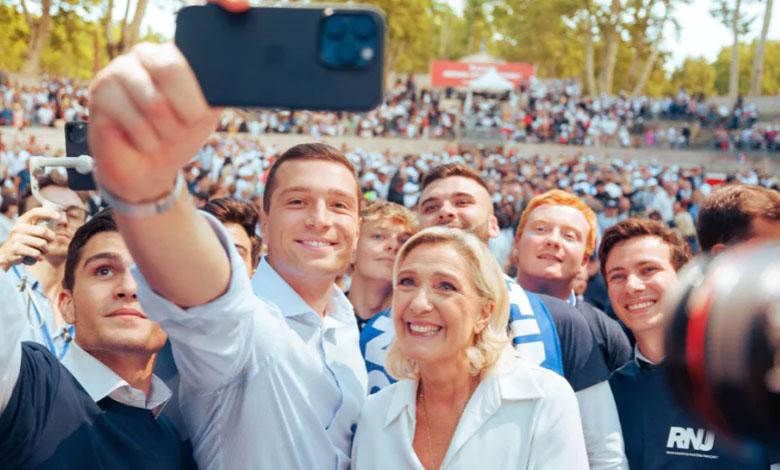
World media and IA “FACT”, in particular, widely highlight the verdict of the French court, which found the leader of the “National Union” Marine Le Pen guilty of embezzlement of the funds of the European Parliament. Court appointed she was sentenced to 4 years in prison (two of them suspended), a fine of 100,000 euros, but the most important thing is a five-year ban on running for office, which makes it impossible for her to participate in the 2027 presidential race. And although an appeal is possible, the verdict takes effect immediately.
The court’s decision caused a real social explosion. Supporters of Le Pen – famous politicians, public figures, even some journalists – spoke about political persecution. They consider the sentence an attempt to crack down on the opposition and undermine the essence of French democracy. Instead, critics insist: the case is not about politics, but about the principle – no one is above the law. And if the accusations are serious, everyone should be responsible for them, regardless of surname and rating.
Jordan Bardella – the face of the replacement: when the far right is not looking for a radical, but a hate manager
Against the background of the scandalous removal of Le Pen from the political arena, the attention of the world’s politicians headed on her young successor – 29-year-old Jordan Bardella. The president of the National Union, a favorite of Le Pen and the son of Italian immigrants, he represents the new face of the far-right: charismatic, stylish, brilliantly oriented in social networks. It is he who is currently briefly and vividly shaping the language of the far-right TikTok era.
His star is rising rapidly, and his name is becoming more and more frequent sounds in conversations about the 2027 presidential elections. However, behind the facade of media success, critics see a lack of experience, a superficial understanding of political processes and doubts whether he will be able to go beyond the boundaries of the far-right electorate and really claim the role of a national leader.
Every political dynasty has its shadow. Marine Le Pen has Jordan Bardella. But this shadow over the years becomes almost full figure. If Le Pen led a frontal attack, Bardella is waging a hybrid war. If Marin played the role of a woman challenging the system, then Jordan wants to lead this system, only by changing its face.
Jordan Bardella was born in 1995 in the suburbs of Paris, where migration is an everyday reality. Raised in a family with Italian and Algerian roots, he looks at migrants not from the top down, but from the inside. And that’s why he can hate them.
It is his origin from the “periphery of the republic” that makes him the new archetype of the French right: not a nationalist aristocrat, but a smart, ambitious manager of malice, ready to wrap racism in a shiny TikTok package.
He is 16 years old entered to the “National Front”, at 23 he became the face of the election campaign for the European Parliament, at 27 he headed the party. And this without scandals, radical statements, only confidently repeating theses about “French identity” and “immigration order”.
Meaningfully, he does not depart from Le Pen’s line: the same anti-immigration appeals, the same mistrust of the EU, the same piety to the “strong hand”. But also in another form. Bardella is a politician of the TikTok era. He makes far-right ideas acceptable to Gen Z: not through xenophobia but through memes, not through fear but through style. He does not bang his fist on the table like the old rightists. He smiles when he talks about deportations. “Bardella is a right-winger who knows how to smile at meetings with European bureaucrats.” And this is its strength. This is what is scary: we are used to aggressive populism as something obvious. Bardella instead offers populism as a comfortable alternative: they say, nothing personal, just that the nation has the right to homogeneity.
After Le Pen’s verdict, he pond not just a de facto leader. He became a symbol of the “legitimacy” of the far-right. Young, without criminal marks, with impeccable French diction, he is able to convince not only the electorate from the flanks, but also the center.
His already are cooking as a 2027 presidential candidate. And unless there is a force majeure, Bardella is the main competitor of Emmanuel Macron or his successor. He doesn’t look dangerous. And that’s why it’s dangerous.
Today, Bardella still talks about the “values of Le Pen”, but this is only a tactical move. He has his own team, his own style, his own electoral base. He does not fight the system – he wants to rewrite it.
Fiction as a political practice: Le Pen’s sentence is a sentence for European populism
Marine Le Pen has always been able to replace reality with images. The image of a strong woman who challenges the establishment. In the image of a mother who “fights for France”. The image of an “anti-system” politician who seems to be standing aloof from the corrupt elite. But the fiction only works until it is considered by the court.
The court in Paris recognized: Le Pen together with 26 associates was part of a well-established scheme with fictitious assistants in the European Parliament. The scheme is classic, even banal. The aides, who allegedly worked in Brussels, were actually involved in party activities in France and received money from the pockets of EU taxpayers. According to the investigation, it is said about at least 4.1 million euros.
The most interesting thing: this very “fiction” became the cornerstone of Le Pen’s program on the fight against EU corruption. While Europe was struggling with Russian aggression, an internal erosion was brewing within its walls, symbolized by those who cloak fraud with narratives of national sovereignty.
During the trial, investigators provided documents that clearly showed that at least 10 of Le Pen’s aides were “hired” to work in the European Parliament, but were actually carrying out internal party assignments in France. E-mails, schedules of meetings, testimonies of former employees have become evidence from which we cannot hide behind the slogan “Let’s protect France from the bureaucrats of Brussels.”
Le Pen’s defense argued that “working for the party is also working for a European deputy.” But according to this logic, the distribution of leaflets at the bazaar should be paid for from the budget of the European Parliament.
This is the first verdict of this magnitude in a case against a far-right party that is no longer marginal. She is part of the mainstream, a partner of Orbán, a friend of the Italian Prime Minister Giorgi Maloni, a Putin sympathizer in the past and a regular guest of Kremlin Today.
And here is the irony: while Le Pen called to “cleanse France of foreign influence”, she financed her party work at the expense of the supranational structure – the European Union, with which she planned to fight.
Why Le Pen’s verdict is not the end, but the beginning of a “great change” in the extreme right
When the court in Paris brought out Marine Le Pen’s verdict, French politics – like Camus’ famous character – suddenly woke up to a sense of absurdity. For the first time in many years, the far-right could not hide behind the rhetoric of “popular sovereignty” and “greatness of the nation.” Before the court appeared not slogans, but banal accounting.
French justice did not give Marine Le Pen what she had fed herself for years – sacrifice. It did not condemn her to exile or political self-immolation, did not ban the party. And it simply admitted: the money of the European Parliament was used for internal activities in France.
And this is banal, criminal waste without myths. This is a verdict not only for politics. It sentence the idea that right-wing populists can parasitize with impunity the very structure they supposedly fight.
Supporters are confused by the question: will Le Pen return? Legally possible. The sentence can be appealed, and the court will hear the appeal until next summer. But it doesn’t matter anymore. Because politics is not only a right, but also an image. And here we have the image of a woman who used to represent an “alternative to the system” and now has tarnished herself with a very “systemic” affair. If Le Pen and will return, then only as a shadow of itself. There is no vacuum in politics, and Jordan Bardella is already filling it.
For the party, this is not just a blow, it is a break with its historical core. A conviction could result in fines, problems with public funding and risks for future campaigns. In terms of reputation, the main thing that allowed the party to expand its electorate is lost: the image of “honest power”. Opponents can now cynically equate Le Pen with the same “corrupt elites” she allegedly fought.
We see the phenomenon of Putin and Orban in the French version: a strong leader who created a movement around him suddenly becomes for this movement is a burden. And then the party either evolves or disappears. It seems that the “National Association” chooses the first – due to the careful transition to Bardella’s generation.
It would seem that the verdict should demoralize supporters. But the far-right voter is not a traditional one. He does not require virtue, but an enemy. And if the enemy is “the whole system”, and the court is a part of it, then any condemnation fuels the rhetoric of “we are being persecuted”. this can be seen from the reaction of the party: its leaders unanimously call the sentence political, and the case itself an attack on the expression of will. And this means: even the defeat of Le Pen can become the victory of the movement created by her. Unfortunately, ideas do not retire with the leader.
The trial of Le Pen is a mirror for Moscow, a slap to Brussels and hope for Europe
Europe is not only a geography, but above all a system of values. And when a French court sentences the leader of one of the most influential right-wing parties, it is not just a criminal case. This is the answer to the question of whether the European Union is ready to resist those who are laying foundations for it under its roof.
The reaction of the European institutions to Le Pen’s verdict was restrained: Brussels does not like public quarrels. But it is worth remembering that the object of the fraudulent scheme is Le Pen steel precisely European money: 4.1 million euros went to fictitious assistants who worked not in the European Parliament, but in the party’s office in France. And here silence is no longer virtue, but weakness.
If Le Pen misused European resources, the silent reaction of the European bureaucracy betrays the very idea of the EU. If the court was silent, it would be Russia. If the politicians were silent, something like Hungary.
The reaction of the Kremlin turned out to be predictable The Russian authorities talked about “political persecution” and “massacre of the opposition”, like this was recently in the case of Milorad Dodik, the pro-Russian leader of Serbian nationalists in Bosnia. This is not because Moscow sincerely sympathizes with the French populist. By simply losing Le Pen, the Kremlin lost one of the key relayers of pro-Russian propaganda in Europe.
It is worth mentioning: in 2014, the Le Pen party received a loan of 9.14 million euros in a Russian bank, and in 2017 met with Putin, openly called the annexation of Crimea legal and called for the lifting of sanctions against Russia.
Now this “loyalty platform” has been destroyed. And for the Kremlin, this is more than a defeat. This is a precedent that can be used in Berlin, Rome, and Budapest.
German politicians – especially from the CDU – already hinted: Le Pen’s sentence is a reminder that politics should not be an indulgence for crime. There is no official reaction in Washington yet, but the expert environment is already interpreting the case as the first serious blow to pro-Russian structures within NATO.
The far right knows how to use defeat as a stepping stone to triumph. Le Pen already blames the system, the court, the state. But there is one detail: she loses with the image of a banal corruptionist, not an idealist.
Such a lesson recently received the leader of Serb nationalists in Bosnia, Milorad Dodik, who was sentenced in February to a year in prison and ordered to leave the post of president of the region for six years for ignoring the decisions of an international representative.
This is also a lesson for Orbán, a warning for Salvini. And for Bardella – an open window of opportunity. It is he who is now becoming the “face of the new generation” of the far-right, not tainted by Russian money. And that is why his candidacy in 2027 looks not only probable, but also strategic.
…After Le Pen’s verdict. the question arises: how widespread is the phenomenon of fictitious assistants in France? And was Le Pen the exception, or just one of many in a system long in need of a purge? Next time we will look at other similar cases to assess where politics ends and criminal liability begins. Perhaps Le Pen’s sentence is not an isolated story, but part of a larger trend? We will ask whether it is appropriate to compare it with the trials of Trump, Salvini, Orbán or Farage. All of them are populists, all of them are under investigation or in court. So how vulnerable are these political figures to the judicial system? And isn’t this about a global confrontation between the “anti-system” and the “system”?
What control mechanisms are currently in place? Is the French system really capable of resisting abuse, or is it only faking transparency, occasionally sacrificing a big name for political balance? Is the social climate changing and do sociologists record the flow of electoral sympathies? What narratives dominate TikTok, Twitter and Telegram? Doesn’t justice turn into another front of political struggle? And the main thing: will Jordan Bardella pull a new right-wing identity, or will he become a compromise figure around which the right-wing spectrum will rally? Or, on the contrary, will the defeat of Le Pen be the beginning of a split and an internal struggle for succession?
Tetyana Viktorova


