
A registry error and a wave of anxiety: how society reacted to the erroneous military registration of women

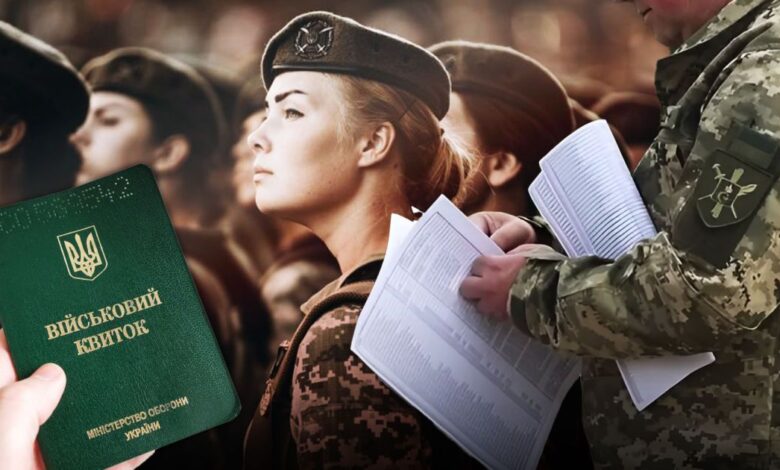
Digital military registration was introduced as a system that was supposed to streamline data, remove chaos from paper archives, and reduce the number of failures that occur during manual work with documents. However, the stories of women who, without medical or pharmaceutical education, found themselves in the “Oberig” registry as conscripts, brought to the surface a much broader problem, because society saw in this situation not an isolated technical error, but a failure that could change a person’s legal status without their participation. This is why the topic quickly went beyond a few private stories and turned into a revealing conversation about trust in state systems, the limits of bureaucratic error, and how the authorities explain such cases in the public space.
What became the reason for the public outcry
The impetus for the wide discussion was the messages of women who claimed that they were registered for military service without legal grounds, without specialized education, and without their own application for registration. Particular indignation was caused by cases where information about the CCK wanted list appeared in the system along with the registration record, since for most people such a combination no longer looks like an official inaccuracy, but as a full-fledged change of status with real consequences.
One of the most notable public cases concerned a woman with a philological education who found herself in the system with a foreign military registration specialty, while other similar stories began to appear in Kharkiv, where women also claimed illegal registration.
Special attention in this story was attracted by the message of psychologist Agata Zakharyan, who stated that she has been on military registration for over a year without her own consent. According to her, she does not have a specialized education that could be the basis for such a status, and she has not undergone training, but in the “Reserve+” system she is listed as a soldier. Another detail makes this situation even more poignant: the woman, according to her own words, found out about the fact of the search by accident, that is, after the decision actually existed in the system and had very real consequences for her.
How society reacts
The indignation of Ukrainians over this fact is explained by the fact that the topic of military registration in Ukraine has long been perceived as an area of heightened sensitivity, where any mistake has much greater weight than an inaccuracy in a regular administrative record. If a person sees an incorrect address or an old document number, they perceive it as an annoying but correctable problem. If the status of a person liable for military service suddenly appears in the state system, the fear already concerns possible restrictions, challenges, checks, and a long process of proving one’s own right. It is this transition from a digital error to a life-threatening risk that has made the topic so acute.
The topic spread very quickly on social media, as people began to recognize in other people’s stories their own fear of a system that operates on a principle that is closed to most citizens. Women share screenshots, describe attempts to find out their status, recall refusals to correct data, and talk about how they accidentally learned about a wanted person or registration. At this level, society reacted emotionally, but this emotionality had a completely understandable basis: it was about the loss of control over personal status in the state register.
In addition, social networks began to talk about the systemic vulnerability of digital accounting, a weak error correction mechanism, and the dangerous logic under which a person is forced to independently prove that the state system entered them into the register without grounds. Society saw this as a broader problem: if such a failure is possible, then how reliable are other data accumulated by state registers?
Another layer of reaction concerned the attitude towards digitalization itself. Some people began to perceive it without initial optimism, because the idea of rapid data exchange between systems loses its appeal at the moment when an erroneous entry gains the force of official status. That is why in the public assessment this topic sounded much broader than a simple dispute around specific CCCs. The question of whether a citizen can trust the state register if the change in his status occurs without explanation, and returning to the factual truth requires effort, time and, in some cases, judicial intervention, was at the center.
Additional tension is also created by the asymmetry of power between a person and the system. The register works as a strong administrative construct, an entry in which has immediate consequences, while the mechanism for correcting errors moves more slowly and requires activity from the person himself. In public perception, it looks as if the state makes mistakes quickly, but recognizes and corrects errors much more slowly. It is this imbalance that generates the deepest irritation, because the citizen sees before him a system that easily assigns status, but not as easily cancels it.
Reaction of the Ministry of Defense
The position of the Ministry of Defense in this story boils down to several key theses. The department admits that state registers may contain some inaccuracies, and explains this by the large amount of mobilization work, the human factor, and problems that arise during data entry or synchronization. In public explanations, the ministry also emphasizes that automatic processing of information is designed to simplify registration, reduce queues and eliminate unnecessary paperwork, but at the same time leaves the citizen with the obligation to contact the CCC if erroneous data is detected.
Actually, it was this part of the official comment that became the subject of particularly careful public reading. For the state, the error looks like an inaccuracy that can be corrected through an appeal, documents and a clarification procedure. For a person who has already found himself registered or wanted, the situation is of a completely different scale, because he is faced with the need to prove the absence of the status that the system assigned to him.
Because of this, the official reaction of the Ministry of Defense is perceived with restraint: the department recognizes the existence of a problem, but its explanation is focused on the technical side and the correction procedure, while society is waiting for a clearer answer about the causes of such cases, about responsibility for incorrect records and about guarantees that the situation will not be repeated.
Official explanations turned out to be insufficient, primarily due to the gap between the administrative language of the state and the real experience of people who have encountered the problem.
A certain irritation arises from the feeling that public The authorities’ communication on this topic is too cautious and too general. People want to hear a specific answer to a specific fear: why did a woman without a medical or pharmaceutical education end up in the system at all, how often does this happen, who checks the correctness of data entry, and what is the quick, clear mechanism for removing an erroneous entry. As long as these questions remain without a clear public answer, anxiety only increases, and each new case begins to be perceived as evidence of a deeper problem.
The consequences of this situation go far beyond the topic of military registration of women. The idea is being entrenched in the public consciousness that a state digital system can mistakenly grant a person a sensitive legal status, after which the person himself will have to look for a way to prove his or her innocence. This logic gradually erodes trust in institutions, as citizens begin to perceive the state not as an arbiter capable of quickly correcting its own failures, but as a cumbersome mechanism to which one must justify oneself even in the event of an obvious mistake.


