A tragic series of terrorist attacks and fatal consequences for police officers: the price of managerial gaps in the Ministry of Internal Affairs

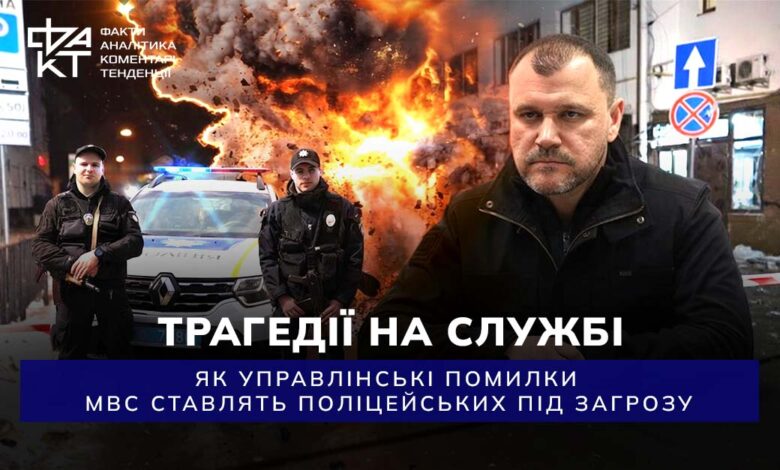
The wave of targeted attacks on law enforcement facilities that swept across Ukraine in February highlighted the critical vulnerability of the police to professional sabotage. The tragic events in Lviv, Mykolaiv, and Dnipro demonstrated that a regular call-out has turned into a high-risk zone, where police officers become targets on a planned basis. The law enforcement system, which for years relied on the outdated inertia of peacetime, is forced to urgently adapt to the realities of today in the fourth year of the war. The issue now is not so much a change in action algorithms, but the ability of the Ministry of Internal Affairs leadership to finally move from post-facto actions to effective management, strategic thinking, and qualified training of subordinates.
A challenge as a trap: how a series of explosions in Dnipro, Mykolaiv and Lviv exposed the weaknesses of the police
High-profile incidents indicate systematic attempts to destabilize internal security through targeted attacks on law enforcement agencies. The latest event was the evening explosion in Dnipro on February 23, which took place in the administrative building of the police in the Amur-Nizhnyodniprovsky district. Despite the fact that the blast wave left behind shattered furniture, broken glass and damaged computer equipment inside department No. 1, and also damaged a car parked nearby, according to the National Police, human casualties were avoided. From now on, the facility is surrounded by explosives technicians and forensic experts who are trying to reconstruct the detonation mechanism and establish the circle of those involved.
Along with the event in Dnipro, the same evening a dramatic situation unfolded in Mykolaiv, where at around 18:20 an improvised explosive device went off at a gas station. The location was not chosen by chance, as the gas station borders the administrative building of the regional patrol police department, which indicates a clear focus of the sabotage against security forces. According to the Prosecutor General’s Office, the consequences were tragic, as seven police officers were injured to varying degrees of severity, with doctors assessing the condition of one of them as critical. Given the scale of the damage, the Security Service of Ukraine has launched a pre-trial investigation into the qualification of a terrorist act that caused serious consequences.
The geography of such incidents over the past winter month extends far beyond the southern and central regions, covering Odessa, Kolomyia, and Lviv. The most saddening was the episode in Lviv, which occurred on February 21 during a routine patrol crew’s response to a call about a robbery at a store in the city center. The insidious detonation claimed the life of a 23-year-old police officer, turning a routine duty trip into a scene of tragedy with crushed vehicles and victims. Although the alleged perpetrator of this terrorist attack has already been detained and reported on suspicion, investigative actions are ongoing to expose the entire network of organizers.
Analyzing these events in total, the leadership of the state and the security bloc sees them not as isolated criminal acts, but as a planned campaign of external influence. The main version currently being worked on by the special services is that the Russian Federation was directly involved in organizing these explosions, which are intended to sow panic and undermine trust in law enforcement institutions in the rear cities of Ukraine.
From response to prevention: preparing a new algorithm of actions
The need for a radical revision of approaches to public security forced the Ministry of Internal Affairs to initiate the development of an updated algorithm of actions for law enforcement agencies when processing calls received via special communication lines. The implementation of this initiative was announced by the head of the department, Igor Klymenko, during a briefing in the capital, emphasizing that the finalization of the new protocols is expected within the next few days.
The scale of the planned changes goes beyond the competence of the National Police alone, as the modernized approach should become a universal standard for all law enforcement agencies involved in maintaining law and order and responding to potential threats. The central element of the future strategy should be the large-scale integration of specialized technical means and the involvement of narrowly specialized units directly at the stage of the initial inspection of objects for which alarm messages are received. At the same time, the priority direction is the active use of the potential of canine services and specialists of explosives departments, which will allow for a deeper and better inspection of incident locations without loss of efficiency. Igor Klymenko noted that the main difficulty lies in maintaining a balance according to which the strengthening of control measures should not lead to a slowdown in the pace of providing assistance to citizens or a decrease in the efficiency of responding to calls.
The process of implementing new rules is directly related to the modernization of the technical base and the revision of existing systems for filtering information received from the population through emergency communication channels. Such a transformation is due to the objective challenges of modernity, in particular, the activity of sabotage groups that are trying to adapt civilian infrastructure to prepare illegal actions.
It is expected that thanks to the strengthening of operational checks and improvement of security protocols, the law enforcement system will be able to more effectively counteract hybrid threats, and new standards of work should be deployed in all regions of the country by the end of this week.
Late reaction of the Ministry of Internal Affairs leadership
The minister’s late reaction to a series of explosions and sabotage raises a natural question about the reasons for the inertia of the Ministry of Internal Affairs leadership, which began to reform security protocols only after numerous incidents and human losses. It is worth recognizing that for a long time the domestic security vertical functioned within outdated orders that did not take into account the evolution of the methods of sabotage groups, which increasingly use civilian objects as cover for attacks.
The situation when response algorithms are revised not in advance, but “on the heels” of tragedies, indicates the dominance of a reactive approach over a preventive one, although the risks of using hotline calls as a tool for ambushes have been obvious to the expert community since the beginning of the full-scale phase of the conflict.
The lack of systematic integration of canine and explosives units into daily patrol activities up to this point indicates a certain managerial vacuum in police activities. Previous methods of work often relied on a visual inspection or superficial check, which, in the conditions of using disguised improvised devices, turned out to be a fatal gap in the safety of personnel. The need to attract additional technical means, which is today spoken of as urgent modernization, is actually a forced patching of holes in the system, which should have been adapted to hybrid threats at the stage of the first reports of the activity of enemy DRGs in rear cities.
In addition, the technical dependence of the new protocols on the presence of dog handlers and special equipment on each potentially dangerous call calls into question the system’s ability to provide the same speed of response as before.
However, the main thing is that the leadership of the Ministry of Internal Affairs did not provide sufficient training for police officers to work in conditions of increased threat, and training scenarios with explosive and sabotage situations remained outdated, which made each trip potentially dangerous. At the same time, the lack of an integrated system for collecting and filtering signals from the population complicated the early detection of suspicious actions.
The Ministry of Internal Affairs should implement a comprehensive preventive strategy that involves regular threat analysis and assessment of weaknesses in regional units, involvement of explosives technicians and dog handlers at the initial response stage, updating tactical protocols taking into account the experience of sabotage attacks. At the same time, qualified systematic professional training of police officers for work in dangerous conditions and strengthening control over objects near mass gatherings of people and critical infrastructure should be mandatory. As is known, it has been carried out formally for years.
Analysis of the technical support of patrol crews by the time of the announced changes highlights the systemic gap between declarative readiness and real ability to detect threats at the early stages. Until now, most line units have relied on visual inspection and basic tactical security skills, which are powerless against professionally planted improvised explosive devices with remote or combined control. The lack of portable gas analyzers or compact mirrors for inspecting hard-to-reach places in the standard equipment of a patrol car turned each check into a risky event, where the life of a law enforcement officer was at risk.
The lack of portable short-range electronic warfare equipment that could block mobile communications signals or radio frequencies in the crew’s work area made police officers vulnerable to explosions as they approached the target. In the situation with the Lviv tragedy, it was the lack of preventive technical scanning of the perimeter that allowed the attackers to implement a fatal scenario, which emphasizes the critical obsolescence of the previous response model. Even the presence of bulletproof vests of the appropriate protection class is not able to neutralize the explosive effect of an explosion in a confined space or when exiting the car, if the source of danger was not localized in advance.
Experience of training police officers in foreign countries
The experience of countries that have been in a state of permanent threats for years demonstrates that effective protection of law enforcement officers is based on the implementation of an active prevention system. The most illustrative example is Israel, where the algorithm for responding to a call to the “red zone” excludes direct contact of the patrolman with the object until the completion of the technological reconnaissance cycle. The Israeli police actively use mobile drones for initial perimeter inspection, which allows detecting ambushes or hidden explosive devices without risk to the lives of officers. Such a strategy turns the patrolman from the “first target” into the coordinator of a high-tech operation, where human resources are involved only after minimizing all unknown factors.
Another example of successful adaptation is the experience of Northern Ireland, where the Police Service (PSNI) has been improving methods of countering booby traps and improvised explosive devices for decades. Local security standards include a strict ban on setting predictable routes and patrol schedules, which is critical to preventing planned terrorist attacks. Each police car in the region is effectively an autonomous fortress, equipped with electronic warfare systems to block remote detonation signals and specialized scanners to check the road surface. This allows you to neutralize the threat even at the stage of approaching the potential attack site, not giving attackers a chance to successfully detonate.
In the United States, in particular, within the framework of the programs of the Ministry of Homeland Security, the emphasis is on seamless integration of various services when responding to suspicious calls. The American model “Integrated Response” provides that patrol officers undergo in-depth training in recognizing indicators of explosive devices, but have clear instructions according to which, if the slightest anomaly is detected, they are obliged to immediately transfer control to specialized EOD (Explosive Ordnance Disposal) units.
The use of robotic platforms for inspecting premises in the USA has become a standard even for municipal departments, which has significantly reduced the number of victims among law enforcement officers during the inspection of mined buildings. Ukraine, adopting these models, should understand that foreign success is caused not only by the presence of, for example, robots, but primarily by iron discipline in adhering to protocols, where speed is never put above safety.
In general, abroad, professional training of police officers occupies a central place in the system of law enforcement agencies, because the effectiveness of responding to complex situations and public trust depend on the level of their training. There, training programs combine deep legal knowledge with practicing realistic scenarios, including crisis and extreme situations, as well as developing communication and conflict de-escalation skills. Special attention is paid to the integration of modern technologies, simulators and training in a real environment, which allows police officers to gain practical experience before going on patrol, reducing risks for themselves and citizens. Moreover, the classes are conducted by experienced police officers, true professionals who pass on their knowledge and skills to the new generation.
It is worth understanding that further modernization, which the leadership of the Ministry of Internal Affairs declares, will require not only rewriting instructions on paper, but also huge investments in the purchase of robotic platforms for inspecting premises and specialized containers for evacuating suspicious objects. If these measures are limited only to changing the sequence of reports into the walkie-talkie, then the risk of repeating tragic incidents will remain high due to the preservation of the technological advantage of saboteurs over patrol police. The transformation of the system must occur by saturating each crew with engineering intelligence tools, otherwise the updated algorithms will remain only an attempt to justify to society for lost opportunities to act proactively.
Ineffective management by the leadership of the Ministry of Internal Affairs, erroneous decisions, the lack of preventive measures and systematic qualified training of police officers make the law enforcement system of Ukraine vulnerable to crime, in particular, professional sabotage. The tragic incidents of the past month demonstrate that every call-out is turning into a potentially deadly operation. If the Ministry of Internal Affairs does not change its approach to its work, personnel losses will continue, and trust in the law enforcement system will fall even further.