
Billionaire bunkers: how fear of global catastrophe turned into an obsession with underground rescue

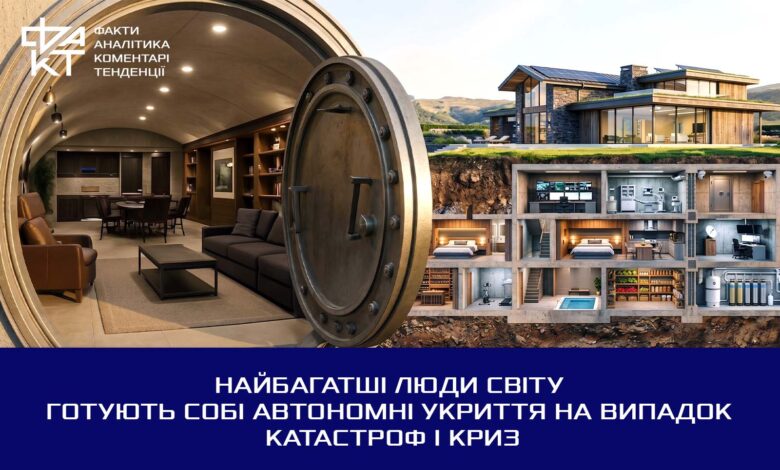
While most people are getting used to living between wars, pandemics, climate and environmental disasters, the world’s richest people are responding by buying islands, gated estates and building luxurious underground bunkers that can operate autonomously for months or even years. What recently seemed like a bizarre hobby of Silicon Valley billionaires has turned into a separate industry of fear in 2025-2026, where they create not just concrete shelters, but the ability to separate themselves from the chaos of the outside world. And the more expensive and complex these projects become, the harder it is to perceive them as an eccentric whim of people with too much money.
Billionaire bunkers: luxurious fear of a major catastrophe
The fashion for private bunkers among billionaires has been formed in waves, and each major global crisis has only pushed it to a new level. Back in the early 2010s, bunkers were mostly associated with state military facilities, but within a few years they had become part of the private world of the super-rich, who were increasingly relying less and less on the stability of states and the global security system.
The first noticeable surge began in 2016–2017, when the media started talking about “Silicon Valley preppers” and society was growing anxious about political instability in the United States, the war in Syria, and nuclear threats from North Korea. It was billionaires and representatives of the tech elite who began actively buying up land in New Zealand, which was perceived as one of the safest regions in the event of global chaos, and companies building bunkers reported an explosive growth in orders.
The COVID-19 pandemic in 2020–2021 turned these fears from theoretical scenarios into practical experience: lockdowns, panic, overwhelmed hospitals and empty store shelves showed how quickly the usual world can stop. After that, the bunker finally ceased to be perceived as an eccentric whim of rich eccentrics and began to be included in the set of “mandatory” elite infrastructure – along with security, autonomous energy and closed territories.
The latest wave began after Russia’s full-scale invasion of Ukraine, when the fear of war and even nuclear conflict again dramatically changed the market and finally turned into a separate multi-billion dollar industry. Billionaires from different countries are increasingly actively investing in underground storage, in 2025–2026 this phenomenon grew into a global trend, which was called “prepperism” among the elite. This almost fashionable formula is not a romantic survivalist approach, but a sober calculation by those who have enough resources to prepare a backup escape route for a future catastrophe.
Technology moguls and the wealthy increasingly view global upheaval scenarios as a risk that cannot be simply brushed aside. The list of fears that drive them to build bunkers includes World War III, new pandemics, climate catastrophes, and large-scale man-made accidents. For people accustomed to managing risk through investments, the fear of a “doomsday” takes the form of an architectural project with concrete walls, autonomous systems, and a closed territory.
It should be noted that New Zealand, Hawaii, and other remote regions have become particularly attractive spots on the map for those looking for space away from overpopulated centers and potential zones of chaos. There, the underground structures of billionaires are being built as luxurious complexes with swimming pools, spas, cinemas, golf simulators and other attributes of life, in which even a catastrophe should not destroy comfort. Such a contrast looks almost grotesque: above ground, world security may be in doubt, while underground, a private island of stability with the services of a luxury resort is planned.
The scale of these plans also speaks for itself, because companies are already offering not individual shelters, but entire networks of underground bunkers. The cost of one such project can reach $ 300 million, which turns the fear of a catastrophe into a separate market for super-rich clients. Where most people imagine an alarming suitcase, a supply of water and the nearest shelter, billionaires are ordering infrastructure that should preserve their usual standard of living even in the event of a global collapse.
The most interesting thing about this trend is not that rich people want to survive, but how they imagine security. For them, it increasingly resembles a privatized space, separated from the general risk by a layer of earth, concrete and money. In this situation, the bunker is both a technical object and material evidence of the deep anxiety of those who have access to the best information, the best consultants and the most expensive solutions.
Underground addresses of fear: which billionaires are preparing an alternative world for themselves
One of the most famous examples of the construction of elite bunkers is the project of the American media magnate, co-founder and CEO of Meta Mark Zuckerberg on the Hawaiian island of Kauai, which has become a symbol of how the private security of the richest people in the world is moving into the format of large closed complexes. The choice of such locations looks indicative, because the elite is looking not just for shelter, but for a long distance from a world that they themselves consider to be increasingly unpredictable. Mark Zuckerberg has invested more than $270 million in a 566-hectare estate, which includes a 465-square-meter underground bunker with tunnels, an autonomous power supply, food and water supplies, and blast-proof airlocks. From the outside, the complex looks like a luxurious billionaire’s ranch, but its internal logic is closer to that of an autonomous fortress: land, security, access control, closure, and a space where you can isolate yourself from the world if it suddenly becomes dangerous.
PayPal co-founder Peter Thiel is another prime example, his project near Lake Wanaka is located on the South Island of New Zealand in the Otago region at the foot of the Southern Alps. Thiel owns a plot of 193 hectares, his bunker looks like a luxurious, maximally closed complex, partially inscribed in the hills so that the architecture seems to be hidden in the landscape. For such people, this country works almost like a geographical safe: far from major centers of tension, politically stable, surrounded by ocean and self-sufficient enough to seem like a place where you can survive a major breakdown of the usual world.
It should be noted that in New Zealand, the story of billionaire bunkers is different from Hawaii: here there is less ostentatious luxury and more secrecy, legal disputes and resistance from local authorities. For a part of the techno-elite, this country has become a convenient point on the map of possible salvation, but buying land does not mean the right to build whatever you want. Local authorities did not approve Thiel’s plan to build a huge residential complex above the bunker. So, even the billionaire’s money did not remove the main question: should unique natural areas become closed private storage facilities for those who are preparing an emergency exit from an unstable world.
In addition to Zuckerberg and Thiel, the topic of elite prepping has long been overgrown with names that reflect different forms of the same fear: some build underground shelters, some buy land in remote places, and some create an almost autonomous private world for themselves. Jeff Bezos, an American entrepreneur, founder and former CEO of Amazon, as well as the founder of the aerospace company Blue Origin, who as of May 2026 is one of the richest people in the world with a fortune of about $ 224–280 billion, chose not an underground bunker in the literal sense, but another format of protected isolation. His choice was Indian Creek Island near Miami, which is called the “Billionaires’ Bunker” due to its isolation, security, and concentration of super-rich residents. His several estates in this area look like a real terrestrial fortress.
Oracle co-founder Larry Ellison has gone even further, as his history is connected with the Hawaiian island of Lanai, a significant part of which he owns. This security format is much broader than a bunker, as it involves control over land, infrastructure, energy, farming, tourism, and the very rhythm of life in an isolated territory. If Zuckerberg built an autonomous complex inside the island, then Ellison is actually working with the island as a private model of the future, where protection is created not only by walls, but also by the ability to control the environment.
An American entrepreneur, investor, and visionary who, as of May 2026, is one of the most influential figures in the world of technology, Sam Altman has become one of the most outspoken representatives of the techno-elite, which does not hide its preparations for crisis scenarios. He often declares about stocks of weapons, gold, antibiotics, water, batteries, and gas masks, as well as readiness to evacuate to a safer place in the event of a major disaster. He is the owner of a luxurious underground palace and a typical representative of the logic of Silicon Valley thinking: people who create the future through artificial intelligence, global platforms and technological breakthroughs, at the same time prepare for the moment when this future can turn into a global catastrophe.
For years, stories about private underground shelters have been circulating around one of the most influential visionaries in the world, known as Microsoft co-founder Bill Gates. However, his story differs from the classic stories about private “doomsday bunkers”. Under his main estates, protected underground areas are equipped, and in 2026, luxury storage manufacturers stated that he had 11 such facilities. His main residence, Xanadu 2.0, in Washington state, attracts the most attention: this estate is partially buried in the ground, which helps maintain a stable temperature, has a private tunnel system, hidden passages and an underground garage for 23 cars.
At the same time, Gates is the main sponsor of the World Seed Vault in Spitsbergen, but this is not his personal bunker, but a global project to preserve plant seeds in case of a major catastrophe, which was supported by charitable initiatives associated with him. That is, his actions represent not a private escape of a rich man from a possible catastrophe, but an attempt to preserve the biological stock of the planet for it. Here the line between personal prepping and global insurance becomes especially noticeable, because some prepare shelter for themselves, while others invest in systems that should survive even the collapse of the modern world.
Reed Hoffman, the co-founder of LinkedIn, didn’t become famous for a specific underground palace, but his words have become one of the most accurate explanations of the mood in Silicon Valley. He said that buying real estate in New Zealand has effectively become a code phrase for “apocalypse insurance” among some billionaires. There is an almost cynical elegance to this detail: instead of the crude word “bunker,” the polite language of investment is used, instead of panic, it is land purchase, instead of fear, it is “risk diversification.” This is how the prep of the super-rich differs from the usual anxious suitcase, because where the average person thinks about water, documents and the nearest shelter, the billionaire thinks about the country, private property, the logistics of escape and the opportunity to live separately from the crowd.
Brothers Andrew and Tristan Tate, British-American influencers and former kickboxers known not only for their scandalous publicity but also for their criminal cases in Romania, are also building a luxurious bunker. As of May 2026, their project is in the process of being implemented. They ordered the underground complex in 2024–2025, and by early 2026 it was already being prepared for installation. The most interesting detail is the location of the construction: the bunker is not to appear on a remote island or in the mountains, but on the territory of their estate in Bucharest. This is the same residence that has already featured in high-profile searches and where the brothers were under house arrest.
So, all these examples show how the topic of bunkers has become a convenient language for describing status, fear, and demonstrative power. They agree on one thing: the super-rich increasingly think of security not as a guard at the gate, but as a separate space in which to wait out a world that has gotten out of control.
The scale of this issue is even more clearly seen in the example of companies that sell an underground version of luxury living. One of the most famous projects is Aerie – a network of ultra-expensive underground residences with medical areas, robotic staff, private apartments and systems of complete autonomy. The cost of such facilities can reach hundreds of millions of dollars, and here fear is sold in the package of comfort. The client is promised not just survival, but the opportunity to maintain a familiar way of life even underground. What is most striking in these projects is the stubborn desire to turn a catastrophe into a controlled scenario for a narrow circle of people who can afford a separate reality. For them, it is a kind of “apocalypse insurance”. According to LinkedIn co-founder Reid Hoffman, more than 50% of Silicon Valley billionaires have already purchased some kind of “escape place.”
Ukrainian bunkers during the war: from private shelters to closed estates of the elite
In Ukraine, the story of bunkers is of a completely different nature than in Silicon Valley or among American billionaires who build themselves an alternative world in case of a hypothetical catastrophe. Full-scale war has turned the shelter from an exotic symbol of anxiety into a separate construction industry, which arose not because of the fashion for survivalism, but because of the daily need to protect themselves from missile strikes and drone attacks.
Owners of private homes are massively ordering concrete and steel shelters for their yards. A few years ago, such a structure would have been perceived as a strange whim, while in 2025–2026 it is increasingly becoming as practical a part of the house as a generator or an autonomous heating system. In this market, a clear line has already been formed between budget modules costing from a few thousand dollars and premium underground houses like the “Shov” project, which provides kitchens, bedrooms, air purification systems, autonomous power supply and water supplies for a long stay underground. In some individual projects, the cost of such shelters already exceeds 200 thousand dollars, but even in this case they are purchased not for isolated life after the “end of the world”, but for quite real protection from war, which has long ceased to be an abstract threat.
Even more significant has been the emergence of large social and state projects that are gradually changing the very idea of civil infrastructure in the country. In 2025–2026, Ukraine is actively building so-called “Civil Citadels” — modular underground complexes for communities, hospitals, and schools, designed for dozens of people and capable of operating autonomously even in the event of long-term power or communications outages.
Similar facilities are already appearing in cities that have experienced occupation or massive shelling, in particular in Borodyanka, and they convey the Ukrainian attitude to shelters much more accurately than stories about billionaires’ underground swimming pools. At the same time, Ukrainian companies like SmartBunkersUA are creating systems that allow people to live underground for up to two months, and office and commercial property owners are increasingly building fortified premises for employees, because without shelter, it is difficult to even rent out a business center today. Against this background, the difference between the Ukrainian and foreign logic of bunker construction becomes especially noticeable: in foreign countries it is about an attempt to escape from a possible future catastrophe, while in Ukraine the underground space has become a part of everyday life during a real war.
As for Ukrainian oligarchs and billionaires, this topic remains much more closed than the stories about Zuckerberg’s or Thiel’s estates. Owners of elite real estate near Kyiv do not advertise what kind of fortified premises they have under their houses. And this is understandable, because during a war such information concerns not only comfort, but also avoiding irritation of the majority of society, safety, security and evacuation routes. However, the logic of development in Koncha-Zaspa, Kozyn and other elite suburbs has changed a long time ago: the underground level in such estates is designed as a protected space with autonomous power supply, ventilation, water supplies, communications and the ability to be there during shelling.
The underground complexes of billionaires speak louder not about the end of the world, but about distrust in the world they themselves help build. People who made their fortunes on globalization, technology, financial markets and a belief in boundless progress are now buying islands, fortifying estates, designing autonomous systems and hiding fear under the architecture of luxury. There is a cold irony in this: the future they have been selling for years as a space of opportunity increasingly looks to them as a threat from which they must have a private escape. The bunker in this story becomes a portrait of an era where security is turning into a commodity with a price tag of hundreds of millions of dollars. The most acute thing here is not even that the elite wants to survive, but that they are increasingly less pretending to plan to survive together with everyone else.
Behind all these stories, we can see not a fashion for exoticism, but a changing idea of security among people who can afford almost any scenario of salvation. There is no romance of survival in this, just a very sober recognition that even the richest no longer take stability in the world for granted.


