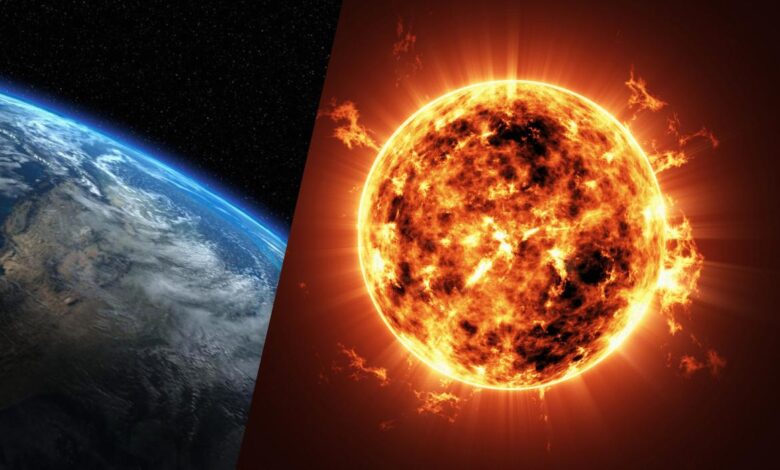
A powerful flare was recorded on the Sun, after which a coronal mass ejection occurred in the direction of the Earth – a cloud of charged particles and magnetic fields. According to data from the Space Weather Prediction Center (SWPC) of the US National Oceanic and Atmospheric Administration, the ejection could reach Earth and cause a geomagnetic storm.
As reported by Space, on April 1, a M5.6-class flare, the second most powerful, occurred in the sunspot region AR4046. Such phenomena can cause short-term radio outages in the polar regions and minor radiation storms, which potentially pose a threat to astronauts.
Since the AR4046 area has moved into the “Earth impact zone”, any coronal mass ejections in the coming days are likely to reach our planet.
The SWPC confirmed that a coronal mass ejection occurred after the solar flare – the release of solar plasma along with magnetic fields. Experts previously believe that the Earth may be affected by this phenomenon on April 4.
At the same time, the main part of the ejection will probably pass the Earth’s orbit. If the cloud of charged particles still affects the planet, a weak geomagnetic storm of the minimum level G1 may occur. At the same time, the residual impact of this phenomenon is predicted for April 5.
SWPC experts also note that the increase in the flow of energetic particles after the flare should not reach a level that would pose a threat to the crew of the Artemis II mission, which will fly around the Moon for the first time in 54 years.
Due to the coronal mass ejection, certain consequences are possible on Earth: disturbances in the ionosphere can cause interruptions in radio communications. In addition, due to the heating and expansion of the outer layers of the atmosphere, the resistance for artificial satellites increases, which shortens the duration of their operation.
Disturbances in the ionosphere can also impair the operation of GPS. During this period, power outages in high latitudes are also possible.
The Earth’s magnetic field holds back most of the energetic particles. Although a small number of them can reach the planet’s surface, this does not cause a significant increase in radiation levels.
For people on Earth, geomagnetic storms do not pose a direct threat. Although some people may experience nausea or headaches, the connection between the deterioration of well-being and solar phenomena requires additional study. At the same time, one of the dangerous consequences of a geomagnetic storm may be the potential harm to astronauts if they are in outer space at that moment. However, there is no direct danger for scientists on the International Space Station due to the relative proximity of the ISS to the Earth.