Age restrictions in social networks: danger for teenagers, Ukrainian dimension and international experience

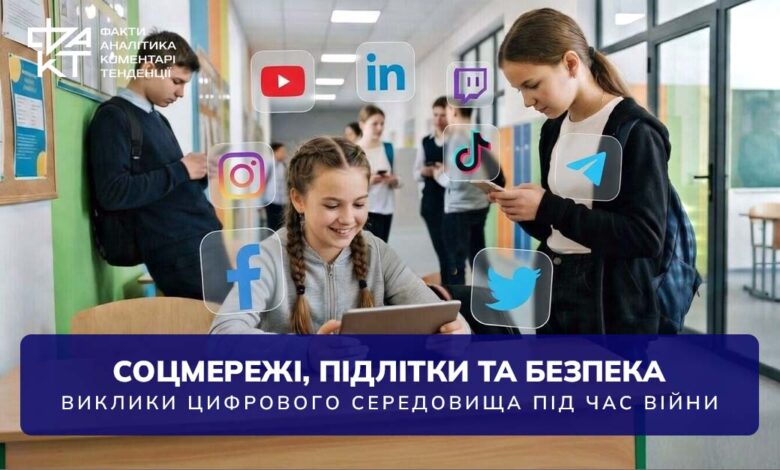
A few years ago, the idea of state restrictions on children’s access to social networks would have seemed excessive and contrary to the very logic of an open Internet. However, recently, regulatory initiatives in this area have been appearing more and more often. In some European countries and the USA, children’s access to social networks has been restricted at the legislative level, introducing age verification and limiting the functionality of accounts. The basis for such decisions is research that records the connection between intensive use of platforms and an increase in the level of anxiety, depressive disorders, cyberbullying and online grooming among teenagers.
For Ukraine, this issue has an additional military dimension. Against the backdrop of a full-scale war, platforms such as TikTok and Telegram have become tools of influence, disinformation and recruitment of teenagers for terrorist attacks, sabotage, arson of military vehicles and correction of missile strikes. In this reality, there is an active discussion in the country about introducing an age limit on social networks, but there is no ready-made bill on this issue yet. However, the main thing is whether the bans will become an effective way to protect minors from informational and psychological influence and criminal use of their vulnerability in wartime.
Telegram as a rear front of war: recruitment of teenagers, political cover-up and regulatory paralysis
For Ukraine, the issue of regulating the digital space has acquired existential importance during a full-scale war, when Telegram became the main platform for enemy IPSO and recruitment. Russian special services cynically use the messenger to involve teenagers in arson of military vehicles, sabotage and correction of missile strikes, which is confirmed by numerous detentions by the SBU.
The discussion about restricting Telegram has been going on for years, because on the one hand, the State Security Service and the Ministry of Internal Affairs emphasize its danger, on the other hand, the Armed Forces of Ukraine use it for their own operations against the Russian Federation. At the same time, the popularity of the service in Ukraine in 2025 reached its peak, counting over 120 thousand active channels and an audience of 433 million subscribers in four years, which makes it too influential a resource for the authorities to easily ignore it.
It should be noted that the political will to regulate Telegram is often broken by the interests of power circles and anonymous million-dollar channels, which have become a convenient tool for media attacks on opponents or silencing uncomfortable topics, such as attempts to eliminate the independence of the NABU in the summer of 2025. After the bloody terrorist attacks in Lviv and Mykolaiv in February 2026, where the perpetrators were found precisely through Telegram, Deputy Head of the Public Security Bureau Iryna Vereshchuk and Minister of Internal Affairs Ihor Klymenko again raised the issue of radical restrictions.
In the conditions of a full-scale war, platforms such as TikTok and Telegram have transformed from platforms for entertainment and communication into channels of targeted influence on teenagers: through them they spread disinformation and establish contact with teenagers, involving them in illegal activities – from setting fire to military vehicles to participating in sabotage and transmitting data for strikes.
Currently, a version of the bill is “hanging” in parliament, which would force the platform to open a representative office in Ukraine and comply with the European Digital Services Act, but real changes are being slowed down by the factor of the probable elections, where anonymous channels traditionally play the role of the main pre-election “mouthpiece” and a platform for discrediting businesses.
Age requirements vs. algorithms: why states equate social media with alcohol and tobacco
The desire of states to protect the mental health of the younger generation from the aggressive influence of the digital environment has turned into a real regulatory expansion, where Australia has become a leader. At the end of 2025, the country introduced perhaps the most stringent mechanism in the world, setting a minimum threshold of 16 years for access to key platforms, such as TikTok, Instagram and X. Interestingly, 77% of the country’s population expressed full support for such a radical cleansing of the digital space.
The foundation for such decisions was a resonant report by the US Surgeon General Vivek Murthy, who directly linked the passion for social media to the epidemic of depression among teenage girls. However, the scientific community is not unanimous, because, for example, scientists from Cambridge and Oxford, whose studies the Australian government used as an argument, accused politicians of manipulating the conclusions. They emphasize that vulnerability to social networks has peak periods:
- 11–13 years for girls;
- 14–15 years for boys.
That is why a total ban may be less effective than targeted protection measures. However, unlike previous attempts at restrictions, the Australian model is deprived of the possibility of circumventing the ban with parental consent, so it places all responsibility solely on the tech giants, threatening them with astronomical fines of up to 50 million Australian dollars for insufficient vigilance. Biometric facial recognition or digital IDs are proposed for age identification, effectively forcing companies to create complex verification systems instead of the usual formal confirmation of date of birth.
The European continent is showing no less determination, but is applying slightly different legal structures, where France has become a pioneer, voting to ban social media for children under 15. The French leader emphasizes that a child’s brain is not a commodity for American or Chinese corporations, so in parallel with online restrictions, the country is scaling up the ban on smartphones in middle and high schools. The French approach, which should be fully operational by September 2026, conceptually connects restrictions in the digital space with physical reality, while simultaneously banning the use of smartphones in secondary education institutions.
The motivation of official Paris is based on scientific findings about the so-called theft of attention and the exploitation of children’s brains by algorithms that push them to depressive states and cyberbullying. Norway is following a similar path, where the government initiated an increase in the age limit to 15, arguing this with the need to protect children from algorithmic dictatorship and inappropriate age content, which, even with parental control, leaks through digital filters.
Similar steps are being taken by Portugal, Spain and Denmark, where the level of social media penetration among children under 13 reaches a shocking 98%, despite formal bans by the platforms themselves. Even in Germany and the Czech Republic, state leaders are in solidarity with the idea of a strict age limit, seeing the platforms as a threat not only to health, but also to social stability.
The US is a patchwork of legislative initiatives, with individual states, such as Florida and Utah, implementing their own rules against the backdrop of a federal debate. Florida has a total ban on creating accounts for children under 14 since 2025, while adolescents 14-15 years old require the formal consent of guardians.
The implementation of these norms in the US constantly faces legal resistance due to the First Amendment to the Constitution, but the trend towards mandatory identity verification and restrictions on “addictive feeds” (from the English. addictive feeds – algorithmically generated news feeds on social networks, designed to maximize the time the user spends on them – ed.) is becoming dominant. States are increasingly considering social networks as high-risk environments that require the same strict regulation as the sale of alcohol or tobacco.
“Silence” of smartphones: a new educational policy against clip thinking
Restricting access to virtual platforms by age is only part of a global protection strategy, because the direct conductor of these destructive algorithms is the smartphone, which often turns from a tool of knowledge into the main factor of distraction within the walls of the school. If the fight against social networks is aimed at filtering toxic content, then the ban on gadgets directly in the educational space is designed to deactivate the very mechanism of “clip thinking” and return students to the reality of live intellectual communication. Since even the most stringent digital barriers lose their meaning when a child spends every break in captivity of endless scrolling, the governments of many countries have come to the conclusion that full-fledged education requires the “silence” of screens throughout their stay at school.
The process of “digital disarmament” of educational institutions as of the beginning of 2026 has become a global trend, covering more than 40% of the world’s education systems and is being implemented through various regulatory approaches: from strict legislative fixation at the national level to flexible autonomous solutions of individual institutions. Back in 2018, France introduced a complete taboo on the use of phones in primary and secondary schools, forcing students under the age of 15 to turn off their devices or leave them in specially equipped lockers.
The Netherlands expanded these rules to all levels of education from September 2025, arguing that smartphones not only reduce academic performance, but also prevent children from building healthy social connections during breaks. Even Sweden, which has been an icon of digitalization for decades, officially announced a return to paper textbooks, recognizing that tablets at an early age negatively affect the development of writing and reading skills.
The UK has also strengthened its stance, with the House of Lords supporting a bill in early 2026 that would give legal force to a complete ban on phones throughout the school day in England, including breaks and lunchtime. This decision replaces old recommendations that were often ignored by school principals, and now British teachers have the official right to search students’ backpacks if they suspect they are hiding a device. In Italy, a strict ban was reinstated after a brief period of liberalization, citing data on a sharp decline in cognitive abilities in children who are constantly distracted by notifications.
Outside Europe, China has the strictest regulations, where primary and secondary school students are prohibited from bringing mobile phones without written parental consent and a justification for pedagogical expediency, and if allowed, the gadgets are handed over to the teacher before the first lesson. In Latin America, Brazil recently passed a law banning the use of personal devices in both public and private schools to protect the mental health of young people. Even Israel has a total ban on phones in all primary schools since February 2026, citing the need to create a healthy social climate free from the intrusion of virtual stimuli.
Methods of implementing such bans vary depending on the technical capabilities and culture of interaction in the country:
- locker system: each student at the beginning of the day puts the phone in an individual locker, which physically prevents access to the device until the end of classes;
- “attention box“: devices are collected by the teacher in special boxes before each lesson, which allows them to be quickly returned in case of emergency communication.
- “hidden gadget” policy: the phone must be in the backpack in the off mode or in the “do not disturb” mode, and violation of the rules usually involves temporary confiscation of the device by the teacher.
Table 1. Comparative effectiveness of restriction methods
| Method implementation | Main advantage | Main challenge | Leading countries |
| Hard locker | Complete impossibility of distraction | High infrastructure costs | France, Netherlands |
| Legislative recommendation | Flexibility for teachers | Difficulty of monitoring each student | Great Britain, Denmark |
| Pedagogical autonomy | Considering the specifics of the community | Risk of conflicts between parents and schools | Ukraine, Belgium |
This global movement to limit gadgets in schools shows that humanity is trying to regain control over its attention, which the modern platform economy has made a bargaining chip. School is once again becoming a space where the immediate presence of the “here and now” is valued, which is critically important for the formation of deep thinking in a world of short videos and instant messages.
In Ukrainian realities, the discussion of banning smartphones in schools has an additional security context, since for many parents the phone is the only thread of communication with their child during air alarms or emergency situations. Minister of Education and Science Oksen Lisovyi emphasizes that Ukraine is not ready for drastic administrative bans, instead proposing a model of a “social contract”, where the rules for using technology are determined by each school together with parents. Education Ombudsman Nadiya Leshchyk supports this approach, noting that the right to communication should not turn into the right to interfere with the educational process, and therefore, turning off the sound and keeping the phone in the bag is the most balanced transitional solution.
The global offensive on digital permissiveness, which is unfolding from the shores of Australia to European capitals, indicates the end of the era of romanticizing technology as an unconditional good. We have reached a point where virtual reality has ceased to be just a world of leisure, turning into an aggressive environment capable of physically destroying destinies through smartphone screens.
For Ukraine, this challenge is doubly difficult, because we are forced not only to fight for the mental health of children, but also to literally tear them out of the clutches of hostile special services that have turned anonymous messengers into a conveyor of sabotage and broken lives. State bans, age restrictions, and school lockers may become necessary protective barriers, but no law will replace the basic responsibility of those who put gadgets in children’s hands.
The modern world requires us to adopt a new, somewhat strict paradigm: being a modern parent today does not mean providing a child with the latest smartphone model, but having the courage to limit their stay online. It is important to realize that social media algorithms and anonymous channels can easily turn from banal entertainment into complex mechanisms of manipulation that prey on children’s attention and vulnerability. However, when introducing bans, the main question is whether they will actually be able to effectively protect minors from informational and psychological influence and the use of their vulnerability in wartime.
When developing and introducing the relevant law, a well-thought-out strategy is needed from the state to control, monitor and ensure the security of the digital environment, while parents should at the same time actively participate in the education of digital literacy and supervision of children’s online activities.