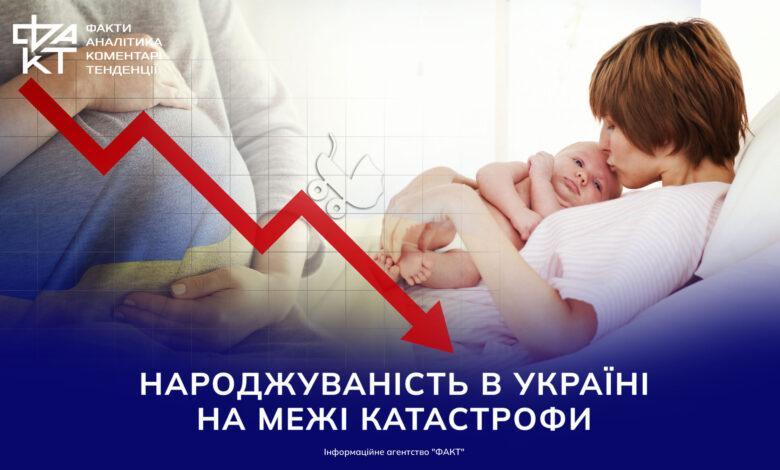
Today, Ukraine faced a harsh reality. The birth rate is falling at a record pace, and now each new generation of Ukrainians is smaller than the previous one. Relentless statistics point to a fundamental shift affecting the economy, the labor market, the pension system, and even national security. Population decline will not only lead to empty kindergartens and schools. The country will face an aging society, a labor shortage, an increase in the tax burden on young people, and the threat that in a few decades Ukraine may find itself in a situation where it will be impossible to restore the demographic balance.
What do the statistics say?
The demographic landscape of Ukraine is inexorably changing. The birth rate is declining at a record pace, the population is shrinking, and society is rapidly aging. During the conference “Demographic future of Ukraine: strategy of stability and recovery. The vision of civil society” was specified a sad anti-record for the birth rate for the entire history of the country’s existence. The international standard of population reproduction is 2.2 children per woman of childbearing age. On average in EU countries, this indicator is 1.5, which indicates a difficult demographic situation in the region. After all, in Ukraine before the start of the full-scale invasion, this indicator was equal to 1.16, and after that it decreased to 0.9. It is also worth noting that in 2024, 495.09 thousand deaths were recorded in Ukraine, which is 2.8 times higher than the number of births – 176.78 thousand.
Even before the start of the full-scale invasion, Ukraine had one of the lowest birth rates in Europe. Similar problems were observed in Spain, Italy and Portugal, which also had low figures. In 2021, there were 116 births per 100 women in Ukraine, while in Spain this figure was slightly higher — 119 children per 100 women. Thus, the difference was negligible. For example, in Malta, this figure was 113 children per 100 women.
That is, Ukraine already had one of the lowest levels among European countries. It is worth noting that in the last decade, a decline in the birth rate was observed in many European countries. Even France, which has traditionally been a leader in birth rates, has seen a decline. If in 2012 the indicator in the country was at the level of simple reproduction of the population, then in 2021 it was only 184 children per 100 women. But the difference between France (184) and Ukraine (116) remained significant.
As you can see, Ukraine is not the only country facing a demographic crisis, but its situation is particularly difficult. If developed countries compensate for low birth rates with migration and high labor productivity, then in Ukraine these levers do not work to their full extent. Every year, the number of children born decreases, and the number of people of working age decreases. And the war accelerates this process with terrible speed. It is clear that such a situation will affect many areas of society and lead to devastating consequences.
The pension system in the country is becoming increasingly unstable, which is caused by a significant decrease in the number of working citizens. The average age of Ukrainians has already increased from 41 to 45 years. And this indicates that in the coming decades, the number of elderly people will significantly exceed the number of young and able-bodied citizens. Such a situation will create serious problems for the economy and social structures. When there are fewer people paying contributions to the pension fund, this leads to a decrease in revenues to the budget, and the main burden falls on those who remain in work. Today, the ratio of pensioners and working citizens is 1:1. If the birth rate does not increase, this balance will be shaken further, which could jeopardize the funding of pensions and the well-being of future generations.
In general, economic growth is also slowing down. A decrease in the number of young people means not only fewer workers, but also the absence of an active generator of new ideas, innovation and technological progress. Startups, usually fueled by the energy of youth, are becoming rare, and economic growth is hampered by a lack of innovative approaches. The labor shortage has already become a significant problem. Now there is an acute need for such specialists as doctors, teachers, engineers, as well as skilled workers. The situation will only worsen in the future, when the decline in the working population will be even more pronounced.
As a result, Ukraine is gradually losing its competitiveness on the world stage. Countries with a young and dynamic population, capable of generating new ideas and developing the economy, are becoming leaders in the development of technology and business, while our country lags behind, reducing its opportunities for rapid progress.
In addition, a low birth rate can seriously affect a country’s ability to recruit and maintain an army. The number of youth is an important resource for the state’s defense capability, and its decrease can become a significant threat to national security.
The factors that lead to declining fertility are multidimensional and reflect the complexity of today’s world. These are not only economic difficulties, but also changes in the social sphere, the impact of war and uncertainty about the future. When life is at stake and tomorrow is full of uncertainty, it is not surprising that many families decide to delay, and sometimes forgo, having children. The risks of combat leave little room for planning for the future, and this forces people to reassess their priorities.
Emigration also plays a role. A significant number of pregnant women went abroad and gave birth to children in other countries. That is, if it were not for the war, all these births would have taken place in Ukraine. We should not forget about the part of the Ukrainian territory that is occupied by the enemy, and because of this, unfortunately, we do not have accurate data on births in these territories. And this is a serious statistical underestimation, which also has a negative impact on the country’s birth rate.
In addition, now more and more young people who could become parents are looking for better living conditions abroad, striving for the security and stability that is lacking at home. They leave not only for a career, but also to provide themselves and their families with more favorable conditions for the future.
Economic instability further complicates the situation. High commodity prices, low wages, expensive housing and education create an atmosphere in which parenthood becomes a luxury not available to everyone. In addition, the change in social priorities also significantly affects the birth rate. Young people are increasingly focused on career development and self-realization, while starting a family and having children are often relegated to the background. If the trend does not change, the country may face serious challenges in a few decades.
How the world is fighting the demographic crisis: successful solutions and failed attempts
Low birth rate is not only a problem of Ukraine. Many countries have been trying to solve this crisis for a long time, and some of them have successful models that can be useful for us as well. At the same time, there are examples when all efforts did not yield any results.
The first and most obvious step is financial stimulation of families. Many countries provide a birth allowance or monthly allowance to parents. France is one of the leaders in supporting families. Here, parents receive not only financial assistance, but also tax benefits, long parental leave and a developed system of free kindergartens. This helped to maintain a relatively stable birth rate.
Hungary decided to take a radical path – to pay huge subsidies for the birth of a child. Women who give birth to four children are completely exempt from taxes for life. But the effect turned out to be weak – money did not solve the problem of emigration and general uncertainty about the future.
Financial assistance is good, but the payments themselves are not enough. People decide to have children when they feel that it will not be a disaster in their career or life.
Sweden and Norway bet on flexibility. Here, both parents can take maternity leave, and part of it must be used by the father. Thanks to this, women return to work faster, and men are more actively involved in raising children.
But Germany preferred comfort. There, they introduced a system under which working mothers can leave their child in kindergarten without any problems, and also reduced the working day for those with small children. As a result, the birth rate began to rise.
Japan faced an acute demographic crisis back in the 90s. Young Japanese people abandoned their families because they were too tired at work. The government tried to change the work culture: they introduced a 4-day work week for some professions, banned overtime work and actively supported the balance between work and family.
When their own population does not give birth to children, some countries solve the problem with the help of migrants. For example, Canada and Australia have developed programs to attract young professionals who are given simplified citizenship. This helps to rejuvenate the population and maintain economic stability.
For a long time, China controlled the birth rate with the “One family – one child” policy, but when the situation became critical, it suddenly allowed to have more children. However, society has become accustomed to living without large families, and the birth rate continues to fall.
Simple solutions such as child support are not suitable for Ukraine – Hungary has already had to do this. Complex approaches work most effectively: financial support, comfortable conditions for families, flexible working hours, affordable housing and quality kindergartens. This is the only way to change the trend and give people confidence that having children is not a burden, but a normal part of life.
To improve the fertility situation, it is important to create conditions that will allow people to feel confident about their future. One of the steps could be access to housing loans, expansion of social programs and reduction of the tax burden on parents. This will allow families to have more financial freedom and reduce stress from financial difficulties.
It is also necessary to provide a safe environment for living. A cessation of hostilities, a stable economy and reliable social guarantees will give people confidence in the future, which will be a powerful incentive to start families.
Labor market reform is also of great importance: competitive salaries, the ability to combine a career with family responsibilities and comfortable working conditions can significantly improve the lives of citizens.
Favorable conditions for women are another important component. Flexible work schedule, access to quality medicine and guarantees of return to work after maternity leave will allow women to combine motherhood with career achievements.
Stimulating the return of Ukrainians from abroad is equally important. If people see real prospects in Ukraine – with a developed economy, stability and the opportunity to realize themselves – they will be more willing to stay here and, of course, will be ready to create families and give birth to children.
Officials should stop treating such alarming signals as declining birth rates as just another number in the reports. This is a question of the survival of the entire state. The loss of population changes the economy, the social sphere and even the defense capability of the country. Without a clear state policy that will make life in Ukraine stable and comfortable, the situation will only worsen. If today’s trends do not change, in a few decades Ukraine risks becoming a country where youth is a rarity and old age is the norm.