
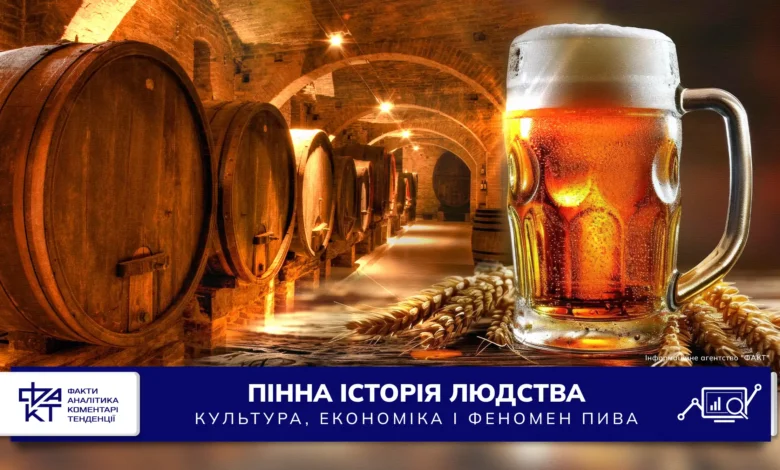
On the first Friday of August, in pubs, at street festivals and even in the kitchens of ordinary homes, beer becomes the protagonist every year. International Beer Day, although still considered an unofficial holiday, has long since turned into an event that unites people, regardless of their geographical coordinates, language or preferences. On this day, glasses clink louder, and conversations become more sincere. This drink has long ceased to be just a means to quench thirst, turning into an element of culture, economy and social life. Behind each bottle are the entire stories of local breweries, modern technologies, cultural transformations and global trends. Beer has long taken its place in world gastronomy, becoming both an attribute of recreation and a serious tool for business and tourism. That is why the celebration of this day is perhaps the best reason to look deeper into the world of beer, in which tradition and innovation, locality and globalization are intertwined.
A celebration of beer brotherhood that unites the world
International Beer and Brewer’s Day started as a small initiative in the US, but quickly turned into a true global phenomenon. Formally, it has three simple purposes: meeting friends over beer, thanking brewers and bartenders, and celebrating the cultural diversity of the beer tradition. But behind these words lies something more than just a toast with a glass in hand.
Beer has become part of a shared social experience. In many countries, its role has long gone beyond the limits of an “evening drink”, because it is a component of gastronomy, local tourism and even economic strategy. Thousands of events take place on the first Friday of August: festivals, excursions, tastings, informal meetings that enrich both local communities and markets. At the same time, this holiday has a professional face. It creates an opportunity to pay attention to the beer industry, from small craft breweries to large breweries, which provide jobs, pay taxes, develop logistics, marketing and technology. Employees of the beer industry include not only brewers, but also suppliers of raw materials, distributors, label designers and salespeople.
It is no less interesting to observe how this holiday adapts to different cultures. In Germany, the Czech Republic, Belgium and the USA, different styles of celebration are manifested, but the essence remains constant: beer is everywhere a symbol of community. So in big cities on this day beer festivals are held with music, food courts and dozens of breweries presenting their best varieties. Here you can not only taste familiar lagers or ales, but also discover craft experiments from honey blends to dark stouts with hints of chocolate.
The atmosphere in pubs and restaurants on this day is also special. Tables are gathered by companies of friends, where everyone orders something new, shares impressions and discovers tastes that he had never imagined before. Bartenders share advice, talk about the origin of varieties and even let you try new items “from the keg”.
The world on the beer map: who brews and how much beer
The world really loves beer, and this love is quite measurable. By data BarthHaas research, billions of liters of foam have been brewed in the world. And despite all the global turbulence, the trends remain quite stable with small but significant changes. In first place is China, where more than 35.9 billion liters of beer were brewed. This is not just absolute leadership, but a colossal advantage over all others. And although there is not much beer per Chinese person, the scale of consumption compensates for the quantity: the market is domestic, huge, and quite pragmatic in its preferences (mass lager still dominates here).
The second place is occupied by the USA with 19.3 billion liters. The American beer market is considered one of the most dynamic. Craft is actively developing here, new styles and local brands are emerging, but at the same time, the big “factory” three (Anheuser-Busch, Molson Coors, Constellation) continue to increase production. Brazil closes the top three with 14.9 billion liters of beer. Beer has long been a part of everyday culture here, and production is growing along with consumption. Mexico (14.2 billion liters), which also actively exports beer, in particular to the United States, is followed by five Brazilians.
The European segment looks more modest, but stable. Germany, with its 8.5 billion liters, remains the beer capital of Europe, not so much in terms of volume, but in terms of history, traditions and quality. It is followed by Japan (4.5 billion), Spain (4.1 billion), Poland (3.6 billion) and South Africa (351 million). In these countries, brewing not only supports the domestic market, but is also gradually looking at exports.
As we can see, in the global dimension, the numbers indicate not only the quantity, but also the character of the culture: for some, beer has become a lifestyle, for others it has become a daily tradition, and somewhere this drink is an important economic resource. One thing is clear, the world brews a lot of beer and in different ways.
Beer statistics in Ukrainian: stability with an aftertaste of losses
Ukrainian brewers are keeping pace, but breathing unevenly. By summaries in the first half of 2025, according to the expert assessment of PrJSC “Ukrpyvo”, 68.3 million deciliters of beer (excluding non-alcoholic beer) were brewed in Ukraine. These are almost the same volumes as last year — 100.6% to the indicators for the first half of 2024. In other words, the market stayed afloat, did not sink, but did not gain momentum either.
However, it is worth looking a little further back, and the picture is not so smooth. Compared to the same period in 2021, the current volumes are only 81.2%. That is, the market still has not returned to the pre-war level, and this is a noticeable decrease, which speaks not so much of a decrease in interest in beer, but of general economic and social changes that affect the consumption habits of Ukrainians.
The beer industry in Ukraine operates in conditions of constant turbulence, with disruptions in logistics, changes in the purchase price of raw materials, and a drop in the solvency of the population. However, in spite of everything, manufacturers keep up, adapt, launch new varieties and invest in modernization of production. Therefore, these numbers should not be taken as confirmation of just dry statistics, behind them there is a living history of the industry, which continues to cook even in difficult times, responds to consumer requests and fights for its niche in the domestic market.
In 2024, Ukrainians spent significantly more on beer than before (7 billion hryvnias more, to be exact). The total revenue of the beer industry reached 46.3 billion hryvnias, which is 17.5% more than in 2023. If we recall the year 2022, when the war hit the economy hard and the income fell to 30.2 billion, then the current growth looks even more convincing: plus 53% in two years. However, it was not an instant takeoff, but rather a gradual, stubborn recovery. Brewers have learned to work in instability. However, the demand remained, and with it the motivation.
As for profitability, 2024 brought the industry 2.5 billion hryvnias of net profit, which is almost the same as last year. For comparison: in 2022, the beer industry ended the first half of the year with a loss of 699 million. That is, the market not only recovered, but even managed to strengthen its position. Although most of the profits are concentrated in the hands of a few big players. “Carlsberg Ukraine” remains the unattainable leader with a profit of 2.1 billion hryvnias, that is, almost the entire industry is in miniature. The company continues to maintain the leading brands (“Lvivske”, “Robert Doms”, “Arsenal”), and its facilities located in Zaporizhzhia generated 84% of the total profit in the country.
In second place is “Obolon” with 1.2 billion hryvnias of profit. A classic of the beer shelf, which is still actively bought both in Ukraine and abroad. The Eurasian Beer Group, known for its Stargorod brand, was in third place, growing more than nine times in a year and ending 2024 with a profit of 180 million.
Steady growth was shown by “Opillya” (107 million hryvnias), “Pivovarnya Sieberta” (153 million hryvnias), as well as “Persha private brewery”, which made a leap from a loss of 25.5 million hryvnias to a profit of 35.8 million hryvnias. Her example became indicative, because the brand adapted to the changes, kept the assortment and improved sales, even in the conditions of martial law.
In general, the geography of profit has developed quite interestingly. Zaporizhzhia region, despite its proximity to the front, topped the list with 2.2 billion hryvnias, mainly thanks to Carlsberg. Kharkiv, Kyiv, Ternopil and Khmelnytskyi regions also entered the top five. The small town of Berdychiv is also famous for its beer. The Berdychiv Brewery won several victories at the XXV International Competition, which brought together producers of beer, non-alcoholic and low-alcohol drinks, fermented products, mineral water and malt. In 2024, the enterprise demonstrated high quality standards, receiving one of the highest awards of the competition. Among the achievements are two gold medals for “Amber Hops” and “Wheat GOLD” beers. Both drinks were awarded for stable quality, taste profile and compliance with technological requirements. Special attention of the jury of the competition was drawn to “Berdychivske Leon” beer, which was awarded the GRAND PRIX – the highest award in the category. This indicates a special appreciation of taste and production skill.
Today, there are 299 active brewing companies on the Ukrainian market, and 11 more new players were registered during the year. This is a good signal for investors: even in difficult times, the beer industry remains attractive. The average price of a bottle of domestically produced beer almost did not change: it increased from 32.8 to 34.1 hryvnias for 0.5 liters, which is a moderate increase that does not scare buyers.
As you can see, the beer market of Ukraine not only survived, but also revived. And although it has not yet reached the pre-war level by all parameters, it is confidently moving in this direction.
Beer as a social phenomenon: myths, legends and interesting facts
If you imagine human history in the form of a party, then beer would definitely be standing somewhere near the fire long before we invented writing or the wheel. Its appearance is due to a natural accident, which humanity quickly turned into a tradition. Somewhere in Mesopotamia, on the fertile banks of the Tigris and Euphrates, our ancestors accidentally left fermented grain in the sun and got not only a strange foamy drink, but also a completely new experience. The drink was tasty, warming and not poisonous, unlike water from the river. The Sumerians, who knew religion and brewing, immediately included a new habit in the pantheon of gods: Ninkasi appeared, the goddess of beer, who even composed a hymn. But this hymn was special: it had a rhythm, a ritual, and even a recipe. This is how the world’s first brewing instruction book appeared. The Egyptians no longer experimented with beer, but systematized it. Workers who hauled stones for the pyramids received their daily ration in the form of four liters of beer and not for entertainment, but for survival. In those days, beer was more like thick, cereal porridge in liquid form. Besides, it was safer to drink than water from the Nile. So we can say that the pyramids stand not only on the sweat of the builders, but also on beer.
Beer was usually brewed by women in ancient times. Brewing was a household affair, and many believe that the image of a “witch with a cauldron” comes from the brewers – women who knew how to manage this process. And while beer already had its own mythology in the East, this tradition was also firmly rooted in Ukrainian lands. The first written mention of beer in Russia dates back to 996. It was then, during the consecration of the Tithe Church, that Prince Volodymyr ordered to distribute “honey and beer” to the people. It was not just hospitality, but a recognized product and part of social life. And since that time, Ukrainian beer has not disappeared from the map: it was brewed by monks in monasteries, breweries were built in cities, and later large industrial breweries.
In different eras, beer played different roles. Sometimes it was a safe substitute for water, and sometimes, even, an element of calculations. In medieval Babylon, for example, poor-quality beer was severely punished: the culprit could be drowned in the same bad beer. So-so PR, but even then the reputation of the brewery was a serious matter. It is interesting that the word “beer” itself has a Slavic origin. But its cognates can be found in all European languages, from the English “beer” to the German “Bier.’ All lead back to the ancient Latin “bibere,” meaning “to drink.” A simple, straightforward, and very human word that expresses the universal need to come together, raise a mug, and drink to life as it goes on, no matter what.
Who would have thought that beer foam is a true indicator of beer quality? It appears thanks to a combination of proteins, hop isoalpha acids and carbon dioxide. A good beer has a dense foam that lasts for several minutes and consists of small bubbles, not large “balloons”. In the Czech Republic, there is even a law that the height of the foam must be at least 2 centimeters. Belgium, a country with more than 1,500 types of beer, has long been recognized as the world center of brewing art. In 2016, its traditions were even included in the list of intangible cultural heritage of UNESCO. And the Belgians take glasses seriously: each type of beer has its own special glass, because the shape of the dish supposedly affects the taste.
And don’t be surprised if you hear that light beer is stronger than dark beer. Color is not always an indicator of strength, because it depends on the degree of malt roasting. For example, a light IPA can be 7-8% alcohol, while a dark porter is only 4-5%. At the same time, it is also worth talking about the so-called “beer belly”, which men are so proud of, without unnecessary clichés. Beer contains about 150 kcal per half liter, but it is impossible to gain weight because of it. More often, the problem is in the general diet, because beer stimulates the appetite, and people combine it with high-calorie snacks, such as sausage or bread.
It should be noted that beer is so affordable in the Czech Republic that in many restaurants a liter of ordinary “tenka” is cheaper than a bottle of water. It is not surprising, because the country leads in beer consumption per capita (over 140 liters per year). In addition, Germany has had a real beer law since 1516, known as the “Reinheitsgebot” (beer purity law – ed.). It regulates that only water, barley and hops can be added to beer (they didn’t know about yeast back then). This law stood for more than five centuries and still sets a high bar for German brewers. It is also worth mentioning yeast. The wild strain of Saccharomyces cerevisiae has been formed naturally for thousands of years, and humans have only improved upon it by keeping the sediment in beer vats for the next brew to be successful.
In general, beer can also impress with its strength: the strongest beer in the world is the British “The Strength of Armageddon”, which has about 67.5% alcohol, which is even more than some vodkas. It is made by freezing the drink and separating the water, rather than the usual fermentation.
Unexpectedly, beer was even able to save lives. During the cholera epidemic in London in 1854, doctor John Snow noticed that workers at a brewery on Broad Street did not get sick. They drank only beer, not contaminated water, and this helped prove that cholera was transmitted through water. It is interesting that in Japan they brew “Chernobyl” beer from barley grown in the restored zone of Chernobyl, and in Antarctica there is a small brewery at the McMurdo base. Even logistical difficulties did not stand in the way of beer, because it is brewed there right on the spot.
As you can see, the history of beer reveals many interesting facts about resource conservation skills, ingenuity, community and culture. And this story has been alive on Ukrainian lands for over a thousand years. And, it seems, it is only gaining a new flavor.


