
The Economics of Easter: A Holiday That Gets More Expensive Every Year with the Government’s Tacit Consent

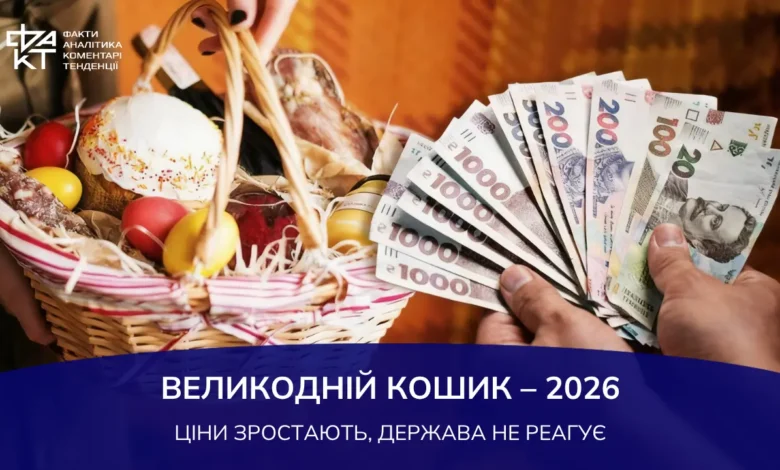
Ukraine is preparing for Easter in the midst of a full-scale war that has been going on for more than four years. Preparations for the holiday are once again taking place against the backdrop of lost income, rising prices for basic goods, and rising daily expenses. Over the years, many families have lost their homes, jobs, or financial stability, so even traditional pre-holiday shopping is increasingly becoming a matter of possibility for many Ukrainians. Despite this, almost everyone is trying to set the Easter table, with some limiting themselves to a minimal set, while others are saving money in advance to treat their loved ones to exquisite holiday dishes.
In such conditions, the Easter basket becomes not only an element of tradition, but also an indicator of the real purchasing power of households. Seasonal demand quickly affects prices, and products that were previously perceived as a familiar part of the holiday table are moving into the category of inaccessible delicacies for many. When even the most basic set of items becomes more expensive before the holiday, a completely practical question arises: to what extent does the current cost of the Easter table correspond to the incomes of most Ukrainians and what does this difference say about the state of the consumer economy during the war.
Price increases against the backdrop of survival
The financial cost of holiday traditions in 2026 demonstrates a steady upward trend, reflecting the complex economic transformations that the country is experiencing. This year, filling an Easter basket for an average family of four will require a budget of almost UAH 2,000. If we compare this amount with the 2025 figure, which was UAH 1,663.26, we will see a 14.4% increase in price, which indicates the cumulative effect of inflationary processes and changes in the cost of basic food products.
The problem goes beyond simple statistics, as the increase in prices for meat and dairy products by 2-3 times compared to previous years turns the traditional Easter set from an affordable norm into a scarce asset, forcing families to choose between preserving festive customs and financial stability until the end of the month.
Analyzing how prices have changed in recent years, one can clearly trace the gap between the pre-war period and the current situation. In 2021, a similar set of products cost almost half as much as today, since then the economy operated in conditions of stable logistics and predictable energy prices. During 2023–2025, we observed a gradual but steady increase in price tags, but it is the jump between 2025 and 2026 that looks the sharpest due to structural changes in production cycles. Therefore, now vegetables, in particular tomatoes, already look like precious delicacies.
Such a price jump is a logical continuation of the dynamics of previous years, because in 2025 the same basket increased in price by 17% compared to 2024, when its cost was 1422.05 UAH, and in 2023 it was 1209 UAH.
Dynamics of Easter basket prices during 2023–2026
| Year | Basic basket (UAH) | Extended basket (with wine and vegetables) (UAH) | Change (%) compared to the previous year |
| 2023 | 1209.00 | 1583.28 | +24.4%(baseline) |
| 2024 | 1422.05 | 1652.00 | +17.6% (base) |
| 2025 | 1663.26 | 2009.76 | +17.0% (base) |
| 2026 | 1903.19 | 2347.94 | +14.4% (base) |
The central element of the festive table — homemade Easter cake — in 2026 will require expenses at the level of 266.89 UAH per kg, which is 14.6% higher than the price in 2025, which was 232.96 UAH, and almost half more than the 2024 figure of 179.80 UAH. If we look at 2023, then Easter cake cost 169.88 UAH. Thus, compared to 2023, the cost of baking increased by 57.1%. Interestingly, between 2023 and 2024, the increase in price was minimal (only 5.8%), which indicates that the main inflationary blow to ingredients fell on the period after 2024.
Analyzing the structure of the cost of baking, we can notice an anomalous increase in prices for milk, which soared by 49.6%, and flour, which added 38.6% to the cost, while eggs rose by 19.3%, raisins by 14.1%, and yeast by 12.8%. Against the background of the general increase in the cost of components, where even butter rose in price by 6.8%, the only pleasant exception was sugar, the cost of which decreased by a record 18%, which somewhat restrained the final price tag of the main symbol of the holiday.
Meat products traditionally retain the status of the most expensive segment, where in 2026 there is a significant price gap between different types of products. Half a kilogram of homemade sausage now costs 287.5 UAH (at a price of 550–600 UAH/kg), which indicates a radical jump of 35.3% compared to last year, while 0.5 kg of boiled pork at a price of 353 UAH added 16.5% to its cost. Interestingly, lard has demonstrated amazing stability: its price per 0.5 kg was fixed at 123 UAH, which is only 0.4% higher than last year’s figure, although compared to 2024, when it cost 110 UAH, the dynamics remain upward.
The meat segment also experienced a significant correction in 2023, when homemade sausage rose to 175 UAH, and bacon to 219.50 UAH per half kilogram, which looks quite moderate against the background of current prices in 2026. Of particular interest is the dynamics of the cost of lard, which in 2023 made a sharp jump of 38.4%, reaching the level of 110 UAH per 0.5 kg, after which its price actually stabilized in 2026. This contrast indicates that meat delicacies continue to rise in price under the influence of the shortage of raw materials, while traditional animal fat products reached their price plateau more quickly.
The dairy group of products in 2026 is characterized by heterogeneity, since the biggest blow to the consumer’s wallet is caused by soft cheese, which has increased in price by a third (+31.3%) and now costs 157.5 UAH per 0.5 kg. Hard cheese and butter showed a more restrained growth of 3.7% and 3.1%, respectively, reaching the levels of 298 UAH and 292 UAH per half-kilogram portion. In 2023, hard cheese cost 189.50 UAH per 0.5 kg, which, against the background of the pre-war 120 UAH, seemed like a significant increase in price.
A similar situation is observed with butter, which in three years went from 171.25 UAH to 292 UAH per half a kilogram, with the main blow to the consumer’s wallet occurring between 2024 and 2025, when the increase was over 37%. Soft cheese, which in 2023 could be purchased for 87.50 UAH, by 2026 had almost doubled in price.
Adding vegetables and wine to the Easter basket in April 2026 brings the total to UAH 2,347.94, which is 16.8% more expensive than the expanded set in 2025 (UAH 2,009.76) and significantly exceeds the 2024 budget of UAH 1,652. Tomatoes and cucumbers have become a real luxury this season, as their cost fluctuates within UAH 187–278/kg and UAH 175–275/kg, respectively, with the price of cucumbers jumping by 38.5% over the year. Apples are also not far behind in the dynamics, adding 17.4% in value, bringing their average price to UAH 45–55/kg, and a bottle of Cahors will now cost an average of UAH 210–280, demonstrating a smooth increase from UAH 165 last season.
It should be noted that the transformation of prices in the post-war period reflects a gradual transition from sharp deficit jumps to the predicted, albeit high inflation, caused by the costs of logistics and energy. If we compare 2024, when a dozen eggs cost 46.75 UAH, and a jar of horseradish – 26 UAH, to 2026 with its price for horseradish at 31 UAH and eggs, which became more expensive by tens of percent, we can conclude about a significant decrease in purchasing power. At the same time, it is indicative that the price of eggs in 2023 was 68.15 UAH per dozen, which was almost at the level of modern indicators.
Jumps in egg prices are a classic example of how the market balances between logistical crises and the internal economy of production. This economic panorama forces consumers to approach holiday purchases more rationally, given that even the minimum cost of salt has increased to UAH 6.72, symbolizing the general trend towards higher prices for life.
The loss of cheap raw materials: how it raised the price of an Easter basket
If today’s cost of a basic Easter set seems like a logical consequence of prolonged inflation, then the 2021 reports recorded the total cost of the holiday at only UAH 780, which is actually two and a half times less than current costs. Even an expanded basket with delicacies and wine, which five years ago cost UAH 963, today looks like an unattainable benchmark of affordability. Homemade Easter cake costing UAH 120 per kg then demonstrates a price increase of over 120%.
It is interesting to observe the transformation of the cost of eggs, which in 2021, despite the then shock jump of 90% compared to 2020, cost only 38 UAH per dozen, while in 2026 this ingredient alone creates a significant burden on the budget. This contrast is explained not only by the change in currency exchange rates, but also by the global restructuring of production chains, which in the pre-war period worked smoothly, providing the domestic market with cheap raw materials.
Meat gastronomy, which has always been the heaviest item of expenditure, in 2021 demonstrated figures that are perceived as minimal today: half a kilogram of homemade sausage cost 130 UAH, and pork sausage – 135 UAH. Comparing these data with the indicators of 2026, we see an increase in the cost of meat almost threefold. Lard, which in the pre-war period could be purchased for a symbolic 50 UAH per half a kilo (with an average price of up to 132 UAH/kg), in 2026 indicates a radical change in the status of this product in the consumer basket of Ukrainians.
The dairy segment has also undergone irreversible transformations, because in 2021, hard cheese cost 120 UAH per 0.5 kg, butter — 114 UAH, and soft cheese — only 58 UAH. Today’s price tags reflect the new reality of high production costs, which in the pre-war years were significantly lower thanks to stable prices for feed and energy. Even small ingredients, such as horseradish, which for years kept its price at 14 UAH, in 2026 also became more expensive, finally completing the picture of a total reformatting of the cost of a traditional Ukrainian feast.
The fundamental reasons for such a sharp increase in prices are rooted in the consequences of military operations in Ukraine and the Middle East, which have deformed the economic structure of the state. The high cost of energy and problems with logistics force manufacturers to include these risks in sales prices, and complicated logistics and internal movement of goods create additional margins at each stage – from the farm to the supermarket shelf. Significant losses in the material and technical base of the domestic agricultural sector have led to a reduction in the supply of certain groups of goods, which, combined with the uncertainty of consumer plans, creates a situation where the celebration of Easter becomes a significant test for the family budget of Ukrainians.
As we can see, the festive table in 2026 has become a mirror of economic reality, in which prices in Ukraine are growing more and more every year, and people’s purchasing power is becoming less and less. It no longer keeps up with price tags, forcing the consumer to switch from the “generous table” format to a strategy of strict rationalization. This is explained both by seasonal demand and the structural restructuring of the agricultural sector, where every gram of product now contains the price of war risks, expensive energy, problematic logistics and shortages of raw materials.
However, against the backdrop of constant price increases and a sharp decline in the purchasing power of Ukrainians, the government demonstrates demonstrative inaction, completely ignoring this issue. For millions of people, more and more products are simply becoming inaccessible, but the authorities respond to this with their silence. Moreover, the Prime Minister of Ukraine Yulia Svyrydenko stated that the government does not plan to introduce strict regulation of fuel and food prices, explaining this by the fact that its main task is to saturate the market with resources and prevent shortages. However, for people who count every hryvnia in the store every day, such statements sound like a frank self-removal of the state from its own responsibility.


