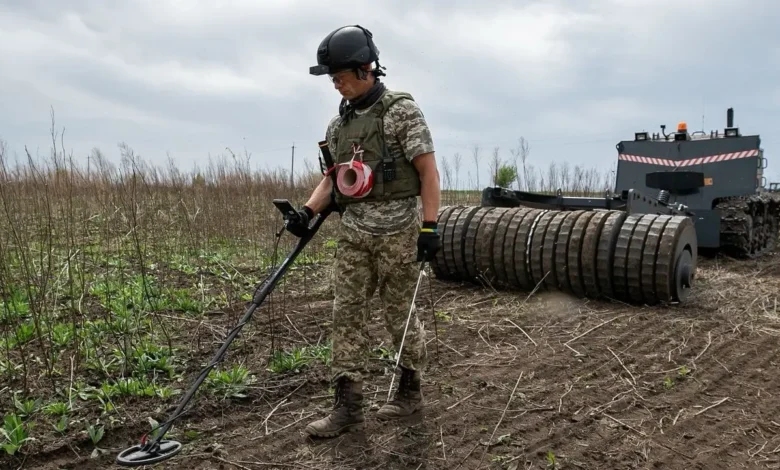
April 4th is the International Day for Mine Awareness and Assistance in Mine Action, International Stray Animals Day, International Firewalking Day and NATO Foundation Day. This day brings together events that have influenced the development of cities, science, culture and international security in different eras.
International Day for Mine Awareness and Assistance in Mine Action
This day is celebrated at the initiative of the UN to draw attention to the threat of mines and explosive remnants of war. For Ukraine, this is directly related to a full-scale war, during which large areas were mined or contaminated with unexploded ordnance. The danger persists in fields, forests, on roads and even in residential areas, which poses a constant risk to the civilian population.
Demining in Ukraine has become one of the key tasks after the liberation of the territories, since without it a safe life and restoration of the economy are impossible. This day is associated with the work of sappers, humanitarian organizations and government agencies engaged in clearing territories and educating the population in safety rules. The problem is of particular relevance for countries that have experienced wars or armed conflicts. Educational activities help reduce the number of accidents, as many injuries occur due to carelessness or ignorance.
Interesting facts
Ukraine is one of the most mined countries in the world, and the area of potentially dangerous territories is measured in hundreds of thousands of square kilometers, which exceeds the area of many European countries.
In liberated regions of Ukraine, mines are sometimes disguised as household items, including toys, phones or bags, which significantly increases the risk to civilians.
There are mines in the world that are made of plastic and are almost invisible to metal detectors, so sappers use dogs, rats and special sensor technologies to detect them.
One anti-personnel mine can cost a few dollars, but its neutralization sometimes costs hundreds or even thousands of dollars due to the complexity and danger of the work.
After wars in some countries, mines remain active for more than 50 years, and cases of detonation are recorded even several generations after the end of hostilities.
In Ukraine, sappers neutralize thousands of explosive objects every day, including not only mines, but also unexploded shells and air bombs.
In some regions of Ukraine, farmers cannot cultivate their fields due to the mine danger, which directly affects the economy and food security.
African giant rats undergo special training and can find mines faster than people, without being detonated due to their low weight.
The largest number of mine victims are civilians, and a significant part of them are children, who often perceive dangerous objects as safe or interesting things.
International Stray Animal Day
This day is dedicated to the problem of stray dogs and cats and their living conditions. The date was not chosen by chance, as it coincides with Animal Protection Day, which emphasizes the importance of a humane attitude towards all living creatures. The main attention is focused on the need to reduce the number of stray animals through responsible human behavior, sterilization and reproduction control.
The problem of stray animals is relevant for many countries, including Ukraine, where a significant part of such animals end up on the streets due to irresponsible owners. Stray animals often face hunger, disease and danger from transport or people. At the same time, they can pose a risk to public health, so solving the issue requires a systemic approach that combines animal protection and human safety.
Interesting facts
There are hundreds of millions of stray dogs and cats in the world, and their number continues to grow in large cities due to uncontrolled reproduction.
In some countries, instead of trapping animals, a “catch-neuter-release” program is used, which allows for a gradual reduction in the population without cruel methods.
In Ukraine, stray dogs often form packs that have their own hierarchy and territory, and can remember the people who feed them or, conversely, show aggression.
Cats living on the street usually have a much shorter lifespan — an average of 3–5 years, while domestic cats can live for more than 12–15 years.
In some cities around the world, stray animals are involved in social initiatives, for example, as “therapy” dogs after adaptation in shelters.
Some stray animals actually have owners, but live on the street due to free-range conditions, which makes it difficult to count and control their numbers.
In the cold season, stray cats often hide in basements or under the hoods of cars, where they seek warmth, which sometimes leads to injuries.
Some studies show that sterilized animals become less aggressive and less likely to leave their territory, which reduces the number of conflicts with people.
International Fire Walking Day
This day is dedicated to the ancient practice of walking barefoot on hot coals, which has existed in various cultures around the world for thousands of years. Historically, such actions had ritual or spiritual significance, often being part of purification rites, testing the strength of the spirit, or transitioning to a new stage of life.
In the modern world, walking on embers is perceived as a psychological challenge and a way to test one’s own capabilities. This practice is used in personal development training, where it symbolizes overcoming fear and controlling emotions. At the same time, it is associated with the risk of burns and requires compliance with safety precautions, as improper conditions or preparation can lead to injuries.
Interesting facts
The temperature of the embers walked on during such practices can exceed 500–700 °C, but the short contact and low thermal conductivity of the coals prevent serious burns under the right conditions.
The physical explanation for the phenomenon is related to the fact that coals do not transfer heat well, as well as the presence of a layer of ash that acts as an insulator.
In some cultures, in particular in India and the Pacific Islands, fire walking is still part of religious rituals and is performed during holidays.
The practice dates back to ancient times, and references to it can be found in various sources, including descriptions of rituals in ancient Greece and Asia.
In the 20th century, hot-air walking became popular in the Western world as an element of motivational seminars and training.
Most often, burns occur not during the passage itself, but when a person stops or runs, which increases contact with the hot surface.
To prepare the path, specially burned wood is used, which gives an even layer of embers without an open flame.
The psychological effect of participating in such a practice is often associated with a sharp increase in confidence after overcoming fear.
NATO Day
April 4 is celebrated every year to mark the anniversary of the creation of the North Atlantic Treaty Organization (NATO), which was founded in 1949. On this day, the North Atlantic Treaty was signed in Washington, uniting the countries of North America and Europe for mutual defense. The main principle of the organization is enshrined in Article 5 of the treaty, which stipulates that an attack on one ally is considered an attack on all.
NATO plays a key role in the international security system, coordinating military cooperation, defense planning, and joint operations. After the start of Russia’s war against Ukraine, the Alliance’s importance for European security has increased significantly, and cooperation with Ukraine has become more intense. Although Ukraine is not a member of NATO, it actively cooperates with the organization in the field of defense, reforms, and increasing interoperability with the forces of member states.
Interesting facts
The North Atlantic Treaty was signed by 12 founding countries, including the United States, Canada, the United Kingdom, France, and Italy.
Article 5 on collective defense has been used only once in history — after the terrorist attacks in the United States on September 11, 2001.
NATO’s headquarters are located in Brussels, Belgium, and are one of the world’s main centers for military and political decision-making.
NATO does not have its own standing army — forces for operations are provided by member countries as needed.
After 2022, the number of countries seeking to join NATO or intensifying cooperation with it has increased significantly due to the changing security situation in Europe.
Finland became a member of NATO in 2023, significantly expanding the Alliance’s land border with Russia.
NATO regularly conducts joint military exercises involving tens of thousands of military personnel from different countries.
Ukraine has been cooperating with NATO since the 1990s and has the status of an enhanced capabilities partner, which implies a closer level of interaction.