April 5 is celebrated in Ukraine as the Day of the First Constitution and the Day of the Neonatologist, and in the world – the International Day of Conscience, the International Day of Walking on Fire. This day also left a visible mark in world history: political alliances, geographical discoveries, scientific breakthroughs, military invasions and even acts of revolutionary justice took place on April 5.
The day of creation of the First Constitution of Ukraine
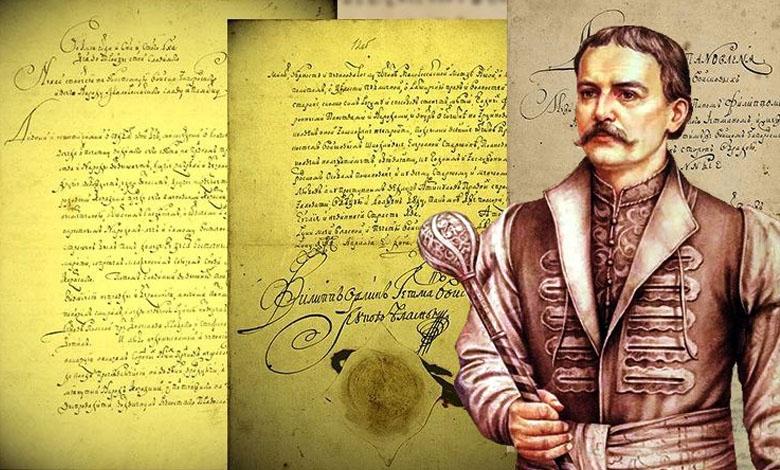
Every year on April 5, Ukraine celebrates the Day of Creation of the First Constitution. This event has a special historical significance, because it is about the Constitution of Pylyp Orlyk, concluded on April 5, 1710. It is considered one of the first written constitutions in Europe and the world in general. The document formalized the ideas of statehood, the distribution of power, the guarantee of rights and freedoms, and the principles of popular sovereignty more than a century and a half before the French Revolution and the adoption of the American Constitution.
The constitution was concluded after the election of Pylyp Orlyk as hetman of the Zaporizhzhya Army in exile, in the city of Bendery (territory of modern Moldova). It became a political contract between the hetman and the Cossacks, which defined the structure of power and the mutual obligations of the parties. The document provided for the limitation of the hetman’s power in favor of the General Council – a prototype of the parliament, the protection of the Orthodox faith, and also recognized the independence of Ukraine from Muscovy.
April 5 was an opportunity to remember this little-known, but extremely important page of Ukrainian statehood, which testifies to deep democratic traditions in the history of Ukraine.
Interesting facts
The Constitution of 1710 was written in three languages - Latin, Old Ukrainian and Old Polish. The Latin version was intended for European monarchs to testify to the desire of Ukrainians for independence.
The document contained 16 articles and a preamble, which emphasized the right of the people to change the government if it betrays the interests of the state. This provision was ahead of European concepts of popular sovereignty.
The Constitution of Orlyk defined the independence of the Ukrainian state within the boundaries from the Siverskyi Donets to the Vistula, including Kyiv and Halychyna. She denied any power of Moscow over Ukrainian lands.
The document provided for the creation of a standing army, a judicial system, limiting the clergy’s interference in secular life, and prohibiting the hetman from appropriating state estates.
Orlyk’s constitution was found in the archives of Sweden in the 20th century, and only later it became the object of serious research. Since 2010, its original has been temporarily exhibited in Ukraine as part of anniversary events.
In 2021, the Constitution of Pylyp Orlyk was transported to Kyiv for the first time for an exhibition in Sophia of Kyiv – it was accompanied as a unique relic and part of national symbolism.
Neonatologist Day
This holiday is dedicated to doctors who save the smallest and most vulnerable patients – newborns, in particular prematurely born, with developmental pathologies, asphyxia, infectious or genetic diseases.
Neonatology is a branch of medicine that arose at the border of pediatrics, obstetrics and intensive care. It covers the care, monitoring, diagnosis and treatment of newborns in the first 28 days of life, and often longer in the case of premature or critically ill babies.
Neonatologists work in maternity hospitals, perinatal centers, and neonatal intensive care units. These are specialists who have a high level of training, because often it is their actions in the first minutes of a child’s life that determine its future – whether it will be able to breathe, whether the heart will work, whether it will be possible to stabilize the condition.
Interesting facts
The first specialized neonatal departments in the world began to be created in the middle of the 20th century. In the USSR, neonatology as a separate specialty was officially recognized in the 1970s, and in Ukraine – after independence, with the expansion of perinatal care.
In Ukraine, a national project on the creation of perinatal centers is actively working, thanks to which it was possible to significantly reduce the level of infant mortality. Modern centers are equipped with incubators, ventilators for babies, and monitors of vital functions.
The profession of a neonatologist requires not only medical knowledge, but also psychological endurance. Doctors face critical situations every day, where every second counts.
In Ukraine, one of the symbols of care for premature babies is a bag of rice, the weight of which corresponds to the weight of some newborns of 500-600 grams. Such babies are called “children born from the palm of the hand.”
Modern technologies make it possible to deliver newborns who were born at 22-23 weeks of pregnancy – this is the limit of viability. Even 30 years ago, such a child had almost no chance.
International Day of Conscience
The International Day of Conscience is celebrated every year on April 5 in accordance with the decision of the UN General Assembly adopted on July 25, 2019. Bahrain initiated the establishment of this day, emphasizing the need to strengthen the role of the internal moral compass as the basis of peace, tolerance and coexistence in the world.
The holiday aims to remind humanity of the importance of conscience – the inner sense of good and evil that guides our actions and helps prevent violence, discrimination and injustice. Conscience is an important component of both personal responsibility and collective ethics in public administration, international politics, education, and culture.
The UN calls on member states, institutions, public organizations and all citizens on this day to promote the development of a culture of peace, tolerance, understanding and dialogue. The International Day of Conscience encourages introspection, rethinking personal and social values, and active participation in building a world based on respect for human dignity.
Interesting facts
The concept of “conscience” does not appear often in UN documents, but even in the Universal Declaration of Human Rights of 1948 it is stated that “all people are born free and equal in their dignity and rights. They are endowed with reason and conscience.”
The Day of Conscience was deliberately chosen at the beginning of April as a symbol of spring renewal, awakening of moral consciousness, cleansing from indifference and aggression.
In 2020, during the COVID-19 pandemic, the International Day of Conscience organized online forums that brought together representatives from more than 190 countries to discuss the role of personal responsibility in the global crisis.
Conscience is interpreted differently in different cultures, but almost everywhere it is identified with a deep inner voice that does not depend on the fear of punishment, but only on the need to do the right thing.
Many philosophers and religious leaders considered conscience the “supreme judge” – from Socrates, who spoke of the “inner daimonia,” to Kant, who saw conscience as the law of moral imperative.
International Fire Walking Day
In 2025, this date falls on April 5. This is an unusual and little-known holiday, which is dedicated to the practice of walking barefoot on hot coals – a tradition that has existed in various cultures of the world for thousands of years.
The day was started to honor the power of will, the overcoming of fear, the inner transformation and personal growth that a person symbolically achieves by walking a path of fire. Nowadays, walking on fire has become not only a ritual, but also a popular element of personal development, team building and psychological therapy trainings.
This day calls for rethinking one’s own limits and limitations, inviting everyone to overcome the conditional “inner fire” – doubts, fears, insecurities.
Interesting facts
The earliest records of walking on hot coals are found in Southeast Asia, India, Polynesia, the Balkans, and Africa. In many peoples, this ritual was part of purification rites, initiations or appeals to the gods.
From a physical point of view, walking on coal is possible due to the low thermal conductivity of wood heat, as well as the short time the foot is in contact with the surface. This is not magic, but physics – although not everyone overcomes the psychological barrier.
In the modern world, fire training was popularized by Tony Robbins, a famous motivational coach who included firewalking in his seminars as a metaphor for overcoming personal fears.
In Spain, the Fiesta de San Pedro Manrique festival is held every year, during which residents of a village in the north of the country traditionally walk barefoot on coals, carrying a loved one on their backs – a symbol of family protection.
In Bulgaria, the ancient tradition of nestinars has been preserved – people who, in a state of ritual trance, dance barefoot on fire on religious holidays. This phenomenon is included in the list of intangible cultural heritage of UNESCO.
Historical events on this day
56 BC – in the city of Lucca (present-day Italy), an important meeting of the three most influential Romans of their time takes place – Gaius Julius Caesar, Marcus Crassus and Gnaeus Pompey. It is then that they renew a secret alliance known as the First Triumvirate, which redistributes power in the Roman Republic.
919 year – the second Fatimid invasion of Egypt, which belonged to the Abbasid dynasty, begins. This is part of a long struggle for dominance in the Islamic world.
1340 year – in the Strait of Gibraltar, an Arab fleet defeats a Spanish squadron, part of the medieval naval conflicts in the Western Mediterranean.
1398 year – the Germans knock out the infamous pirates, known as the Vitaly brothers, from the island of Gotland. The move strengthens trade and security in the Baltic Sea.
1536 year – Charles V, Holy Roman Emperor, makes the last ever triumphal entry into Rome – a ceremony that repeats the ancient Roman tradition of celebrating victory.
1614 year – in England, the parliament begins work, which will later be called “rotten” – because it did not pass a single bill and lasted only two months.
1722 year – the Dutch navigator Jakob Roggeven discovers the mysterious Easter Island, known for its moai – giant stone statues.
1792 year – President George Washington for the first time in the history of the United States uses the presidential veto – a mechanism that is still an important part of restraining the branches of power.
1793 year – Jean-Paul Marat becomes the president of the Jacobin Club – a cell of radical revolutionaries during the French Revolution.
1815 year – one of the most powerful volcanic eruptions in the history of mankind begins – Tambora on the island of Sumbawa. Its consequence will be a “year without summer” and a global climate anomaly.
1818 year – the army of Jose de San Martín and Bernardo O’Higgins wins a decisive victory over the Spanish forces, ensuring the independence of Chile.
1913 year – Niels Bohr completes the first of three papers that will lay the foundations for his model of the atom. These works will become the foundation of the old quantum theory.
1919 year – French troops leave Odesa after the Entente’s attempt to intervene in the Ukrainian revolution and civil war is over.
1933 year – the decree of US President Franklin Roosevelt prohibits citizens from owning gold – part of the anti-crisis policy of the Great Depression.
1941 year – British troops enter Addis Ababa, ending Fascist Italy’s occupation of Abyssinia and restoring Emperor Haile Selassie to the throne.
1945 year – Georgian legionnaires raise an uprising on the island of Texel (Holland), not agreeing with the orders of the Nazi command – one of the last uprisings of the Second World War.
1951 year – in Minneapolis (USA) for the first time, an artificial blood circulation device is successfully used during open heart surgery – a breakthrough in cardiac surgery.
1956 year – American chemists Marshall Gates and Gilg Chudi for the first time in history synthesize morphine – a complex organic compound with narcotic properties.
2001 year – The Verkhovna Rada of Ukraine adopts the new Criminal Code, which has been in effect since then with changes and additions.
2005 year – Askar Akayev officially resigns as president of Kyrgyzstan after the Tulip Revolution.
2017 year – a new type of military is being created within the German armed forces (Bundeswehr) – a cyber command designed to protect the state from digital threats.
August 15, 1922 a man was born in Italy who for the first time seriously engaged in the study of human stupidity – Carlo Manlio Cipolla. Historian of economics, laureate of the Balzan Prize, author of a number of works, among which two stand out in particular: “Pepper, wine (and wool) as dynamic factors of social and economic development in the Middle Ages” and “The Basic Laws of Human Stupidity.” If the first of them is about agrarian Europe, then the second is about a reality that is painfully familiar to each of us. After all, as it turned out, stupidity is much more dangerous than we used to think about it.
His focus was not just individual manifestations of stupidity, but the patterns by which it works. Cipolla noted back in the 1970s: stupid people are not random deviations, but a systemic threat. And proposed a model that allows you to detect, recognize and even neutralize the threat that comes from human stupidity.
Cipolla claimed: stupidity is stronger than the mafia, the military-industrial complex or international communism. It is a disorganized force, without a leader, without laws and without an ideology, which acts in a surprisingly coordinated way, as if directed by an invisible hand. And the actions of each fool only increase the damage done by others.
Here are the five basic laws by which, according to Cipolla, human stupidity functions:
- We always and everywhere underestimate the number of fools. There are more of them than it seems. We make a mistake when we judge people by their education, appearance, and social status. Stupidity lives in the most unexpected places – among intellectuals, in state institutions, and especially – in social networks.
- The probability that a person will turn out to be stupid does not depend on any of his characteristics. It doesn’t matter how many degrees she has, what position she holds, or even how nice she seems. Stupidity is an independent constant. “Fool for life” is a universal phenomenon.
- A fool is one whose actions harm others without benefiting himself. On the contrary, they often harm him. This is what distinguishes a fool from other types:
- a simpleton harms himself by helping others;
- reasonable acts in the interests of both parties;
- the bandit acts only in his own interests;
- a fool harms everything – without meaning and without benefit.
- Smart people, simpletons and thugs always underestimate the power of stupidity. And the main mistake is to try to cooperate with a fool. It is always expensive.
- A fool is the most dangerous type of person. He is worse than a criminal, especially when he comes to power. Because such power becomes unpredictable, destructive, undermines the foundations of well-being, knowledge, and morality – and society eventually impoverishes and degrades.
Cipolla warned: history clearly shows that the state develops only when there are enough smart people in power to restrain active fools. If a critical mass of stupid thugs appears in the ruling circles, and naive simpletons prevail among the population, the system will inevitably collapse.
Nassim Taleb, author of the books Black Swan and Antifragility, wrote about Chipolla:
“Could it be that nature—or God, if you believe in him—is trying to slow down progress, slow down economic growth, hold back business expansion in this way? Maybe that’s why a fool appears who harms both himself and society at the same time?”.