Archaeologists have found a civilization destroyed by the global flood 20 thousand years ago

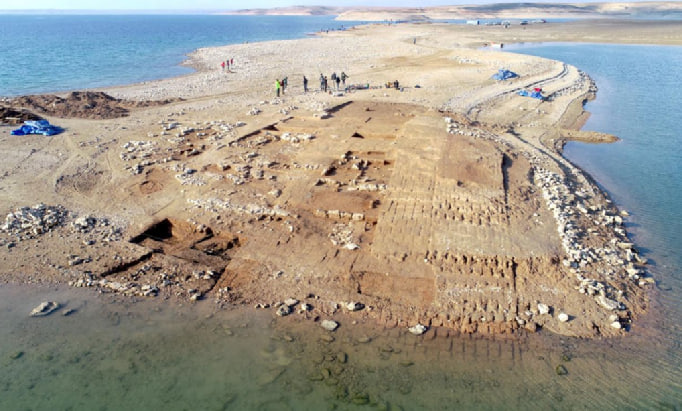
Archaeologists claim that they managed to find evidence of the existence of a highly developed civilization destroyed by the global flood about 20 thousand years ago. About this reports Daily Mail.
Back in the 1930s, during excavations in Tell Far in Iraq, settlements over 5,000 years old were discovered, which belong to the period of the birth of cuneiform writing, centralized administration and complex urban organization.
Tell Fara has long been considered an important Sumerian city-state, providing valuable insights into early civilizations, trade, and administrative practices. However, archaeologists later discovered a thick layer of yellow clay and sand under these settlements, known as the “flood layer”. This indicates a large-scale flood that preceded the appearance of known settlements. Scientists explain that such deposits are usually formed on inhabited lands, so there is a possibility that an even older civilization was destroyed by a catastrophic flood tens of thousands of years ago.
Similar traces of flooding have previously been found at Ur and Kish (Mesopotamia), Harappa (Indus Valley) and ancient settlements along the Nile in Egypt. The discovery of such layers on different continents suggests that whole communities in different parts of the world could have perished from sudden floods, leaving behind only scattered archaeological finds and legends.
Independent researcher Matt Lacroix emphasizes that geological data points to a global catastrophe about 20,000 years ago. According to him, “nothing in the last 11 thousand years even comes close to explaining these data.
He adds that sudden climate changes may have caused floods so severe that they formed the basis of myths in many cultures. A global catastrophe of this scale could destroy entire nations, leaving only fragments of cultural heritage and collective memory.
Preliminary scientific studies of ice cores confirm sharp climatic fluctuations, in particular the cooling of the Late Dryas about 12,800 years ago. Some scientists suggest that it could have caused large-scale floods. However, the team of researchers ruled out these later events and, combining various indirect data, came to the conclusion that it was a much older catastrophe – more than 20 thousand years ago. These conclusions are consistent with both geological data and myths preserved in various cultures.