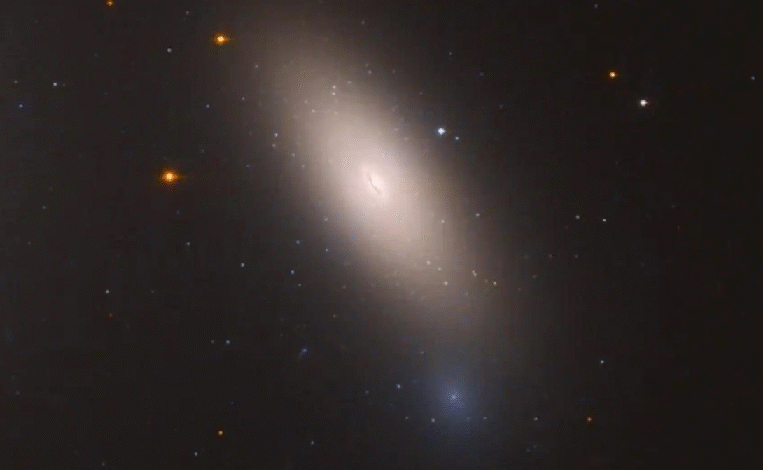
Astronomers have discovered a galaxy that has remained virtually unchanged for billions of years — that’s why it’s jokingly called a “space dinosaur.” It’s about a galaxy called KiDS J0842+0059, the discovery of which could provide new insights into how the universe evolved. About this informs Space.com.
“We have discovered a galaxy that has been perfectly preserved for billions of years – a true archaeological find that tells us how the first galaxies were born and helps us understand how the universe evolved to the present day.” – said Crescenzo Dove, a researcher at the National Institute of Astrophysics (INAF) and one of the leaders of the research team.
The so-called “fossil” galaxies are those that have survived almost unchanged, without interacting with other galaxies, and remain a kind of “time capsules” that allow a glimpse into the early history of the cosmos.
Studies based on observations with the Large Binocular Telescope (LBT) have shown that KiDS J0842+0059 has not undergone significant changes for about 7 billion years. It is located 3 billion light years from Earth and was first observed in 2018 as part of the Kilo Degree Survey (KiDS) project.
Images obtained by the Very Large Telescope Survey Telescope (VST) allowed us to determine the mass and size of the galaxy, and data collected by the X-Shooter instrument on the VLT telescope made it possible to refine these characteristics. As it turned out, the stellar mass of KiDS J0842+0059 is about 100 billion times greater than the mass of the Sun, but at the same time it is much more compact than other galaxies with similar parameters.
It has also been established that star formation has practically not occurred in this galaxy for a long time, which is another sign of its relict nature. To clarify the structure of the galaxy, scientists used adaptive optics on the LBT telescope, which made it possible to obtain images with a detail that is ten times higher than previous results.
“The data from the LBT allowed us to confirm that KiDS J0842+0059 is indeed compact, and therefore a true relic galaxy with a shape similar to NGC 1277 and the compact galaxies we observe in the early Universe. This is the first time we have been able to do this with such high-quality data for a relic galaxy at such a great distance.” Chiara Spiniello, a researcher from Oxford University, explained.