For Ukrainian refugees living in the European Union, regularly crossing borders, processing documents or returning to Ukraine and back, the stable operation of border rules is of practical importance. The launch of the new Entry/Exit System was supposed to simplify control over the entry and exit of third-country nationals, but the first days of its operation showed another side of digitalization: instead of faster border crossing, people faced long queues, technical delays and a return to the old procedure with stamps in passports.
What happened to the new EES system
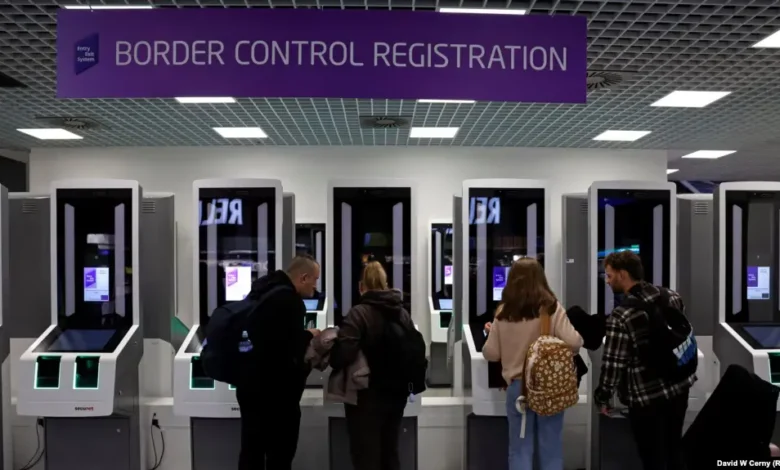
The EES biometric control system officially started operating on April 10, 2026. It provides that citizens of non-EU countries must undergo a facial and fingerprint scan when crossing the border.
According to the European Union, such a system was supposed to replace the usual stamping of passports with a digital record of border crossings. Border guards were supposed to check the duration of foreigners’ stay faster, record entry and exit in a common database and reduce the number of manual procedures.
However, after the launch, it turned out that the new procedure requires more time for each passenger, especially at airports and busy checkpoints. Scanning the face, taking fingerprints, comparing data and technical processing of information take more time than the usual passport check with a stamp.
This hit the tourist countries of Southern Europe most noticeably, where the number of passengers traditionally increases in spring and summer. With a large flow, even a few extra minutes per person quickly turn into hours-long queues. Because of this, individual EU countries began to temporarily abandon mandatory biometrics in order to prevent a transport collapse. This is reported by The Sun.
Greece was one of the first countries to suspend biometric procedures, as checkpoints could not cope with the load after the launch of the EES. In order to reduce queues, the country returned to the usual stamping of passports.
For Ukrainians who are in Greece under temporary protection or cross its borders while traveling, this means that they may have to go through control according to the old rules. Biometric passports remain the main document for travel, but the procedure at the border may depend on the situation at a particular checkpoint.
In Portugal, border guards have also started to apply a flexible approach. If long queues arise due to scanning, some travelers can be allowed through without mandatory biometric verification.
This option is important for Ukrainian refugees who have chosen Portugal for temporary or long-term residence, because the country remains one of the destinations where Ukrainians apply for documents, work and transport their families. When traveling through Portuguese airports, it is worth considering that the control procedure may change depending on the workload.
Italy is also considering returning to stamps in passports after the resonant situation in Milan. Due to delays associated with biometric verification, only 34 of 156 passengers on one flight were able to depart.
For a country with a large passenger flow, such a problem became a signal that the new system requires technical and organizational refinement. Italy is important both for Ukrainians living there under temporary protection and for those who use its airports as transit points while traveling through Europe.
Do countries violate EU rules
The temporary suspension of biometric procedures is not considered a violation of EU rules. The rules allow the system to be suspended if its application creates significant delays at the border.
Such a suspension can last up to 90 days, and then it can be extended for another 60 days. Therefore, the limited return to stamps in passports could be in effect until around September 2026, if the problems with the EES cannot be resolved quickly.
Ukrainians who are in the EU under temporary protection should plan their trips more carefully, especially through airports and popular tourist destinations. The new system may not work the same in different countries, so a traveler may be scanned according to the EES rules at one border and a regular stamp at another.
For people who travel frequently between Ukraine and the EU, it is worth allowing more time for control, checking documents before the trip and taking into account possible queues. This is especially true for families with children, people traveling for work, study, medical procedures or have connections between flights.
With millions of Ukrainians remaining in the EU under temporary protection, stable border procedures are important not only for tourists. For many Ukrainian families, the border has become a part of life, connected with security, documents, work and maintaining contact with Ukraine. That is why disruptions in the EES directly affect those who depend on predictable rules for crossing European borders.