Chinese scientists have created a “DNA cassette” for storing a huge amount of information (video)

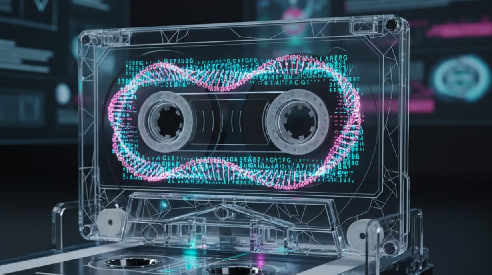
Chinese researchers have created an experimental “DNA cassette” that could become a solution to the global problem of data storage, because the volumes of their creation far exceed the available possibilities for storage. The new technology uses a high density of DNA, which allows storing huge amounts of information in a compact and durable format. reports Interesting Engineering.
“The DNA cassette provides a strategy for fast, compact and large-scale storage of DNA-based cold or warm data”, said researchers from the South China University of Science and Technology.
This approach can become an alternative to the usual servers and hard drives. Theoretically, the DNA of a human cell can hold about 3.2 gigabytes of information, which is equal to 6,000 books, 1,000 songs, or two movies. The new work of scientists is based on the idea of a cassette from the 80s and 90s, only now the carrier is DNA, which stores data in the same way that audio cassettes used to store music.
The physical tape for this system was made from a mixture of polyester and nylon, and its surface was patterned with barcodes that created millions of tiny addressable sections, similar to folders on a computer. Such a structure makes it possible to quickly find the necessary data.
Digital information is converted into a DNA sequence using the bases A, C, G, and T, which act as a code similar to binary. The tape is covered with a crystalline protective layer that prevents damage and allows data to be stored for hundreds or even thousands of years without power supply. A team of scientists has already proven the system’s functionality by successfully saving and restoring digital images. This confirmed the effectiveness of the method for fast processing of large data sets.
One 328-foot long DNA tape can hold more than 3 billion songs, many times the capacity of traditional tapes. The prototype device is expected to have “36 petabytes” data — the equivalent of “36,000 hard drives”. If the technology can be successfully implemented, it can offer a scalable and energy-efficient solution for data centers, ensuring permanent storage of huge amounts of information.