Civilians after captivity in Russia: how bureaucracy in Ukraine blocks assistance to released hostages

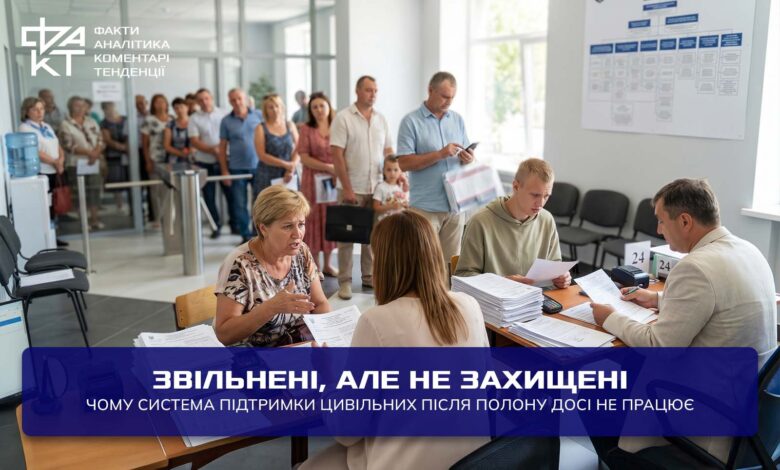
To date, 9,048 Ukrainian citizens have been returned from Russian captivity, including 452 civilians detained by the occupiers in their own homes or on the streets. However, the current system of state support for these people is blocked by strict and unrealistic verification criteria. Instead of automatically recognizing the status of victims, the state forces people who have been tortured and isolated to independently collect paper evidence of their imprisonment and wait for months for their cases to be considered. The state system ignores the fact that people were victims solely because of their Ukrainian passport, and requires ordinary civilians to provide evidence of active resistance in order to receive basic social and medical assistance.
Hostages without a release mechanism: how the exchange system does not work for civilians
The issue of releasing civilians held captive by the Russian Federation has finally reached a dead end, taking on the signs of a systemic legal crisis. During the February 2026 stage, 7 civilians were returned home, the March event brought freedom to only two citizens, and the Easter exchange, which took place on April 11, allowed the release of 7 men from Kharkiv, Kyiv, Kherson and Donetsk regions from long-term illegal detention. Most of these people had been in complete isolation since 2022 without any official charges or court decisions. This practice clearly demonstrates the Russian Federation’s deliberate disregard for the basic principles of international humanitarian law, where the civilian population has effectively been turned into an instrument of geopolitical pressure.
The main reason for such an unsatisfactory result lies in the Kremlin’s manipulative interpretation of international norms. The Russian side is using legal loopholes in the Geneva Conventions, which strictly prohibit the practice of exchanging civilians for prisoners of war, but at the same time Moscow continues to demand the extradition of its captured military personnel in exchange for ordinary Ukrainian citizens.
The Russian penitentiary and judicial systems use specific legal mechanisms to legalize the holding of hostages. Giving people the official status of “detainees for opposing a special military operation” instead of recognizing them as prisoners or criminal suspects allows them to hide the real volume of deportations and arrests. The International Committee of the Red Cross is currently able to verify and confirm that only about 15% of the real number of captives are in isolation. While thousands of other Ukrainians are formally listed as missing, being in the “gray zone” of the legal field. At the same time, relatives of many detainees have accurate data on their actual location in the detention centers of Taganrog, Kursk or in the territory of temporarily occupied Crimea.
At the same time, a conveyor belt production of artificial criminal cases has been launched in the occupied territories and inside the Russian Federation. By fabricating charges under articles of espionage, sabotage or international terrorism, civilians are transformed into the status of “convicted criminals”. This legal maneuver automatically removes people from the plane of standard humanitarian negotiations on return.
This situation is large-scale, since according to the Unified Register of Persons Missing under Special Circumstances, more than 25 thousand civilians are currently considered missing. This imbalance has turned the civilian population into a so-called “filtration resource”, which the occupying authorities use as a human shield and a lever to coerce local communities into loyalty. Unlike prisoners of war, whose rights, conditions of detention and algorithms for return are clearly spelled out in the Third Geneva Convention, civilian hostages have found themselves in a complete international legal vacuum. There is no effective global tool for the forced release of non-combatants in the international arena, which allows the aggressor country to hold them without any legal consequences.
Return from Hell: Assistance to Civilians After Captivity Still Not Launched
A long stay in Russian penitentiary institutions causes deep trauma to people’s mental health. Experts have recorded severe forms of post-traumatic stress disorder in former hostages, manifested by a constant sense of danger, destructive panic attacks, chronic nightmares and intrusive memories. Prolonged social deprivation leads to a partial or complete loss of social ties, which causes people to experience serious barriers in communicating even with their closest family members.
Survivor’s guilt syndrome is especially devastating, when a released person experiences severe emotional pressure due to the fact that he or she is free, while his or her cellmates remain in prison. This leads to the complete destruction of basic trust in the world around him or her in general.
In addition to mental health care, the physical condition of the returned individuals also requires long-term clinical intervention due to the direct consequences of torture and ill-treatment. Doctors diagnose former prisoners with unfused or improperly fused limb fractures, severe chronic spinal injuries, bruises of internal organs, and chronic concussions.
Due to chronic malnutrition and the use of poor-quality drinking water, the detainees are experiencing critical exhaustion and nutritional dystrophy. The conditions of detention in damp, cold, and overcrowded cells without access to fresh air provoke systemic problems with the lungs and kidneys. In the absence of timely basic medical care and medications, people rapidly progress to chronic diseases such as diabetes and cardiovascular pathologies.
However, instead of full-fledged treatment and adequate support from the state, the process of returning civilian prisoners to a full life is complicated by serious legal obstacles. Official confirmation of the status of a person who was in captivity turns into a lengthy procedure due to the lack of any documents or certificates from the aggressor country. The situation is worsened by the loss of basic personal documents, including passports, work books and education diplomas, which either remained in the occupation zone or were irretrievably seized during detention. These factors create bureaucratic red tape when processing state-guaranteed financial payments and benefits.
The socio-economic adaptation of released citizens takes place in conditions of lack of basic material resources. The main cornerstone of this problem is the housing issue, which for many becomes practically insoluble. Returning to the territory controlled by Ukraine, a significant part of the former hostages suddenly realizes that they simply have nowhere to go. Their homes are either physically erased from the face of the earth as a result of fierce fighting, or remain in the zone of temporary occupation, blocked for access. Without a roof over their heads and without starting capital, these people fall into a vicious circle of dependence on temporary shelters or volunteer help. The lack of a stable place to live destroys any foundation for psychological recovery, because it is impossible to make plans for the future without a basic sense of security and their own space.
The next critical barrier to integration is the labor market, which turns out to be surprisingly cruel to this category of citizens. A long forced break in professional activity automatically reduces a person’s competitiveness, because technologies are advancing, work processes are changing, and professional ties are breaking. Attempts to catch up are shattered by a sharp deterioration in health. Severe torture, which contributed to the emergence of chronic diseases and post-traumatic syndrome in former prisoners, significantly limits their ability to work.
The situation is further complicated by the age requirement, as many of the dismissed citizens belong to the mature or pre-retirement age group. For the modern Ukrainian labor market, which already demonstrates a certain bias towards older candidates, people over 50 with a whole bunch of chronic diseases are of no value. Employers are rarely willing to invest in the adaptation of employees who require long-term medical or psychological rehabilitation and a flexible schedule.
The Tale of the Ministry of Reconstruction: How the Conflict Around the Commission Nullified a New Repatriation Strategy
Aware of the ineffectiveness of traditional approaches, Ukraine reformatted its diplomatic vector in 2026, abandoning the terminology of “exchange” for civilians. Now the state insists on the terms “repatriation” or “unconditional release”, involving the International Platform and authoritative mediators in the form of third countries, in particular the Vatican, Qatar and the UAE, in the process. The return of citizens today occurs either within separate isolated humanitarian tracks or during large-scale comprehensive exchanges facilitated by foreign diplomats.
At the domestic level, the government has implemented an updated regulatory framework for the social protection of persons returned from captivity. Resolution No. 1775 provides for the payment of 50,000 hryvnias immediately upon release, as well as guarantees monthly funding for treatment and rehabilitation during the first quarter after return. At the same time, civilians released from captivity are entitled to receive a basic one-time cash benefit from the state in the amount of 100,000 hryvnias upon release and annual payments of the same amount for all years of captivity to support their families. In addition to financial instruments, returnees have the legal right to a full course of medical and psychological rehabilitation at state expense, as well as additional compensation under separate decisions of the Cabinet of Ministers.
The government resolution adopted at the end of last year was supposed to be a systemic step to support civilians who have gone through difficult trials in captivity. The state declared its readiness to provide these people with a critically important package of basic assistance, which includes temporary accommodation, food, material support, as well as comprehensive medical and psychological support along with legal assistance in restoring lost documents. The implementation of this important social initiative depends entirely on the creation and launch of a special commission under the Ministry of Community Development, Territories and Infrastructure, which is tasked with verifying documents and making decisions on providing assistance.
However, despite the acute urgency of the issue, this collegial body has not yet held a single working meeting, which is why real people remain without the promised support. At the same time, the main obstacle to the start of work was internal disagreements and conflicts around the principles of forming the personnel of this structure. Thus, the new procedure was supposed to simplify access to support for people who returned from captivity, but the mechanism for its implementation has not yet worked.
The sharp reaction of the human rights community has exposed significant shortcomings in the process of selecting candidates from the non-governmental sector, which representatives of specialized organizations have called devoid of transparency. Such procedural gaps force activists to draw parallels with previous bureaucratic models, where subjectivism prevailed, and the mechanism for accessing benefits turned into a grueling ordeal. The greatest concern is the fate of those victims who do not have comprehensive documentary confirmation of their captivity or who deliberately avoid contact with law enforcement agencies due to the real danger to their loved ones who are still in the temporarily occupied territories.
Public outcry and reasoned criticism from society forced the ministry’s leadership to sit down at the negotiating table with human rights activists to find a compromise. Currently, the official deployment of the commission’s work is temporarily suspended, and government officials are considering a compromise, albeit controversial, option. The relevant department is still only feeding promises to those who should be supported, because, as in that fable about the swan, the pike and the crayfish, “the cart is still there.”
As we can see, a paradoxical gap has formed in Ukraine between the foreign diplomacy of release and the internal inability of the state to provide proper support to people who have returned from captivity.