
Deadly hantavirus after MV Hondius cruise: what is known about the deadly infection and is there a threat to Ukraine?

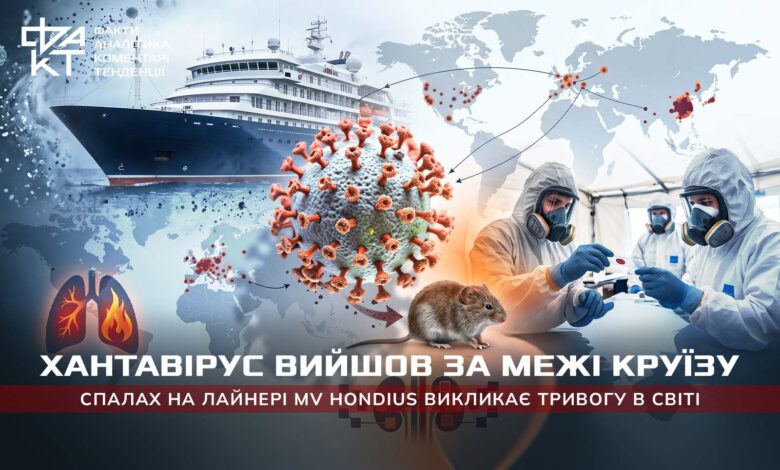
A luxurious Antarctic cruise aboard the expedition liner MV Hondius has turned into a sealed epidemiological testing ground, confronting the world community with a new threat. The tragic death of three European tourists and the emergency confirmation of aggressive hantavirus in six passengers have taken the situation beyond a local emergency. For Ukraine, this incident has acquired the status of a national security issue, as the Ministry of Foreign Affairs officially confirmed that five of our compatriots are among the isolated hostages of the virus. Before the incident on the liner, there was an opinion that hantavirus enters the human body exclusively from animals, but now experts are reviewing the risks of direct transmission between people, which may radically change the assessment of the global threat.
Hantavirus comes ashore: why the MV Hondius landing caused a crisis in the Canary Islands
All passengers on the ship, totaling almost 150 people from 23 countries, are now under strict quarantine supervision as people who had direct contact with the infected. Despite the fact that the Spanish authorities and the WHO state that the rest of the crew and passengers are asymptomatic, the medical community remains in a state of intense debate.
The appearance of the liner near the Canary Islands has caused a wave of indignation among local residents and port workers in Santa Cruz. Protesters, armed with flags and vuvuzelas, staged a loud rally outside the walls of parliament, demanding transparency and security guarantees. The lack of clear instructions and special protective equipment for the personnel who are supposed to serve the ship was of particular concern to the participants of the rally. The protesters were joined by medical professionals, whose stance reflects a broader spectrum of discontent, from fear of the virus to the general migration challenges facing the region due to the influx of people from Africa.
The President of the Canary Islands, Fernando Clavijo, took a hard line, rejecting plans for a full berth for the MV Hondius. Instead of mooring at a pier, the ship is being held at anchor in the waters of the port of Granadilla, which involves a complex logistical scheme of transporting passengers to shore using small boats.
It should be noted that the evacuation operation has already entered the practical phase, and according to reports by the AFP and Reuters agencies. Fourteen Spanish citizens were the first to disembark, but their path is not home, but to a military hospital in Madrid to undergo mandatory quarantine. Five Ukrainian sailors are feeling well, no symptoms of the disease have been recorded. At the same time, the Ministry of Foreign Affairs notes that Ukrainian diplomats in the Netherlands are in constant contact with the ship’s operator.
Against the backdrop of the detection of new cases of infection, the health systems of several countries have switched to a mode of enhanced epidemiological surveillance. At the same time, the priority task remains tracking contact persons and localizing potential outbreak centers. In Poland, quarantine has already been introduced due to the threat of hantavirus after a person who had contact with a passenger on the MV Hondius cruise liner was sent for medical supervision. According to available information, this person has not yet shown symptoms of the disease, but Polish doctors have taken the person under supervision.
The doctors made this decision as a precautionary measure, as the outbreak on the ship has already attracted the attention of health services in several countries. Polish doctors operate according to the logic of contact tracing: if a person could have been near a potentially infected person, their condition is monitored for a certain period in order to react quickly in the event of a fever, weakness, respiratory symptoms or other signs of the disease.
At the same time, American specialized services have launched surveillance in five states (Arizona, California, Georgia, Texas and Virginia). Currently, seven people who were at risk of infection are under monitoring. As of today, no clinical symptoms have been recorded in them. Separately, two more citizens are under observation in New Jersey. The most radical step was the organization of a special flight for 17 Americans who were on board the ship: they are being transported to Nebraska to undergo strict quarantine in a specialized center.
The British Ministry of Health has officially confirmed two cases of the disease and one suspected case. Particular attention is being paid to the fate of 56-year-old Martin Anstie, who was evacuated on May 6. He is receiving medical care in the Netherlands. The geography of the spread of contacts of British origin reaches even the remote island of Tristan da Cunha. At the same time, a case of the Andes strain has been recorded in Switzerland. The patient has been hospitalized at the University Hospital of Zurich. His wife, who traveled with him, is in isolation under the supervision of doctors. Dutch epidemiologists have focused their efforts on tracking passenger flows. Two flights are under the sights of specialists: the route to Johannesburg, which was traveled by an infected Dutch citizen, as well as flight KLM592, the passengers of which are considered potential contacts.
The current situation demonstrates a high level of coordination between international medical services. The main emphasis is on preventive isolation, which is critical to contain the Andes strain and prevent the uncontrolled spread of the virus within countries.
The scale of the event is emphasized by the personal presence in Tenerife of WHO Director-General Tedros Adhanom Ghebreyesus. The head of the organization is trying to dispel panic by comparing the situation with past experience with pandemics. He emphasizes that this outbreak is not an analogue of COVID-19, and the current risks to global health remain within the controlled minimum.
However, the presence of WHO top management to “control safe disembarkation” indicates that the real level of threat requires manual management of processes, despite public assurances of low risks. Conflicting sentiments among local specialists, in particular doctors who joined the protests, only increase the information resonance surrounding the fate of the MV Hondius passengers.
One of a Kind: Why the Andes Strain is Shattering Old Concepts About Hantaviruses
The history of the discovery of hantaviruses is etched in the medical archives due to the dramatic events of the Korean War in the 1950s, when more than 3,000 UN soldiers were confronted with a then-unknown hemorrhagic fever. The pathogen got its name from the Hantaan River, near which South Korean virologist Ho Wan Lee first isolated the pathogen from a field mouse in 1976. This moment became the starting point for understanding that humanity is not dealing with an ephemeral disease, but with an entire family of viruses that have evolved together with rodents for millions of years. Unlike many other zoonoses, hantaviruses do not use insects as intermediaries, instead they have chosen the path of direct transmission through aerosol particles of the excrement of their natural hosts.
Structurally, hantavirus is a complex sphere surrounded by a lipid envelope, inside which are 3 segments of single-stranded RNA, which are responsible for its ability to quickly adapt. In a biological sense, it acts as an invader that affects the endothelium – the inner layer of blood vessels, causing the capillaries to become excessively permeable. This leads to the release of blood plasma into the tissues, which, depending on the specific strain, causes either critical kidney damage, characteristic of the Old World, or rapid pulmonary edema, which is more common in America. The virus demonstrates impressive stability in the external environment, remaining viable in dry dust for several weeks, which makes ordinary cleaning of the basement or pantry a potentially dangerous activity if infected rodents are present.
The appearance of the American strain of hantavirus “Andes” on board the liner caused serious concern in the medical community due to the unique properties of this pathogen. Unlike its European relatives, which enter the human body exclusively through contact with the waste products of infected rodents, the Andean variant is the only known type of virus capable of being transmitted directly from person to person under very close contact. However, the main way of spreading remains the airborne method.
The insidiousness of the disease lies in its long incubation period, which varies from 4 to 49 days. This means that the first alarming signs can make themselves felt only a few weeks after the actual infection. According to the US Centers for Disease Control and Prevention, the clinical picture usually develops within 1-2 weeks, but in some cases this period is extended to 8 weeks, which significantly complicates timely diagnosis.
At the initial stage, hantavirus skillfully disguises itself as ordinary influenza. Patients complain of a sharp increase in temperature, intense headache, muscle aches, general weakness, chills and nausea. However, as the disease develops, the symptoms become specific and threatening. Depending on the direction of the lesion, the disease transforms into either hantavirus pulmonary syndrome (HPS) or hemorrhagic fever with renal syndrome (HFRS).
When the respiratory system is affected, patients experience rapidly progressing cough and shortness of breath, leading to severe edema and breathing problems. If the kidneys are affected, the patient’s skin acquires a characteristic purple color, internal hemorrhages, rash, as well as nasal and gum bleeding appear. In critical conditions, complete cessation of urination and the development of renal failure are observed. Mortality statistics remain disappointing, as depending on the strain and the general condition of the body, mortality ranges from 1% to 15%, and in certain aggressive forms of the virus this figure can reach a critical 40–50%.
Ukraine and Hantavirus: Why the Rodent Virus is a Concern
The epidemiological situation in Ukraine regarding hantaviruses remains consistently tense, although it rarely makes headlines in the central media due to the lack of large-scale outbreaks. The “Puumala” and “Dobrava” strains, which are transmitted by red foxes and field mice, are mainly circulating in the country, creating natural foci in forest and forest-steppe zones. The risk for the average citizen increases significantly during periods of agricultural work or during active recreation in nature, since infection usually occurs through inhalation of dust during contact with hay, straw, or dry bedding.
Incidence statistics are often underestimated due to the difficulty of diagnosis, as the initial symptoms can easily be confused with severe influenza or leptospirosis, which requires doctors to be highly vigilant and perform specific laboratory tests. According to data from the Center for Public Health of the Ministry of Health, the situation with hemorrhagic fevers has sharply worsened. In January 2026 alone, doctors recorded 41 cases of the disease, with 36 of them concentrated in the Sumy region, which has become the real epicenter of the spread of the infection. This surge was not accidental, because even at the end of 2025, statistics showed a rapid growth, when the incidence rate jumped more than 4.3 times compared to 2024.
The main culprit of such dynamics was hemorrhagic fever with renal syndrome (HFRS), which affected 436 people in 2025. The geography of distribution turned out to be extremely uneven: while 428 patients were recorded in Sumy region, only two cases were detected in Lviv, Ternopil and Chernihiv regions, and one each in Kharkiv and Cherkasy regions.
Interestingly, the virus has a clear “social portrait” of its victim: from 70% to 90% of patients are men aged 16 to 50. Most often, these are foresters, farmers or summer residents who encounter the infection during seasonal work from June to October. The disease begins aggressively, although after recovery, a person receives lifelong immunity. However, the price of such experience is too high.
Since there is no specific vaccine against GGNS, the only effective protection remains total deratization and hygiene. Law of Ukraine No. 1645-III clearly obliges enterprises and institutions to carry out regular destruction of rodents, especially in educational and medical institutions. The fight against the epidemic requires an integrated approach – from professional traps and poisons to strict control over garbage dumps, which must be equipped with disinfection barriers and reliable fencing. Only a combination of systematic state control and personal caution during spring work at summer cottages can stop the further growth of these disappointing figures.
However, full-scale war has added new, previously unaccounted variables to the security equation, as large-scale destruction of infrastructure and migration of wild animals change the usual boundaries of the virus’s natural reservoirs. Crowding of people in unadapted basements and dugouts creates ideal conditions for direct contact with rodents seeking warmth and food near human habitation.
However, it is not yet worth talking about the threat of a hantavirus pandemic in the classical sense, since this pathogen, with extremely rare exceptions, is not transmitted from person to person. The main danger lies in individual cases, which can have a high mortality rate without timely supportive treatment, since there is still no specific antiviral therapy or a widely available vaccine for European strains. Patients are inpatients, which involves infusion therapy and respiratory support. In case of critical condition, kidney replacement therapy (hemodialysis) or artificial ventilation of the lungs is used.
The incident on board the MV Hondius is forcing international institutions to review security protocols that were previously considered unshakable. The situation indicates that in conditions of high population mobility and global climate change, isolated natural foci of infections can instantly transform into cross-border challenges.
For Ukraine, where the natural reservoirs of hantaviruses coincide with zones of active hostilities and humanitarian crises, this case becomes an additional argument for the modernization of the epidemiological surveillance system. The statistical increase in the incidence within the country, combined with the risks arising from expeditionary or migratory flows, requires the state to take preventive measures and strengthen the laboratory base. In the absence of specific therapy and vaccines, the only effective tool remains strict control and the readiness of the medical system for “manual management” scenarios of crises similar to the one that unfolded in the waters of the Canary Islands.


