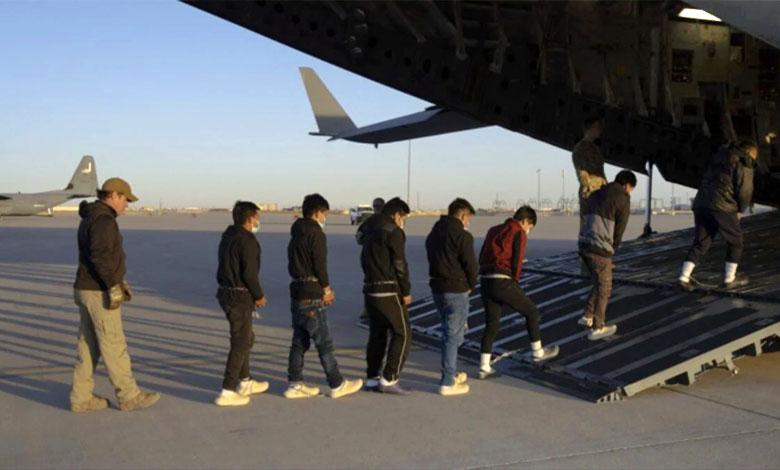
After the odious US president returned to power, one of his administration’s first priorities was an old idea with a new dimension — deporting as many migrants as possible. But it turned out that not everyone can be returned home. Some do not have documents, others do not have citizenship, some are fleeing persecution. And then Washington decided: why not hand over these people… to other countries?
At the start of the new presidential term, Trump’s team did not delay to show: Allies should pay for American aid with more than just gratitude. Despite the war, missile attacks and broken infrastructure, Kyiv arrived from Washington, a cynical request is to accept foreigners deported from the USA on their land. The Ukrainian side is polite promised to “consider” the offer — and put it away, actually putting the brakes on it.
How Trump is trying to get rid of “undesirables” — even at the cost of international law
Under the cover of backroom negotiations, Washington launched a global migration campaign: it promised financial support to some countries, and transparently hinted at tariff wars or threats regarding the Panama Canal to others. The new approach of the White House is pressure, money, secret agreements. The Trump administration has decided to get rid of undesirables at any cost, even at the cost of other people’s safety.
In particular, with El Salvador, USA concluded an agreement to deport individuals to the CECOT mega-prison built to hold gang members. In March, more than 200 people were deported to prison, and many of them had no criminal record! These actions provoked open criticism from human rights defenders and the international community. And El Salvador not only received financial aid, but also a political bonus — a photo session for President Bukele in the White House.
Attempting to transfer migrants to a place where they have never lived is not only cynical, but also contrary to international law. In particular, the principle of non-refoulement, i.e. the ban on deporting a person to a place where he is threatened with persecution, torture or death.
When the U.S. tried to extradite refugees to Libya, where violence and slavery thrive, a federal court imposed this is prohibited.
It is not only illegal migrants. Among the administration’s targets are asylum seekers, students, and stateless people. A recent example is Rümeisa Öztürk, a student from Turkey, who detained after criticizing Israel. She could have been deported even though she studied legally and had the support of the academic community.
The most vocal against the practice of illegal deportation stands out Amnesty International, considering: “States should not assist the US in creating a ‘dark zone’ where the rights of asylum seekers are systematically ignored.” Human Rights Watch adds: the Trump administration is “ignoring the principles of refugee protection that the United States itself once helped to shape.”
Grenada is open refused to accept “foreign” deportees, declaring that it had never signed such an agreement with Washington. The Libyan governments are also categorical denied, having any agreements with the USA.
Panama instead received 14 million dollars to accommodate two thousand migrants who are expelled by America. Costa Rica accepted 135 people, including children. A deportation plane carrying people who had no ties to the country arrived in February.
Rwanda leads negotiations with the USA to accept foreigners from third countries – it seems, according to the British scenario, when the United Kingdom agreed to “transfer” some of the refugees to Africa.
It should be noted that migration acceptance did not go smoothly everywhere. Yes, there was a scandal in Panama. Journalists and politicians asked why a country with a lot of problems should use American money to hire people it cannot verify and integrate. Human rights defenders spoke about the risks of human rights violations.
In Costa Rica, the ombudsman reported that the deported are placed in temporary camps with questionable conditions. People do not understand what will happen to them next.
Did it work for the US? At first glance, yes, migrants have decreased. But human rights defenders warn: there is a price for numbers — people’s rights and America’s international reputation. Human Rights Watch has repeatedly emphasized that these agreements violate basic principles of international law. Such actions can become a precedent, when rich countries will “offload” responsibility to the poor, buying their silence.
Everything works simply: money or pressure. Someone gets millions like Panama. Others, like Colombia, are threatened with export tariffs. With some countries agreed “gently”, with others – ultimatum. But in the end, everyone who is weaker and dependent agrees.
This practice has become a bargain for a number of countries in the Global South, who agree to Washington’s terms either under pressure or in exchange for money. Forced logistics gained scale: Uzbekistan turned into a transit hub, where not only citizens of Central Asian republics were taken, but also Belarusians and Russians. They also tried to draw Georgia into this chain: the negotiations took place under the seal of confidentiality, their results are not disclosed.
Among the “recalcitrant” were Germany, France and Spain, which are open refused to accept persons without confirmed citizenship, despite US diplomatic pressure. In a number of Latin American countries, even after official agreements, flared up protest actions. Independent media and human rights organizations accused their governments of “sellout” and “humanitarian degradation.”
The situation is particularly difficult in countries at war, such as Ukraine. They are critically dependent on American support, cannot afford open refusal, but are also unable to accept deportees without threats to internal security or international image. Therefore, silence, procrastination, and vague answers continue, as in the case of Kyiv diplomats. And while part of the world is protesting, and part is bargaining, the White House is consistently implementing its program to dispose of junk.
Disposing of the Unwanted: Continuation or Departure from the Practices of Previous Administrations
Previous American leaders also agreed with other states on the reception of deported persons — in particular, citizens of third countries. However, these processes were mostly non-public, spot-on, formalized through long-term diplomatic channels and without pronounced political pressure.
Instead, Trump is taking this practice to a fundamentally new level: combining deportation negotiations with other strategic agreements, such as access to critical resources or support for certain geopolitical initiatives. Trump does not just ask – he bargains, imposes, combines packages of agreements, reducing complex multi-layered relations to the logic of “you to me – I to you”.
This is a departure not only from the form, but also from the essence of previous diplomacy. If under Obama or Bush military aid went along with the promotion of democratic standards, then under Trump it goes along with ultimatums.
The concept of “America First” demonstrates a philosophy of hard benefits: the United States must receive concrete, measurable benefits from any international partnership. In this worldview, international law, moral obligations or collective responsibility give way to pragmatic interest.
In the case of deportation policy, this means that the US does not want to keep unwanted aliens, even if they have nowhere to return. Therefore, countries dependent on American aid are offered to become “receiving countries” — regardless of whether they have a connection with the deportees, whether they have the resources to keep them, or whether they are at war.
Clearly, “America First” is not isolationism, as it is often interpreted, but an aggressive transactional approach to foreign policy: every alliance must bring the United States an immediate, visible, direct benefit to the United States.
…Next time, we’ll look at whether the Trump administration is truly driven by security concerns in its crackdown on illegal immigration, or whether it’s more of a voter show of force, a political signal bordering on legal risk. How consistent are these policies with US law and international obligations, and what role do entities like DHS, ICE, or CBP play in this?
The question is especially acute for Ukraine — can participation in such schemes, at a time when millions of our citizens are themselves forced migrants, not only harm the image of the country as one that respects human rights, but also delegitimize our demands in international courts? Will this not become a moral compromise, for which we will have to pay both politically and diplomatically?
Tetyana Viktorova