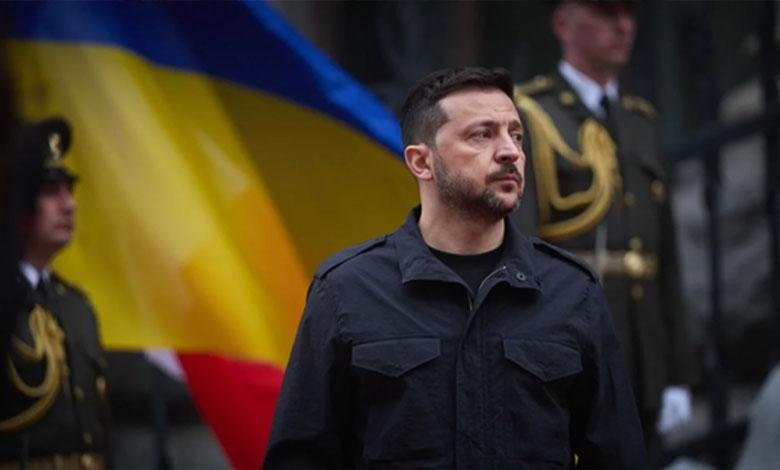
President of Ukraine Volodymyr Zelenskyi said that he is ready to personally meet with Vladimir Putin this week – after US President Donald Trump called on Kyiv to “immediately” accept the Russian offer to hold talks in Turkey.
Amid a visit by the leaders of France, Germany and Great Britain to Kyiv on Saturday, Ukraine and its key European allies have issued a clear condition to Russia: Either Moscow agrees to an unconditional 30-day ceasefire by Monday, or it faces tough new sanctions. This initiative was supported by Trump, as the new Chancellor of Germany, Friedrich Merz, announced.
However, in a night address, Putin ignored the ultimatum, instead offering to hold “direct negotiations” with Ukraine in Turkey already on Thursday. It was the first such proposal from the Kremlin since the start of a full-scale invasion in 2022.
In response, European leaders emphasized that there will be no new negotiations until Russia agrees to a cease-fire. However, Trump’s surprise call on Truth Social “HOLD A MEETING, IMMEDIATELY!!!”, written in capslock, shifted the focus from demands to Moscow to pressure on Kyiv.
Subsequently, Zelensky announced that he was ready to come to Turkey on Thursday for a personal meeting with Putin. “I will wait for Putin in Turkey. Personally. I hope the Russians will not make excuses this time“, he wrote in X.
Although Zelensky added that a “full and lasting ceasefire” from Monday could become the basis for diplomacy, he did not set it as a clear condition for participation in the negotiations.
Thus, despite the position of the West regarding the need for an immediate cessation of hostilities, which was clearly articulated on Saturday, already on Sunday the attention of the world media was focused on a possible meeting between the leaders of Ukraine and Russia. It is currently unknown whether Europe will implement the promised sanctions if Russia does not meet the Monday deadline.
Before Trump’s statement, Zelensky perceived the Russian initiative with caution, calling it a “positive signal”, but insisted that a ceasefire should be a prerequisite for negotiations. European leaders rejected Putin’s proposal much more harshly.
Chancellor Mertz stated that “negotiations are possible only when the guns fall silent“. Polish Prime Minister Donald Tusk emphasized: the world is waiting for “Moscow’s unequivocal decision on an immediate and unconditional ceasefireAnd French President Emmanuel Macron wrote: “There can be no dialogue if the civilian population is bombed at the same time. A ceasefire is needed now so that negotiations can begin. For the sake of peace”.
Even Keith Kellogg — the special representative of the Trump administration in Ukraine — supported the Europeans, by writing in X: “Negotiations are only possible after a ceasefire, not the other way around”.
Trump pushes, Europe slows down
However, Trump, who had previously demanded the Kremlin to announce a cease-fire, abruptly changed his position and called on Zelensky to agree to negotiations without any preconditions.
Analysts point out: Putin’s night proposal is an attempt to remove responsibility for ignoring the demands of the West and shift the pressure to Kyiv.
“He knows Trump wants direct talks. Now Putin can say: we are ready, but Ukrainians do not want peace“, he explained in the comment CNN Professor Serhii Radchenko from Johns Hopkins University.
In parallel with the diplomatic maneuvers, a short “pause” in hostilities, announced by Russia on the occasion of Victory Day, came to an end. Ukraine reported more than 100 drone attacks on Sunday night. Both sides blame each other for breaking the truce.
Turkey has already declared that it is “ready to accept negotiations”, however, according to President Erdoğan, it is the ceasefire that should create the right conditions for peace. And although Ankara has not specified whether it will accept negotiations without a ceasefire, its position is closer to the European one.
Meanwhile, US Secretary of State Marco Rubio is planning a visit to Turkey precisely on the days of possible negotiations, to participate in an informal meeting of the foreign ministers of NATO countries.
Given the situation, Zelensky was faced with a difficult choice: abandon negotiations and face Trump’s public criticism, or sit down with Putin — without guarantees of a ceasefire.
Between Trump’s pressure and the NSDC ban
However, the most problematic pitfall of potential negotiations is not this, but the document, which makes any negotiating contacts with the Russian side impossible.
We will remind you that Presidential Decree No. 117/2022, signed by Volodymyr Zelenskyi in October 2022, prohibits holding any negotiations with the President of the Russian Federation, Vladimir Putin. This document leaves Kyiv’s current position: no dialogue with the current Russian leadership, which unleashed a full-scale war. The decree clearly states that the decision of the National Security and Defense Council of Ukraine “impossible to negotiate with the President of the Russian Federation Vladimir Putin” is mandatory.
In the context of Volodymyr Zelensky’s statement about his readiness to meet with Putin in Turkey, this decree takes on a new meaning. After all, any agreements reached in Istanbul without an official change or cancellation of Decree No. 117 may be of no legal force, or at least contradictory from the point of view of Ukrainian legislation.
This creates a legal conflict: on the one hand, there is the president’s political will to negotiate — under pressure from international partners and in response to Russia’s proposal, supported by Trump; on the other hand, there is a clear rule that prohibits any contact with Putin. If the decree is not formally changed before a possible meeting, any agreement reached there could easily be challenged in Ukrainian courts, questioned in parliament or simply not ratified.
Moreover, from the point of view of legitimacy, such circumvention of its own decree can be used both within Ukraine itself — by the opposition and society — and outside its borders, by Russia or third parties. For example, the Kremlin could present it as negotiations that Ukraine was forced into under external pressure, or as a sign of a split in Kyiv’s position.
At the same time, Zelenskyi’s decree is not a verdict of diplomacy. The President at any time has the power to modify or revoke this document if he deems it necessary to ensure the national interest. But as long as it remains in place, the supposed talks in Istanbul are only a symbolic gesture or public play, not a legally binding process.
The head of the Ministry of Foreign Affairs, Andriy Sybiga, who on January 15, 2025, literally stated: “Ukraine will not go to direct talks with the head of Russia Vladimir Putin, the decision of the NSDC to ban direct talks with Putin remains in effect”, – wrote journalist Ostap Drozdov on his Facebook.
A flurry of statements, proposals and ultimatums creates an impression active diplomatic movement around the war, writes The Guardian, but behind this verbal exchange it is still unclear whether the parties have really revised their fundamental approaches.
Return until April 2022
On Sunday, one of Vladimir Putin’s key advisers, Yuriy Ushakov, said that the previous round of talks in Istanbul, held in the spring of 2022, should serve as a basis for possible new talks. According to him, this format “showed the potential of reaching an agreement” and could be the starting point for current diplomatic efforts.
Sources from the then negotiations that appeared in the press (in particular, in The New York Times), give an idea of the key provisions.
As the publication writes, in March 2022, the Ukrainian and Russian delegations came seriously close to ending the war for the first time. The Istanbul Communiqué was potentially the most realistic attempt to stop the hostilities. The agreements stipulated: Ukraine undertakes neutrality (not joining NATO and refusing to host foreign bases), and Western states legally undertake to guarantee its security. At the same time, the issues of Crimea and Donbas were postponed for 15 years in order to solve them diplomatically.
However, this structure quickly began to collapse. Russia refused to accept Western guarantees, fearing NATO’s covert expansion. The USA and Great Britain were skeptical about guarantees for a state that is not a member of the Alliance. And Putin, despite the military failure, demanded concessions regarding Ukrainian sovereignty.
In the end, the negotiations broke down. Russia has concentrated its forces in Donbas, and the West has increased military support for Ukraine.
The declassified details of the negotiations, published by the newspaper, show that peace was possible – but at a price that Ukraine could not accept without losing part of its independence and territory. And even in this scenario, Russia still did not agree to mandatory restrictions on its further actions, which ultimately destroyed the already shaky negotiation process.
Since that time, Kyiv has repeatedly emphasized that any future negotiations can only take place on conditions that do not involve the loss of territories or sovereignty.
Politician and diplomat Roman Bezsmertny, commenting on a potential meeting in Istanbul, emphasizes that this is a return to the situation of April 2022. And this should be clearly understood, as well as the fact that not all the details of the negotiations at that time became the property of the public space. At the same time, he insists on the need to form a strong, authoritative and professional delegation, which will be headed by a person who has the trust of both society and the authorities. Such a person should be able to firmly defend the interests of Ukraine. Separately, Bezsmertnyi proposes to include representatives of France, Germany, Great Britain, and, if possible, the USA as part of the delegation. This, according to him, will allow European partners to directly see what the process looks like, and not rely on other people’s interpretations.