Elementary school: how a new typical program will change children’s education from 2028

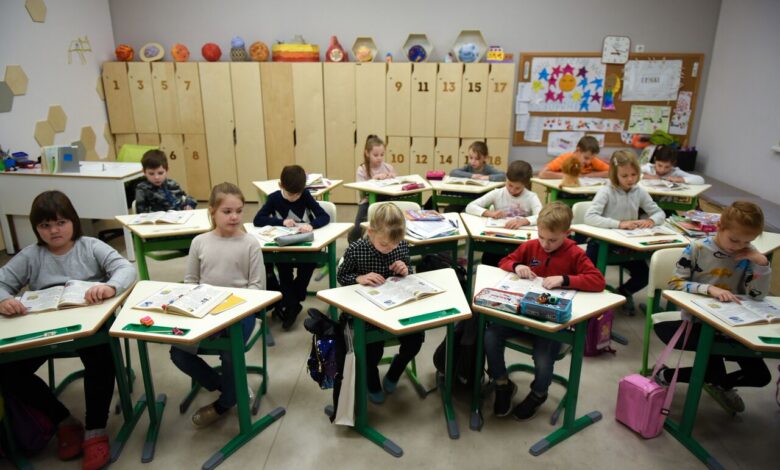
Elementary school education during the war has long ceased to be an even and predictable process in which all children move at the same pace, learn the material according to a common scheme, and enter the classroom with similar experiences. Some students come to school after moving, long breaks, distance learning, living under occupation, or in conditions of constant anxiety, so any decision to change the program should be evaluated not by the language of orders, but by the extent to which it takes into account this broken and uneven children’s experience.
Taking into account modern conditions, the Ministry of Education and Science announced that it has approved a new Standard Educational Program for students in grades 1–4, which will first come into effect for first-graders in September 2028. The Ministry of Education and Science explained that the document defines the structure of curricula, the distribution of workload between educational branches, and approaches to organizing the educational process, and its main idea is to give schools more freedom in choosing a learning model depending on the needs of children.
What will the new program change
The new program provides for a framework that is the same for all schools without exception, within which the educational institution will be able to determine how to organize the curriculum. At the same time, schools will have the right to choose the option of distributing teaching hours depending on the composition of students, and educational branches will be able to implement either through integrated courses or through separate subjects, if this approach better meets the capabilities of the institution and the needs of children.
Separately, the Ministry of Education and Science drew attention to the fact that teachers will be able to determine the number of hours in the language and literature branch and in the integrated course “I explore the world” differently. Behind the dry educational terminology here is a rather practical thing: the teacher and the school receive a tool that allows them not to keep everyone within the same table, but rather to distribute time where children need more explanation, repetition, or a calmer pace.
One of the important provisions of the new document is that it applies to all types of educational institutions, including special schools and classes where children with special educational needs study. For a Ukrainian school, which in war conditions is increasingly working with very different children within the same space, such a step seems logical, since primary education can no longer be built on the principle of a conditional “average student”, who often simply does not exist in a real classroom.
The standard curriculum also expanded the correctional and developmental component to support such students. In addition, the Ministry of Education and Science separately emphasized that the document took into account the needs of children with autism spectrum disorder, and also provided for flexible approaches to organizing education in classes where there are children with different levels of support and educational difficulties. For schools, this means that for the first time the unevenness of children’s experience is so clearly laid down not as an exception, but as one of the working conditions of the program itself.
The standard program was approved after a public discussion, during which, according to the Ministry of Education and Science, more than 350 proposals were processed and more than 17 thousand responses from teachers to the survey were taken into account. For an educational document that should be implemented in all institutions, such a large amount of feedback is important not in itself, but as a sign that the program was finalized after contact with people who work in the classroom every day and see the real difficulties of children’s learning.
The significance of the new program for children
For children whose early school experience fell on the war, this very attitude of the program may be decisive, since primary school lays not only basic knowledge, but also the child’s attitude towards learning itself. If at this stage the system turns out to be too deaf to the real state of children, school begins to be associated not with development, but with constant lagging behind, exhaustion and fear of not being able to keep up.
Elementary school in wartime works with children who very often have different attention spans, different levels of preparation and different abilities to withstand the same learning rhythm, so an overly rigid program in such conditions inevitably begins to put pressure on the weaker ones. If a child who has changed his place of residence several times, a student with long gaps in his studies, a student who has studied part of the material remotely, and a child who needs additional support are in the same class, then a universal model for everyone works worse than a program that allows adjustments to the real situation.
Therefore, the key word in this solution is “flexibility”, although in this case we are not talking about fashionable pedagogical vocabulary, but about an attempt to bring the school document into line with what Ukrainian children’s education actually became after the start of the Great War. For younger students who are just entering school and are still learning to live in the mode of lessons, rules, and teamwork in the classroom, overload or an unsuccessful pace can have much deeper consequences than for older children.
After approving the standard program, the system must go through another necessary stage, because, as the ministry noted, it is necessary to develop new model curricula and textbooks for primary school. It is at this level that it will become clear whether the declared flexibility will turn into a real working tool for the teacher, or whether it will remain a general construction that does not change the child’s daily learning experience.