
Exhausted to the brim: how bureaucracy and lack of support push mothers of children with disabilities into depression and suicidal thoughts

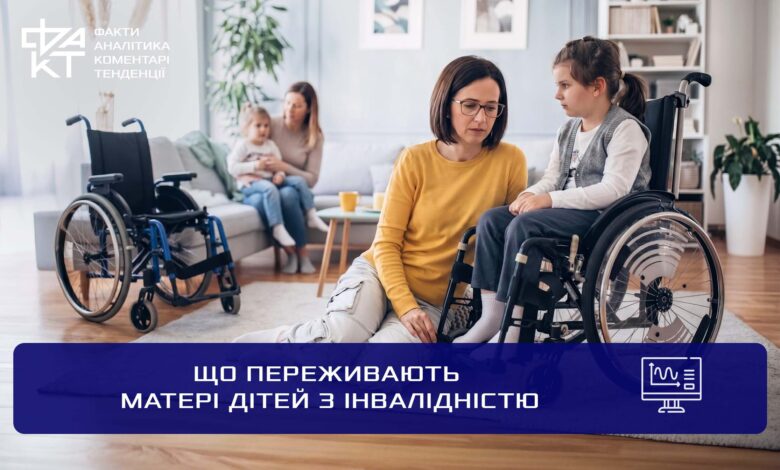
During the full-scale war, the number of people with disabilities in Ukraine increased by 600 thousand, reaching 3.4 million people. However, the state apparatus still works according to peacetime patterns, ignoring the scale of human pain, which has ceased to fit into the standards. The hardest blow fell on 160 thousand mothers raising children with disabilities. Now every second such mother is in a state of severe depression, and 15% are thinking about suicide, because they are carrying the physical and financial burden alone, while the state offers them bureaucratic labyrinths instead of real help.
Structural Isolation of Mothers of Children with Disabilities: Between Care and Exclusion from the Labor Market
Analysis of the current situation of mothers raising children with disabilities, conducted by the organizations “Epiprosvita” and “Academy of Cognition”, highlights a deep systemic crisis, where human potential is held hostage by an inflexible social model. The main mass of respondents are women aged 30 to 45, but the presence of an older age group indicates that the caregiving burden often turns into a lifelong imprisonment within the framework of everyday life, which actually cancels out the chances of professional rehabilitation after a long-term break. Most of the respondents invest more than 40 hours in caregiving every week, and for mothers whose children require continuous support, this schedule transforms into a grueling 24-hour marathon, including even complex medical procedures in the middle of the night.
At the same time, a fundamental obstacle to any social change is the complete absence of “respite” services, i.e. guaranteed professional replacement of the mother for a few hours for her respite. More than 70% of women are deprived of even minimal support of this kind, although, according to the survey, only 10–15 stable hours of assistance per week could become the critically needed bridge that would allow them to return to economic activity. The paradox of the situation is that 55% of these women have higher education and solid experience in medicine, economics, pedagogy or the IT sector, but the forced professional vacuum lasting 10–15 years destroys their confidence in their own qualifications.
It is worth noting that the return to work is blocked by a number of structural “defects”, among which the leading place is occupied by stigmatization by employers, who in advance label such specialists as “unreliable” due to potential sick leave. Added to this is the absurd logic of the state payment system, where official employment automatically cancels care benefits, making going to work economically pointless, since the final family income remains static or even decreases.
The situation is also preserved by digital inequality, where only one in five mothers confidently owns specialized software, and 30% of those surveyed do not even have basic technical support in the form of a laptop, which cuts them off from the remote work market.
The psychological state of this population group borders on a catastrophe, as chronic isolation has led to 45% of women existing in a state of clinical anxiety. The subjective feeling of complete loss of control over their own lives, constant tension and exhaustion of adaptive resources are exacerbated by incorrect communication on the part of medical professionals, which only deepens the emotional gap. The process of establishing a diagnosis in Ukrainian realities often turns into an act of medical gaslighting, where instead of professional support, a woman faces communication aggression.
Instead of becoming a guide to a new complex reality, the doctor often acts as a harbinger of social death, suggesting that the baby be abandoned or using dehumanizing predictions about the child’s future. Such an approach inevitably traumatizes the mother, and also lays the foundation for clinical depression and social isolation of the family at the very beginning of its journey. The way out of this ethical impasse should be the introduction of strict protocols for communicating the diagnosis and the mandatory presence of a medical psychologist within the framework of the early intervention model. Only through systematic training of personnel in empathetic communication skills can the paradigm be changed from “diagnosis-verdict” to “diagnosis-action plan”.
Internally displaced persons in this category found themselves doubly vulnerable, as the war destroyed their usual support networks, leaving them alone with bureaucracy, lack of information about medical services, and total dependence on payments. For such a family, displacement means not just a change of geographical coordinates, but the complete destruction of the microsystem built over years, which was based on scarce specialists, inclusive institutions, and local networks of mutual assistance.
The loss of usual social ties deprives the woman of “horizontal” support, turning her into a single and constant caregiver in conditions where external resources are inaccessible or unknown. The process of integration into the medical space of a new community often resembles a chaotic wandering through a labyrinth, where instead of clear algorithms, the woman encounters the inertia of the bureaucratic machine. The lack of verified information about the availability of narrow-profile medicines or access to free procedures forces a woman to turn to the private sector, which only accelerates her financial exhaustion. Bureaucracy becomes not just a technical inconvenience, but a serious barrier, since confirmation of the child’s status requires paper certificates, which are often physically impossible to obtain from occupied territories or combat zones.
The economic model of survival of such a family is characterized by total determination by state payments, which actually deprives the woman of any financial guarantee. The labor market remains closed to her due to the lack of specialized temporary stay services for children with disabilities in the communities, which turns forced unemployment into a life sentence. In a situation where every penny is spent on housing rent and specific food, state measures to strengthen income control or combat informal employment are perceived as direct pressure, because the mother simply has no legal tools left to improve her situation.
In addition, the situation of women raising children with disabilities is further worsened by the fact that for a third of them, the child’s diagnosis has become a sentence to marriage. Men leave the family, unable to withstand the physical, economic and moral pressure, while women are left alone with their problems.
As a result of constant isolation and excessive burden of responsibilities and problems, every second woman is in a state of depression, and 45% of mothers are in a state of clinically pronounced anxiety. At the same time, almost 15% of the women surveyed reported that they had thoughts of self-harm.
Aid that does not exist: why state payments do not cover even basic needs
The situation with state financing of the needs of children with disabilities, as of 2026, has acquired signs of a systemic humanitarian crisis, where declared social guarantees are increasingly at odds with the basic ethics of supporting vulnerable segments of the population. The current level of basic assistance, which is only UAH 1,816.50, looks like a mathematical paradox, because this amount barely reaches 70% of the subsistence minimum for disabled persons. It is difficult to imagine what calculations are guided by responsible officials when they offer families to support a child for a month for funds that are actually equal to the cost of several days of full meals or a minimum set of hygiene products.
Even in the most critical cases, when it comes to subgroup A (children with the most severe health disorders who require constant external supervision – ed.), financial support remains critically disconnected from life. Payments in the range of 8,229 – 9,619 UAH, despite the presence of a care allowance, disappear into the cycle of expenses for medications, special nutrition and mandatory therapeutic procedures. In a country where the market cost of professional rehabilitation and necessary medications is steadily growing, such amounts force families to balance on the verge of poverty, as they are unable to ensure even physiological survival, let alone the development or social adaptation of the child.
Instead of being a reliable foundation, state assistance has turned into a symbolic gesture that leaves mothers alone with ever-increasing checks from pharmacies and medical centers. The lack of a mechanism for adjusting payments in accordance with the real consumer basket and the specific needs of a child with a disability indicates a deep gap between office statistics and the daily struggle of thousands of Ukrainians for a decent existence for their children. This state of affairs actually ignores the real cost of living in the face of modern economic challenges.
Modern Ukrainian legislation builds a hermetic trap around a woman raising a child with a disability, where the status of a “caregiver” de facto becomes a legal synonym for total incapacity for work. State logic views caring for a child not as an extremely heavy additional burden that requires support, but as an exclusive alternative to any professional realization. As soon as a mother tries to integrate into the labor market, the system regards this as the disappearance of the need for assistance, instantly canceling payments.
To overcome this absurdity, it is necessary to draw a clear line between social assistance to a child, which is his inalienable right to support, and compensation payments to the mother for lost earnings. The reform should be based on a flexible mechanism, where part-time employment or remote work does not become a basis for financial sanctions from the state, transforming the mother from a “dependent of the system” into a full-fledged participant in the labor market.
European formula for inclusion: financing that follows the person
It is obvious that the transformation of social support in Ukraine requires the abandonment of archaic methods of support in favor of flexible mechanisms, where the state budget is transformed from a tool for financing walls into a tool for supporting a specific individual. While Ukrainian realities often force mothers of children with disabilities to wander through the corridors of administrative chaos, the experience of the European Union countries offers a proven algorithm in which the person is the center of the system, not its appendage.
Successful inclusive models in Sweden and Poland are based on the understanding that caring for a child with special needs should not become a “life sentence” for the mother. The state in these countries acts as a customer for the services of a personal assistant who comes directly to the home and takes over the daily support. This approach is fundamentally different from the concept of a short-term respite (respite), as it creates a full-fledged workplace for a professional and at the same time returns the mother the right to career self-realization. Instead of forced dequalification and social isolation, a woman gets the opportunity to work in her specialty, pay taxes and maintain her own identity, knowing that a trained specialist is taking care of her child’s development.
A fundamental difference in the Western roadmap is the implementation of the principle according to which financial resources inextricably follow a person. If the domestic system has historically tended to maintain huge residential complexes that absorb funds regardless of the quality of the services provided, the European model directs these flows directly to the family or small group homes of the family type. This creates a healthy market for social services, where the mother can independently choose the provider of assistance, focusing on the real needs of the child, and not on the limited capabilities of the territorial institution. Money ceases to “feed” outdated institutions, becoming real fuel for inclusion and providing decent living conditions in the community, and not behind its fence.
Comparing these approaches, it becomes obvious that foreign experience considers inclusion as a long-term investment in human capital, which ultimately turns out to be more economically beneficial than the old-style state care system. The absence of the need to maintain a bulky infrastructure of residential institutions allows us to focus resources on personalized assistance, which minimizes the risks of disability together with the child and mother. The introduction of a structured evaluation system allows us to move away from subjectivity in favor of transparent and targeted resource allocation. The combination of clear quantitative indicators with a deep qualitative analysis of life circumstances ensures maximum compliance of assistance with the real needs of each person.
Such an approach not only guarantees social justice, but also significantly increases the efficiency of using available funds, directing them to where they will bring the greatest benefit. A smooth transition from a command-administrative distribution to a service model, where the state is a reliable partner, not a strict controller, becomes the necessary change of vector that can lead Ukraine out of the “bureaucratic labyrinth” onto the path of civilized coexistence and real assistance to mothers in need.


