
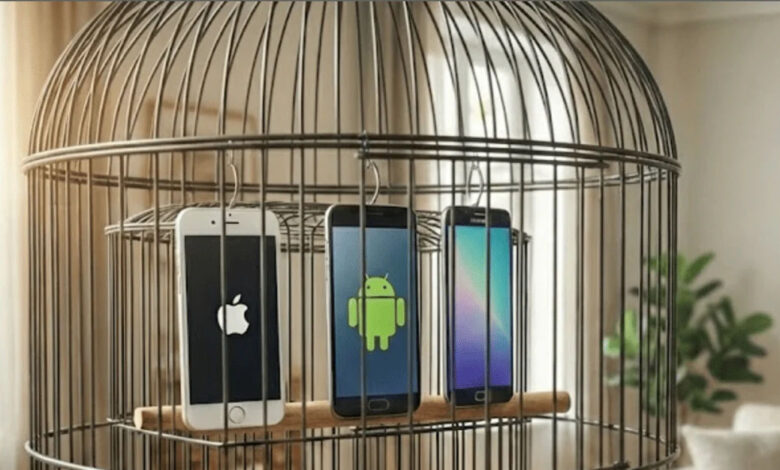
February 6th is World No Mobile Day, International Bartender Day, and Social Media Day. The events of this day cover a wide range of historical processes — from monarchs’ decisions and church acts to technical breakthroughs, cultural phenomena, and global tragedies.
World No Mobile Day
World No Mobile Day is celebrated every year from February 6 to 8. The idea appeared in the early 2000s in Europe as an attempt to draw attention to the excessive use of mobile communications in everyday life. For three days, people are invited to consciously limit the use of phones and focus on live communication, work without constant notifications, and the usual rhythm of the day without digital distractions.
The date does not have the official status of an international holiday, but it is supported in different countries at the level of public initiatives and media. A day without a mobile phone is associated with the topics of digital hygiene, information overload and the impact of gadgets on concentration. These days are often discussed the balance between technology and personal space without being tied to appeals or symbolic actions.
Interesting facts
The first mobile call in the world was made on April 3, 1973, and the conversation lasted less than a minute due to the rapid discharge of the battery, which weighed almost a kilogram.
The average modern smartphone is dozens of times more powerful than the computers used for the Apollo flights to the moon, with most of this power being spent on social networks and multimedia.
According to research by European universities, the average person touches the phone screen more than two and a half thousand times a day, often without realizing it.
In Japan, there is a concept called “phubbing,” which describes ignoring someone on the phone, and it is considered one of the reasons for the growth of social isolation among young people.
In Ukraine, the first mobile phones for mass use appeared in the mid-1990s, and a minute of call then cost much more than the average trip on public transport.
According to Ukrainian sociological surveys, most people check their phone within the first five minutes after waking up, even on weekends.
In some European countries, there have been cases when schools temporarily returned to paper diaries because the constant use of smartphones reduced student performance.
The production of one smartphone requires the use of rare metals, some of which are mined in a limited number of regions of the world, which makes the industry dependent on geopolitical factors.
In Ukraine, during large-scale power outages in 2022, a mobile phone became the main source of news and communication for many people, while push-button models became more popular due to their longer battery life.
International Bartender Day
This date is associated with the day of memory of Saint Amanda, who is considered the patron saint of winemakers, brewers and alcohol traders in Western Europe. The professional holiday was formed as an informal event dedicated to the work of bartenders, the culture of establishments and the history of drinks, without official international status.
On this day, the role of a bartender is usually remembered as a specialist who works with recipes, cooking techniques and serving guests. The profession combines knowledge of ingredients, flavor combinations and traditions of different countries. International Bartender Day became an occasion to draw attention to the development of bar culture and its influence on the gastronomic environment.
Interesting facts
The first prototypes of bars appeared in ancient times, when wine was sold in special taverns, and the owners often mixed drinks themselves according to the individual preferences of customers.
The word “bar” comes from the English bar – a partition that separated the area of the drinks seller from visitors in taverns and inns.
The first known book with cocktail recipes was published in 1862 in the USA, and it contained not only recipes, but also advice on the behavior of a bartender at the bar.
The classic Martini cocktail has dozens of variations, and the exact origin of the recipe is still controversial among bar historians.
In many countries, bartenders are considered a separate gastronomic specialization, for which there are professional schools and multi-year training programs.
In Ukraine, the active development of modern bar culture began in the early 2000s, along with the opening of specialized cocktail bars in large cities.
Some Ukrainian bartenders create original drinks from local ingredients, using honey, berries, herbs and tinctures according to traditional recipes.
In the professional environment, it is believed that the taste of a drink can change depending on the temperature of the room, lighting and even the noise level in the bar.
There are non-alcoholic cocktails with the same complex recipe as the classic ones, and working with them requires no less precision and experience from the bartender.
Social Media Return Day
This initiative appeared as a reaction to the growth of aggressive behavior, manipulative content and disinformation in the digital space. The focus of the day is on the conscious use of social platforms and responsibility for public statements and the dissemination of information.
The date does not have an official international status and exists in the format of a public movement. This day is usually used to discuss the impact of algorithms, anonymity, and emotional content on online communication. Social Media Day is used as an occasion to draw attention to the quality of online interaction and the consequences of digital behavior for society.
Interesting facts
The term “trolling” in its modern meaning was established in the late 1990s in the first Internet forums, where provocative comments were used to evoke an emotional reaction.
Social media algorithms are more likely to promote posts with strong emotional overtones, since such content holds users’ attention longer than neutral messages.
According to media analysts, fake news spreads faster than verified materials, especially in the first hours after publication.
The first social networks of the early 2000s did not have a news feed in its modern form, and users independently went to friends’ pages without automatic content sorting.
In Ukraine, social networks have played an important role in spreading news during crises, while disinformation has also increased dramatically during such periods.
Ukrainian researchers of digital culture have recorded an increase in hate speech in comments during periods of social tension and a decrease in its level after active moderation of platforms.
The function of complaints about content on social networks did not appear immediately and was initially available only to moderators, not ordinary users.
Restrictions on hiding the number of likes have already been tested in various European countries, as this indicator affects the perception of posts and the behavior of the audience.
Some social platforms changed algorithms after internal data leaks that showed a connection between aggressive content and increased user engagement.
Historical events on this day
1633 ‒ Władysław IV was crowned king of the Polish-Lithuanian Commonwealth after a difficult period of internecine disputes. His reign was an attempt to strengthen the central government and maintain a balance between the nobility, clergy, and the Cossack element in the state.
1819 ‒ The Sultan of Johor, Tengku Abdul Rahman, granted the British Stamford Raffles permission to establish a trading post in Singapore. This decision marked the beginning of the transformation of the small port into one of the key financial and trading centers of Asia.
1840 ‒ Under the Treaty of Waitangi, New Zealand formally passed under the control of Great Britain. Maori tribes received protection from the crown, but different interpretations of the terms of the agreement later led to long-standing conflicts and disputes over land and sovereignty.
1900 ‒ Alexander Popov first transmitted a radio signal about distress at sea. This incident demonstrated the practical value of wireless communication and was an important step in the development of maritime safety systems.
1901 ‒ The first public telephones appeared at train stations in Paris. The innovation changed the everyday communication of citizens and became a symbol of technical progress at the beginning of the 20th century.
1922 ‒ The Washington Naval Conference, dedicated to the settlement of interests in the Pacific Ocean and East Asia, ended. The USA, Great Britain, France, Italy and Japan signed an agreement on the limitation of naval arms, trying to avoid a new naval race.
1925 ‒ The first Ukrainian pioneer newspaper, “Na Zminu”, began to be published, which later received the name “Zirka”. The publication became part of the Soviet system of ideological education of children and adolescents.
1931 ‒ Charlie Chaplin’s film “City Lights” premiered in the USA. The film combined elements of silent cinema with musical accompaniment and became one of the director’s most famous works.
1933 ‒ A tripartite agreement was signed between the Little Entente countries. The agreement was aimed at preserving the post-war order in Central Europe and curbing revisionist sentiments.
1935 ‒ The board game “Monopoly” went on sale for the first time. It quickly gained popularity and became one of the most famous economic games in the world.
1936 ‒ The Fourth Winter Olympic Games opened in Garmisch-Partenkirchen, which were held in conditions of active propaganda by the Third Reich and the use of sport as a political tool.
1938 ‒ The flagship Soviet airship crashed in the Murmansk region. 13 crew members died, 6 more survived, and the tragedy itself accelerated the decline of airship construction in the USSR.
1944 ‒ a resolution was adopted on the return of the Academy of Sciences of Ukraine from evacuation to Kyiv. This decision symbolized the gradual restoration of scientific life after the devastation of the war.
1952 ‒ Queen Elizabeth II of the Windsor dynasty ascended the throne of the United Kingdom of Great Britain and Northern Ireland. Her reign became one of the longest in the history of the British monarchy.
1958 ‒ a plane with the Manchester United football team on board crashed in Munich. 23 people died, including eight players, coaches and journalists, which became one of the most tragic events in the history of sports.
1958 ‒ the Union of Cinematographers of Ukraine was created, which united film figures and played an important role in the development of Ukrainian cinema.
1968 ‒ The Tenth Winter Olympic Games opened in Grenoble, which were remembered for their active use of television broadcasting and modern technology.
1971 ‒ During a walk on the surface of the moon, American astronaut Alan Shepard demonstrated a golf ball hit, which became an unofficial symbol of human presence in space.
1985 ‒ Apple co-founder Steve Wozniak left the company, protesting its transformation into a bureaucratic structure that, in his opinion, was moving away from innovative ideas.
1985 ‒ Microsoft announced the creation of the Word word processor for IBM PC computers, which later became one of the most common software products in the world.
1992 ‒ Ukraine established diplomatic relations with Burkina Faso, continuing to expand international ties after gaining independence.
1996 ‒ The British Antarctic Station “Faraday” was transferred to Ukrainian polar explorers. On its base, the “Akademik Vernadsky” station was created, which became an important scientific center of Ukraine.
2004 ‒ in Thailand, 357 parachutists set a world record in dome acrobatics, forming a figure in the sky in the form of a flower in the colors of the national flag.
2004 ‒ an explosion occurred in a train car in the Moscow metro between the stations “Avtozavodskaya” and “Paveletskaya”. 39 people died, more than 120 were injured.
2018 – SpaceX successfully completed the first flight of the Falcon Heavy rocket from Cape Canaveral, demonstrating the new capabilities of private spaceflight.
2023 – a powerful earthquake in Turkey and Syria killed more than 50,000 people. The disaster caused widespread destruction and became one of the most tragic events of the early 21st century.
Ronald Reagan’s Birthday
On February 6, 1911, Ronald Wilson Reagan was born – the 40th US President from the Republican Party and president of the Screen Actors Guild of America. His path to big politics was atypical and combined experience in manual labor, the media, and the film industry.
Reagan’s first job was as a lifeguard on the beach, and, according to official figures, he saved 77 people during his service. Later he worked as a sports commentator, and from 1937 he began an acting career in Hollywood, where he starred mainly in Westerns and war films, creating the image of an almost real cowboy. Reagan himself ironically remarked: “The producers did not strive to make these films good – they strived to make them ready by Thursday”.
Reagan received his star on the Hollywood Walk of Fame in the category “Television” under number 6374. It was during this period that he gradually entered political life and was twice elected governor of California, which became a stepping stone for him to national politics.
Initially, Reagan was a staunch Democrat and supporter of Franklin Roosevelt. In 1962, he switched to the Republican Party, explaining this with the words: “I did not leave the party, the party left me.” Already as one of the leaders of the Republicans, he, according to the memoirs of contemporaries, introduced an unspoken rule: “Do not speak ill of any of your fellow Republicans.”
At 73, Reagan defeated Jimmy Carter in the presidential election, becoming at that time the oldest US president in the country’s history. This record was later surpassed by Joe Biden, who took office at 78.
During the Cold War, Reagan called the Soviet Union an “evil empire” and publicly used the image of Rambo as a symbol of the American army. He pursued policies that reflected his belief in individual freedom, made significant changes in the economic, domestic and foreign policies of the United States, raised the morale of American society and encouraged a decrease in the dependence of citizens on the state. It was during his presidency that the Star Wars program was launched and military spending was significantly increased, while he signed a treaty with the USSR to eliminate intermediate- and shorter-range missiles.
Reagan earned the nickname “The Great Communicator” for his ability to explain complex political issues simply and easily, often using humor. One of his jokes was: “I have ordered that in the event of a threat to national security, I be woken up at any time of the day, even if I am at a government meeting.”
One of his humorous remarks on live radio on August 11, 1984, almost caused an international scandal. Checking the microphone and not knowing that the broadcast had already begun, Reagan said: “Dear compatriots! I am pleased to inform you that I have just signed a document that permanently outlaws Russia. The bombing will begin in five minutes.”
His sense of humor never failed him even in critical situations. In March 1981, after an attempt on his life, lying on the operating table, Reagan addressed the doctors with the words: “I hope you are all Republicans?”
Reagan is also known as a connoisseur of Soviet jokes. According to a popular version, he even instructed the State Department to collect them for him, and this collection allegedly numbered over 15 thousand jokes.
Elizabeth II ascends to the British throne
On February 6, 1952, at the age of twenty-five, after the death of her father, King George VI, Elizabeth II ascended to the British throne. She became the reigning queen and head of state of the United Kingdom of Great Britain and Northern Ireland, as well as the head of fifteen countries of the Commonwealth of Nations.
Her coronation was a historic event, as it was the first to be broadcast live. Cameras were allowed into Westminster Abbey for the first time, and the ceremony was watched by over 27 million viewers in the UK on television and an additional 11 million listeners on radio. This significantly changed the perception of the monarchy as a public institution.
Elizabeth II became the record holder among all British monarchs in terms of age and length of reign. During her reign, seven popes, twelve prime ministers of Great Britain and seven Archbishops of Canterbury changed, which emphasizes the scale of the historical period covered by her reign.
Despite the fact that British law exempts the monarch from paying taxes, since 1992 Elizabeth II voluntarily agreed to pay income tax and income tax. She also did not have a passport, since all British passports are issued in the name of the monarch, and the current ruler does not formally own such a document.
The Queen was a good shot and led a rather modest lifestyle for a person of her status. She could be seen walking around Buckingham Palace unaccompanied on several occasions. There is a famous case when tourists, not recognizing her in simple clothes and a headscarf, asked if she had seen the Queen. In response, Elizabeth said: “I haven’t, but he definitely did,” pointing to a policeman nearby.
Elizabeth II died on September 8, 2022 at the age of 96. Her death marked the end of the longest reign of a monarch in the history of Great Britain. Dozens of countries declared mourning, and billions of people around the world followed events in Britain and beyond. The press then wrote: “Today the most influential person and the most famous woman in the world died.”
The First Golf Game on the Moon
On February 6, 1971, an event occurred that went down in the history of astronautics and sports as the first golf game on the Moon. During the Apollo 14 mission, American astronaut Alan Shepard decided to demonstrate hitting a golf ball directly on the lunar surface.
Due to his spacesuit and flight conditions, Shepard could only hold an improvised club with one hand. The gravity on the Moon is about six times less than on Earth, so the first hit was unsuccessful and raised only a cloud of lunar dust. During the second attempt, the ball still flew away from the astronaut at a distance of about one meter. Conventionally, this hit is considered to have been counted, and the episode itself is often called the first interplanetary golf competition in human history.
This moment was broadcast and recorded on video, but over time, alternative versions have emerged around the lunar missions in general and this episode in particular. Some conspiracy theorists claim that the astronauts’ landing on the moon was supposedly a Hollywood production. At the same time, scientific data, technical records, and independent observations from different countries of the world confirm the reality of the Apollo program flights and the presence of people on the surface of the moon.
Somali pirates release Ukrainian ship “Faina”
On February 5, 2009, Somali pirates, after receiving a ransom of 3.2 million US dollars, released the Ukrainian ship “Faina”. The seizure lasted more than four months and attracted significant international attention due to the nature of the cargo and lengthy negotiations.
The crew of the Faina consisted of 21 people: 17 citizens of Ukraine, 3 citizens of Russia and 1 citizen of Latvia. The sailors were held in difficult conditions, part of the time the ship was under the protection of foreign warships, which did not intervene directly due to the risk to the lives of the hostages.
The cargo of the ship caused a special resonance. On board were more than 30 T-72 tanks, grenade launchers and anti-aircraft guns. According to the documents, the recipient of the cargo was Kenya, but the official authorities of this country refused to deliver and stated that the actual recipients were rebel groups in South Sudan.
After that, the Somali pirates publicly stated that they were not demanding a ransom, but “a fine for using the territorial waters of Somalia for illegal supplies of weapons to the conflict zone”. Despite the wording, the money was paid, and after that the crew was released.
President of Ukraine Viktor Yushchenko congratulated the sailors on their liberation. The ship sailed for the Kenyan port of Mombasa, from where the crew members were evacuated. This was the official end of the story.
Prime Minister Yulia Tymoshenko later stated: “All arms trade is now under the direct control of the president and the National Security and Defense Council, which complicates the government’s control over these processes.”
The ship was seized on September 25, 2008. During the same period, from August 27 to September 9, 2008, explosions occurred at ammunition depots in Lozova. Unofficially, there were suggestions that the Faina could have been transporting weapons from this arsenal, but these allegations remained at the level of rumors.


