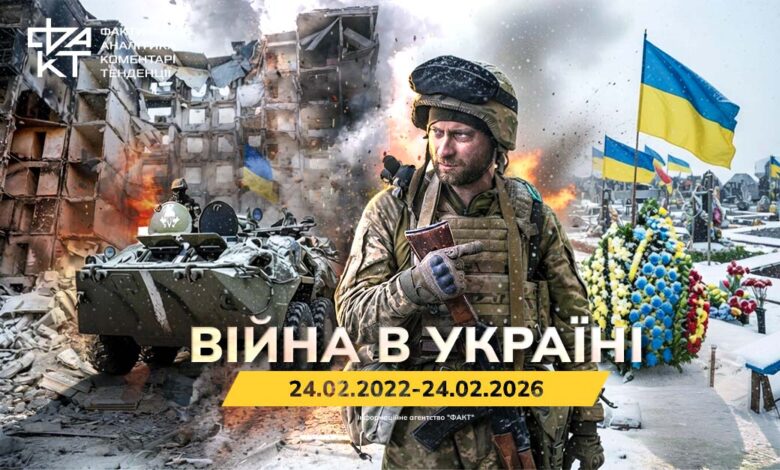
Today marks four years since the full-scale war in Ukraine, which has radically changed the fate of people. There are now hundreds of thousands of dead and missing, including children, entire cities and villages destroyed, millions of refugees and IDPs, almost 20,000 children deported to Russia, people living in constant fear and uncertainty. The country’s demographics have shrunk by a quarter, the economy has lost more than 25% of GDP, and the state debt has approached 100% of GDP. The war has significantly changed the army, mobilization, infrastructure, social and economic structures. All this is the result of a long-term transformation that determines today’s tragic realities of Ukraine, which has turned into a country of orphans and widows.
How it all began
February 24, 2026 marks four years since the start of the full-scale invasion of the Russian Federation, and if earlier we had one day of mourning for those killed during World War II, now there are two.
It should be recalled that long before the war, Ukraine lived in an atmosphere of alarming forecasts. However, in early 2022, US intelligence and a number of European states publicly warned about the high probability of a full-scale offensive by Russia. They spoke of the concentration of troops near the borders of Ukraine, the media counted battalions, and society was nervous.
In this tense atmosphere, on January 19, 2022, Volodymyr Zelensky appealed to citizens to remain calm. He emphasized that panic is more harmful than rumors of an invasion, and that life must go on – with work, plans, and even rest for the May holidays. Then the phrase about “shishliks on May Day” was heard as a symbol of the normality that the president proposed not to postpone due to fear. The idea of the authorities was clear: to prevent an economic collapse and mass panic. Businesses could stop, investors could leave, and people could rush to buy up currency and leave the country en masse.
However, after February 24, 2022, when a full-scale invasion began at four in the morning, this phrase took on a different meaning. “May shishliks” became a public outrage and a meme on social networks. Critics saw these words as an underestimation of the risks, and supporters saw a desire to prevent fear from paralyzing the state.
On February 24, 2022, missile strikes simultaneously covered Kyiv, Kharkiv, Dnipro, Odessa and border regions, and Russian troops moved from the north through the territory of Belarus, from the east through the occupied parts of Donetsk and Luhansk regions, and from the south from the Crimea. Airfields, warehouses, air defense systems, and critical infrastructure facilities were under fire, after which martial law was introduced in the country and general mobilization was declared, which turned the peaceful life of millions of people into the mobilized reality of a warring state.
In the first hours of the offensive, Russian units tried to break through to Kyiv through the Chernobyl zone, and the battles for Gostomel airport were an attempt to ensure a quick landing to capture the capital, but the Russian Federation’s calculation of a rapid scenario faced heroic resistance from the Ukrainians, which thwarted the plan for a lightning campaign. At the same time, part of the territory of Ukraine was occupied in the first days, millions of people left their homes, and the roads from major cities turned into endless lines of cars.
The war, unleashed by Russia in violation of international law, immediately brought thousands of deaths, systematic violations of human rights in the occupied territories, the deportation of Ukrainian children, the cruel treatment of prisoners of war and civilians, the destruction of cities and critical infrastructure, and caused the largest migration crisis in Europe in the 21st century. Its duration has already exceeded 1,418 days of hostilities between the USSR and Nazi Germany – this limit was exceeded on January 11, 2026, while World War II lasted a total of 2,194 days. This comparison gives the current war a historical scale without any exaggeration.
How the war and the army have changed in four years
In four years, the war in Ukraine has ceased to be just our history. Since the start of the full-scale invasion, almost the entire world has become an active participant in the conflict: states provide aid, supply weapons, intelligence and technology, and also try to find ways to a peace that seems increasingly difficult to imagine.
Our defenders, both men and women, are doing everything within their human capabilities to prevent the enemy from achieving his goal, while the battlefield has changed beyond recognition. Modern warfare has long gone beyond the traditional long trenches, air strikes and hand-to-hand combat. The modern front has become a testing ground for new tactics and technologies, where strike drones and robotic systems perform functions that were exclusively human four years ago.
Russia’s Black Sea Fleet is practically blocked by modern unmanned systems, and its submarine and surface forces are forced to remain in ports that have turned into full-fledged “house arrests”. Surface drones and underwater quadcopters regularly monitor the Black Sea, turning the classic fleet into a symbol of strategic helplessness. Once transport routes through the Bosphorus provided continuous supplies of weapons, today the shadow fleet avoids approaching Novorossiysk, understanding that losses will be inevitable.
At the same time, on land, classic mechanized attacks are becoming less frequent every year, and in 2025 they have almost completely disappeared. At the same time, drones have replaced the technique, and “meat” assaults have been replaced by point infiltrations, which the enemy uses, trying to capture key points of cities in small groups. Such tactics resemble a semi-guerrilla strategy: the enemy does not seek to hold positions, but seeks critical nodes for destabilization. In such conditions, Ukrainian defenders are forced to invent countermeasures on the go, combining classic infantry with new technologies — drones, robotic systems, and medium-range pinpoint strikes — to regain control of the situation.
Now the role of drones on the front has increased tenfold, and their strikes have formed so-called kill zones, which initially extended ten kilometers, and later 30–40 km deep from the front line. At the same time, the enemy’s logistical routes have proven so vulnerable that the losses of rear units exceed the losses of infantry on the front line. In response, the Ukrainian Armed Forces have introduced medium-range strikes, expanding kill zones in controlled territories and making classic offensive operations impossible.
Thus, the Ukrainian army’s command system has undergone a profound transformation: the corps model allows for coordination of actions on large areas of the front, rapid response to enemy infiltration groups, and minimization of the risks of breakthroughs, which were the main threat back in 2024. At the same time, the gradual automation and robotization of the front line reduces casualties, but ultimately it is impossible to conduct combat operations without infantry.
In addition, the experience of the war over four years has shown that the traditional approach to mobilization in modern conditions has exhausted itself. At first, hundreds of volunteers lined up, ready to defend the country, but over time, unfair, often illegal, and aggressive mobilization has become a source of internal tension in society. Conflicts between civilian and territorial recruitment centers are becoming more frequent and often end in tragedies, which shows, instead of unity, confrontation within Ukrainian society.
It should be noted that a significant event occurred at the turn of the fourth year of the war. Recently, the former Commander-in-Chief of the Armed Forces of Ukraine, Valery Zaluzhny, for the first time in all the years of the war, publicly placed responsibility for the failure of the counteroffensive of the Ukrainian troops in 2023 on the political leadership. According to him, the plan developed by the main command of the Armed Forces of Ukraine with the participation of NATO was not implemented due to insufficient resources and a change in the offensive strategy. Instead of a concentrated strike on the front line in the Zaporizhia region, as proposed by the former commander-in-chief, the attack was dispersed over several sectors, which dispersed forces and reduced the effectiveness of the operation.
Valery Zaluzhny also stated that the numerous appeals of the General Staff for the supply of ammunition, equipment and demining equipment often remained unanswered or were only partially satisfied. At the same time, the political leadership demanded quick successes and bright media victories, which did not correspond to the real situation on the front.
“It is impossible to win a war with numbers and steel alone, with only paper plans and soldiers without proper support. The decision of the political level to go on the offensive without the necessary resources was a critical mistake,” the general emphasized in comments to journalists.
Zaluzhny’s statements caused a wide resonance in political circles, giving rise to a discussion of the reasons for the failure and the role of the political leadership in planning operations. Despite this, no official comments were received from the Office of the President, leaving the statement of the commander-in-chief as the only open position in this story.
Such an admission of failure by the military leadership for the first time opened an internal conflict between the army and the political elite during strategic planning and resource provision of combat operations. It demonstrates how difficult it is to reconcile military plans on the battlefield with political priorities and limited resources, and how this discrepancy can affect the results of even carefully designed operations.
Human Losses and Destruction
Since the beginning of Russia’s full-scale invasion, Ukraine has found itself in a situation where the actual civilian and military losses remain a subject of disputed estimates and silence. While the General Staff of the Armed Forces of Ukraine reports approximately 1,261,420 dead Russian soldiers, Ukrainian military losses are announced by President Zelensky in much lower figures — about 55 thousand dead soldiers, while official reports of wounded reach hundreds of thousands. The difference between official data and confirmed UN reports creates the impression that the real picture of the war is largely hidden, and citizens receive only partial information about the scale of the tragedy.
Civilian casualties also demonstrate a deep gap between reality and official statistics. According to the UN, at least 15,172 civilians have been killed since the beginning of the invasion, including 766 children, and more than 41,000 people have been injured, but the report’s authors emphasize that these are only confirmed cases, as the real number of deaths is much higher. In 2025, the number of civilian deaths increased by 31% compared to 2024, and the share of victims from long-range weapons reached 35%. Drones, mines and explosive remnants of war have claimed the lives of hundreds of people. However, official reports from the authorities often ignore this data or present it in a less dramatic form, which creates an information vacuum and a sense of distrust.
In addition, the issue of prisoners of war is no less alarming. UN monitoring shows that 96% of released Ukrainian soldiers were tortured, and at least 109 men were executed, most of them in 2024–2025. At the same time, official information about prisoners of war and those executed is often limited or presented vaguely. International reports create a contrast with the data of the Ukrainian authorities, which do not disclose details about torture and execution. This gap between official reports and monitoring data effectively hides the scale of the humanitarian crisis, affecting the understanding of the war by society.
The difference between official reports and data from international missions highlights a systemic problem: the suppression and selective presentation of information creates a distorted picture of the course of the war. This information gap is becoming an invisible component of war, determining not only the perception of the war, but also the effectiveness of humanitarian assistance and recovery planning.
Occupation, mining and cultural heritage
Currently, more than 116 thousand square kilometers of Ukrainian territory are under the control of Russian troops, which is almost a fifth of the country. At the beginning of 2026, according to rough estimates, about 6 million people remained in the temporarily occupied territories of Ukraine. At the same time, residents of the occupied areas live under constant pressure of repression and a humanitarian crisis. For comparison, in pre-war 2021, the occupation was limited to Crimea and certain areas of Donbas — about 43,300 km², or 7% of the country’s territory.
Every square meter in the front-line regions remains an arena of constant threat: mining, remnants of ammunition and dangerous structures complicate the return of people, land cultivation and economic recovery. As of early 2026, Ukraine has a mined or potentially dangerous area of about 137,000–139,000 square kilometers. This is approximately 23% of the country’s total area — more than the area of some European countries, including England.
In total, more than 66,000 hectares were demined in 2025, and in January 2026 alone, the Ministry of Defense cleared more than 1,189 hectares of territory. However, about 137,000 square kilometers remain dangerous for the population, and this danger will continue for more than a decade.
At the same time, one of the most visible consequences of the war was the destruction of housing and cultural facilities. As of early 2026, more than 236,000 buildings had been damaged or destroyed, and about 13% of the housing stock had become uninhabitable, leaving millions of people homeless. At the same time, cultural heritage suffered enormous losses: in 2025, 307 monuments were destroyed and damaged, of which 153 are of national importance, 1,333 are local, and another 154 have just been discovered. The greatest destruction was suffered by Kharkiv (344), Kherson (297), Odesa (182), Donetsk (175) and Kyiv regions with the city of Kyiv (163). In addition, 2,446 cultural infrastructure objects were damaged, of which 498 were completely destroyed, including libraries, museums, theaters and buildings of historical importance.
Energy shocks and the destruction of industrial facilities only deepened the crisis in Ukraine. The loss of more than half of the country’s electricity generation capacity has left the country with 11 GW instead of the required 18 GW on peak winter days, making it impossible to provide a stable supply of light and heat in many regions. People across Ukraine are now living in their homes for 8-16 hours without light, water, and heating.
Mined areas, contaminated soils and aquifers, and toxic waste from industrial demolitions are a real ecocide and long-term threats to human safety. The forests of the Kinburn Spit have been destroyed on more than 10,000 hectares, thousands of nesting sites for Red Book birds have been burned, and the unique plants of Dzharylgach have been destroyed on an area of more than 1,500 hectares. The scale of mining and land contamination makes tens of thousands of hectares of agricultural land unsuitable for cultivation, and the accumulation of industrial waste and air pollution create long-term environmental risks for many years.
Catastrophic Demography
The demographic situation as of early 2026 is critical – according to the State Statistics Service, as of January 1, 2022, the population of Ukraine was 41.17 million people, but after the start of the full-scale invasion, official data ceased to be published. Expert estimates range from 27 to almost 30 million, reflecting the scale of losses, internal displacement and mass emigration.
The Worldometers portal offers a more optimistic estimate of 39.66 million as of mid-February 2026, but the discrepancy with UN data leaves many questions about the accuracy of these calculations. Forbes Ukraine estimates the population in the controlled territory at 30.5 million, and in the internationally recognized territory as a whole at 35–35.5 million, while the Mykhailo Ptukha Institute of Demography and Research gives figures from 28 to 30 million, based on state registers and data from mobile operators. This discrepancy shows that the lack of transparent statistics turns demographic assessment into a task with a hundred unknowns, where the real picture of life and population losses is constantly changing under the influence of the war.
According to official data, as of early 2026, there were about 10.2 million pensioners in Ukraine, and with a ratio of workers to pensioners of approximately 1:1, the number of officially employed people is also about 10.2 million. Based on these data, the adult population of Ukraine is approximately 20.4 million people, and if we add children and disabled citizens, who are traditionally included in the total number, the real population of the country may be about 25–26 million people. This estimate shows a sharp decrease in the population compared to pre-war figures and confirms a large-scale demographic crisis caused by both direct human losses of the war and mass migration, internal displacement and demographic changes over the past four years.
The demographic crisis has been significantly exacerbated by the outflow of refugees – according to the UN, 5,898,150 Ukrainians are currently outside Ukraine. Their mass outflow has become the largest migration crisis in Europe since World War II. Additionally, the demographic crisis is complicated by the fact that the number of Ukrainians who are ready to return from abroad is constantly decreasing: according to the UN, if in 2023 77% of refugees planned to return, then by the end of 2025 this figure had fallen to 49%.
At the same time, as of the beginning of 2026, there were officially more than 4.6 million internally displaced persons (IDPs) in Ukraine. Most of them are women, of whom there are about 2.76 million, as well as more than 837 thousand children. The largest number of displaced persons was recorded in Kharkiv, Donetsk, Dnipropetrovsk regions and Kyiv.
Another shocking dimension of the war is the deportation of children. As of February 2026, the officially confirmed number of Ukrainian children taken to Russia reaches about 20,000 minors, but experts and human rights organizations emphasize that the real figures may be much higher. Every child who finds themselves thousands of kilometers from home is deprived of their family, familiar environment, and the right to their own identity. At the same time, official reports from Volodymyr Zelenskyy speak of the return home of 2,000 children, but most families have still not received any news about their children.
The return process is complicated not only by bureaucracy, but also by political and military obstacles. Each return story is accompanied by months of negotiations, checks, and paperwork, and for families who have lost contact with their children, the lack of information becomes a constant source of anxiety and pain. For the psychological state of children, this means a loss of a sense of security, and for society, a new front in the humanitarian crisis, where the numbers of losses turn into concrete stories of broken children’s lives.
In addition, due to the full-scale war, despite the high mortality rate, the birth rate in Ukraine has fallen to a critical level – about 0.8 children per woman, which is one of the lowest rates in the world.
Demographic indicators continue to reflect a critical shortage of population: mortality has exceeded the birth rate by almost three times, and the birth rate has been declining for decades. The loss of human resources, combined with the destruction of cities, the economy and social infrastructure, creates a vicious circle in which even a slow recovery becomes a difficult task.
Economic consequences
The economic consequences of the full-scale war in Ukraine have been the most profound in the country’s modern history. In 2022, after the Russian invasion, real GDP fell by 29.1%, although a fall of 40–50% was predicted, which indicates the unpredictable dynamics of the crisis and the ability of the economy to withstand the shock. The following years were marked by a gradual recovery: in 2023 the economy grew by 5.3%, in 2024 by 2.9%, and according to preliminary estimates for 2025 by 1.8–2.2%.
Forecasts for the restoration of the pre-war level vary: optimistic estimates speak of 2028, and more realistic ones – about 2030–2034, taking into account the destruction of infrastructure, staff shortages and security risks. Currently, according to government agencies, the economy has stabilized at 75–78% of pre-war GDP.
However, as of early 2026, Ukraine’s industry was under threat of a large-scale shutdown due to the energy crisis and staff shortage. Experts’ forecasts indicate the threat of the disappearance of 60–85 thousand direct jobs in industry. The greatest risks of a shutdown are characteristic of industrial cities: Kryvyi Rih, Nikopol, Horishni Plavni, Dolynska, Marganets.
At the same time, Ukraine’s gold and foreign exchange reserves have reached a historical maximum, which was made possible thanks to international assistance. As of February 1, 2026, they amounted to $57.66 billion, while in February 2022 they were half that amount. Thanks to this, it was possible to stabilize the hryvnia exchange rate, which, although it underwent devaluation, avoided collapse. At the same time, on February 17, 2022, the official hryvnia exchange rate was 28.09 UAH per dollar and 31.93 UAH per euro, and on February 17, 2026 it was 43.17 UAH per dollar and 51.16 UAH per euro. Thus, the hryvnia has lost more than half of its value against key currencies, but the banking system is working, and hyperinflation has not arisen.
Consumer inflation over the four years of the war was about 61%, which means that goods that cost 100 UAH in 2022 now cost an average of 161 UAH. Food prices rose much faster: a loaf of bread — by 76.1%, hake fish — by 101.4%, butter — by 112%, potatoes — by 120.8%, chicken fillet — by 122.7%, a dozen eggs — by 181.1%, apples — by 299.2%, cucumbers — by 456.8%. Such dynamics emphasize that even with the stabilization of the economy, household spending has increased significantly.
Sociological portrait of the nation
At the beginning of the war, people experienced shock and deep anxiety due to the invasion, massive bombing, and numerous civilian casualties. Then came the emotional euphoria after the great victories at Kyiv, Kharkiv, and Kherson, when everything seemed possible. However, since the end of 2023, the main feelings of Ukrainians have become exhaustion and disappointment, reflecting the long-term psychological stress and losses that the war has brought to everyday life.
According to Gradus, conducted in December 2025, most respondents noted a feeling of constant fatigue, while the level of fear is gradually decreasing, which does not mean relieving stress, but rather adapting to new realities. 72% of Ukrainians assess the quality of their own life as low, the main factors being the security situation, worries about the lives of loved ones, financial difficulties, and constant concern for their own safety. At the same time, satisfaction with the psychological state decreased from 36% in 2024 to 29% in 2025, which indicates the growing emotional fatigue and exhaustion of the population, which is forced to stay on the verge of sustainability.
The social transformation over the four years of war is manifested not only in exhaustion, but also in a change in expectations and priorities. The vast majority of Ukrainians have moved from the hope of a quick end to the conflict to a realistic understanding of its duration: only 10% expect a quick end to the war, and about a third are convinced that the struggle will continue for several more years. At the same time, an increasing number of the population wants to end the war as soon as possible under any conditions, and a share is ready to endure the war “as long as necessary” and is categorically against territorial concessions, although 33% are ready to consider certain compromises for the sake of security guarantees.
This demonstrates a complex, multidimensional social landscape. At the same time, Ukrainian society is increasingly divided in its positions on the war, mobilization, ideological and linguistic views, attitude towards refugees, etc. This is an extremely alarming signal that destroys consolidation and may lead to dangerous consequences in the future.
At the same time, a linguistic and cultural transformation is observed: the use of the Ukrainian language in everyday life has reached 75%, compared to 50% at the beginning of the war, which has become an important marker of identity.
In the social and psychological sphere of the war in Ukraine, a phenomenon has emerged that the American writer Gertrude Stein described as the “generation of lost people.” She used this term to designate people who experienced the horrors of the First World War, lost faith in the former values and ideals of civilization, and were unable to adapt to peaceful life, abusing alcohol, going crazy, or ending their lives by suicide. Later, writers, including Ernest Hemingway, Francis Scott Fitzgerald, John Dos Passos, Erich Maria Remarque and others who themselves experienced similar things, wrote about such people in their works.
Our generation can be called a lost generation in its own uncertain present. People are lost in a reality where familiar landmarks have disappeared, slogans and promises of the authorities have stopped working, and news and official data no longer inspire trust. In conditions of war, constant threat, and a destroyed sense of stability, the everyday life of Ukrainians has become not life, but survival, which creates a deep sense of loss of landmarks.
The war left a deep mark on the consciousness and daily rhythm of life, but Ukrainians have learned to organize their lives amidst chaos, adapt to new conditions, and find small joys in their affairs, which previously seemed ordinary. The war has been etched in our memory for many years, four years of deaths, shelling, destruction, constant anxiety and sleepless nights have left their mark on every aspect of life. Against this background, numerous international peace negotiations have been going on for years without any visible result, creating a feeling of prolonged uncertainty. However, we all hope for the best and dream that the war will end soon.